 Skip to content
Under the US federal Fair Labor Standards Act baseline, paid time off for a holiday generally does not count as hours worked when determining weekly overtime. Hours actually worked on a holiday do count as work. An employer policy, contract or applicable state rule may produce a different or more generous result.
The distinction is between being paid for time away and performing work. Use the Overtime Pay Calculator by State as an estimate, after identifying the rule and the actual hours worked.
The federal starting point
The US Department of Labor states that covered, nonexempt employees generally receive at least one-and-a-half times their regular rate for hours worked over 40 in a workweek. A workweek is a fixed recurring seven-day period, which may not match the payroll period.
The DOL’s hours-worked guidance distinguishes paid holiday leave from actual work. Its FLSA questions and answers also explain that the federal law does not itself require holiday pay. A benefit promised by an employer still needs to be checked against the governing policy or agreement.
Example 1: 32 hours worked plus a paid holiday
Assume a covered, nonexempt employee has a $20 regular hourly rate, works 32 hours and receives eight hours of paid holiday leave at that same rate. Assume no state daily overtime, additional premiums, bonuses or more generous contractual rules apply.
- Pay for work: 32 × $20 = $640.
- Assumed holiday benefit: 8 × $20 = $160.
- Total gross pay: $800.
- Federal weekly overtime hours: zero, because actual work is below 40 hours.
The paycheck represents 40 paid hours, but the federal weekly threshold in this example is tested using 32 worked hours. Treating the paid-hours total as the worked-hours total would misdescribe the calculation.
Example 2: 44 hours worked plus a holiday benefit
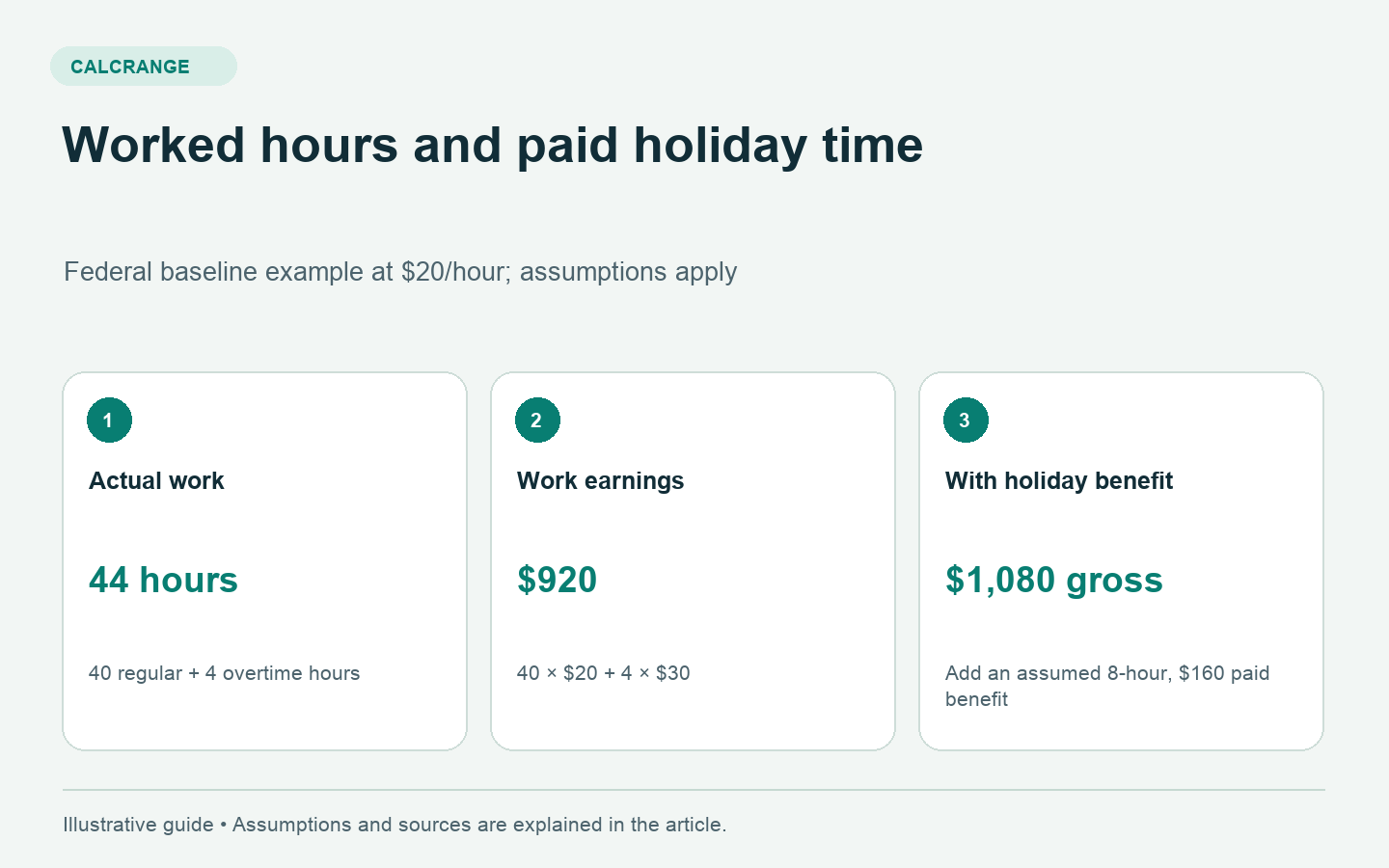
Now assume the same employee actually works 44 hours in the workweek and separately receives the same $160 holiday benefit for time not worked. All other simplifying assumptions remain unchanged.
- First 40 worked hours: 40 × $20 = $800.
- Four overtime hours: 4 × $30 = $120.
- Separate holiday benefit: $160.
- Total gross pay: $800 + $120 + $160 = $1,080.
Do not enter 52 as worked hours merely because the paystub combines 44 work hours and eight benefit hours. Doing so in a simple time-and-a-half model would create 12 overtime hours instead of four.
Working on the holiday is different
A person who works eight hours on the holiday has performed eight hours of work. Whether the employer pays an additional holiday premium is a separate question from whether those hours count in the week’s work total. A holiday label does not remove worked time.
Premium pay can introduce additional rules. The DOL regular-rate fact sheet explains that some qualifying premiums may be credited toward statutory overtime. Do not automatically add every premium together or assume the base wage is always the correct regular rate. Other compensation can affect that rate.
Check the policy before comparing a payslip
Collect the workweek start and end, daily actual hours, holiday leave hours, pay rate and relevant policy wording. Keep the rows separate. For a two-week payslip, calculate each workweek independently instead of averaging a busy week with a quiet week.
If a policy counts paid holiday leave toward its own overtime benefit, write a second calculation using that policy and label it clearly. This preserves the difference between the federal minimum calculation and the employer’s promised benefit without assuming either calculation is the whole answer.
What the calculator cannot decide
A state selector cannot determine every exemption, industry rule, collective agreement or regular-rate adjustment. If a result differs from payroll, ask for the hours and rate calculation for the specific workweek. A useful question is: “Which hours were counted as work, which holiday benefit was added, and what regular rate was used?”
This guide provides a federal baseline and hypothetical arithmetic checked against DOL sources on September 18, 2026. It does not decide an individual wage claim. For unresolved entitlement questions, consult the relevant wage agency or an employment professional with the actual records.
Sources and method
Source links checked September 18, 2026. Examples are original educational calculations using the assumptions stated above.