 Skip to content
Late ovulation means ovulation occurred later than expected for that cycle. If it happens later, the next period may also arrive later than an app predicted. But a late period alone does not confirm late ovulation, and a calendar cannot determine the cause.
The Ovulation Calculator estimates dates from cycle information. Treat those dates as assumptions to compare with observations, not evidence that an egg was released.
Why day 14 is not universal
ACOG describes ovulation about 14 days before the next period in an average cycle. That is different from saying everyone ovulates exactly 14 days after their period starts. Cycle length and the timing within a cycle can vary.
NICHD also emphasizes variation between people and between months. A calendar built from a usual cycle length projects a pattern; it does not observe the current cycle directly.
Worked example: move the assumption by one week
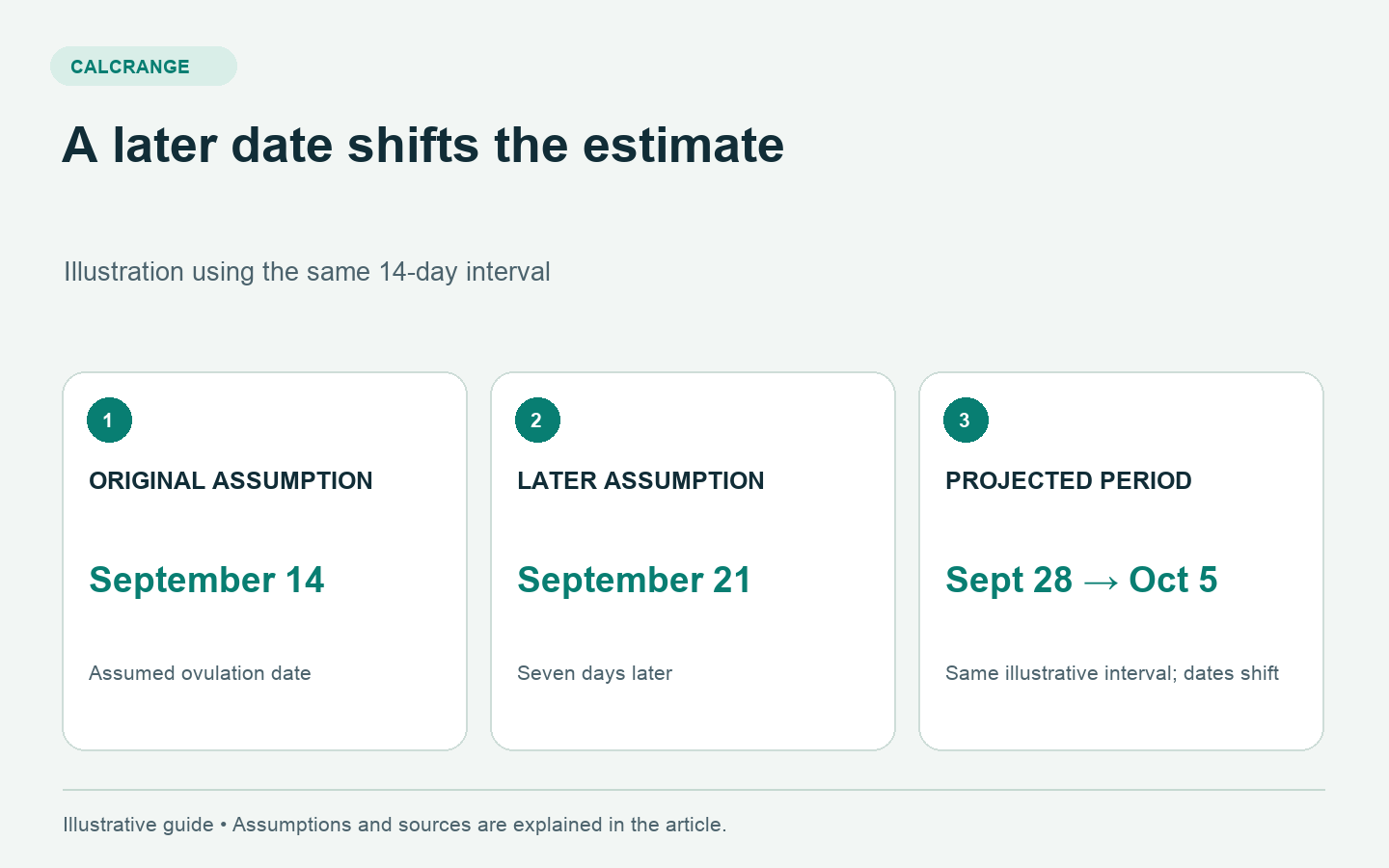
Suppose an app assumes ovulation on September 14 and then uses an illustrative 14-day interval to the next period. That produces September 28. If ovulation instead occurred on September 21 and the same interval applied, the projected period date becomes October 5.
| Scenario | Assumed ovulation | Add 14 days |
|---|---|---|
| Original calendar assumption | September 14 | September 28 |
| One-week-later assumption | September 21 | October 5 |
Both dates shift seven days because the same interval is being added. This example explains the arithmetic. It does not establish a fixed 14-day interval for you, diagnose the cycle or predict whether pregnancy occurred.
Keep predictions separate from observations
Create two columns in your record. In the first, save the app’s original predicted dates. In the second, record actual bleeding dates and any test results with the date and time. Do not overwrite the original prediction after the event and then treat the corrected chart as proof the app predicted it accurately.
If you use an LH test, follow its instructions and record the result. ACOG describes a positive LH result as suggesting ovulation may occur in the next 24–48 hours. It is not the same as directly observing egg release, and the meaning can require clinical interpretation.
A body-temperature change is another type of observation, but it should not be silently converted into an exact conception date. Label what you actually measured. Combining uncertain observations without acknowledging their limitations can create false confidence.
Can you still use a fertile-window estimate?
The useful response to uncertain ovulation is to recognize that the estimated window may move. ACOG notes that pregnancy can result from sex in the days before ovulation as well as shortly afterward. A calendar estimate should not be used to declare particular days safe for unprotected sex.
If preventing pregnancy, discuss an appropriate contraceptive method with a healthcare professional. If trying to conceive, a clinician can help interpret patterns without turning every shifted date into a diagnosis. See the existing irregular-period calculator guide for the wider limitations of cycle-based prediction.
When a date discrepancy needs attention
If pregnancy is possible and a period is late, use a pregnancy test according to its instructions rather than assuming the delay is ovulation. Repeated changes, pain or unusual bleeding deserve a clinical discussion.
ACOG recommends assessment when periods stop for more than three months without explanation. Seek prompt care for severe symptoms rather than waiting for a calculator’s next date. The calendar can organize information for that conversation; it cannot diagnose hormonal conditions or rule out pregnancy.
Sources and method
Sources checked September 18, 2026. Numerical examples are illustrative calculations, not patient or animal records.