 Skip to content
For a flat rectangular ceiling, multiply its length by its width, multiply by the number of coats, then divide by the paint’s stated coverage per gallon or liter. Use the coverage printed for the actual product and surface; a room’s floor area alone does not tell you how many cans to buy.
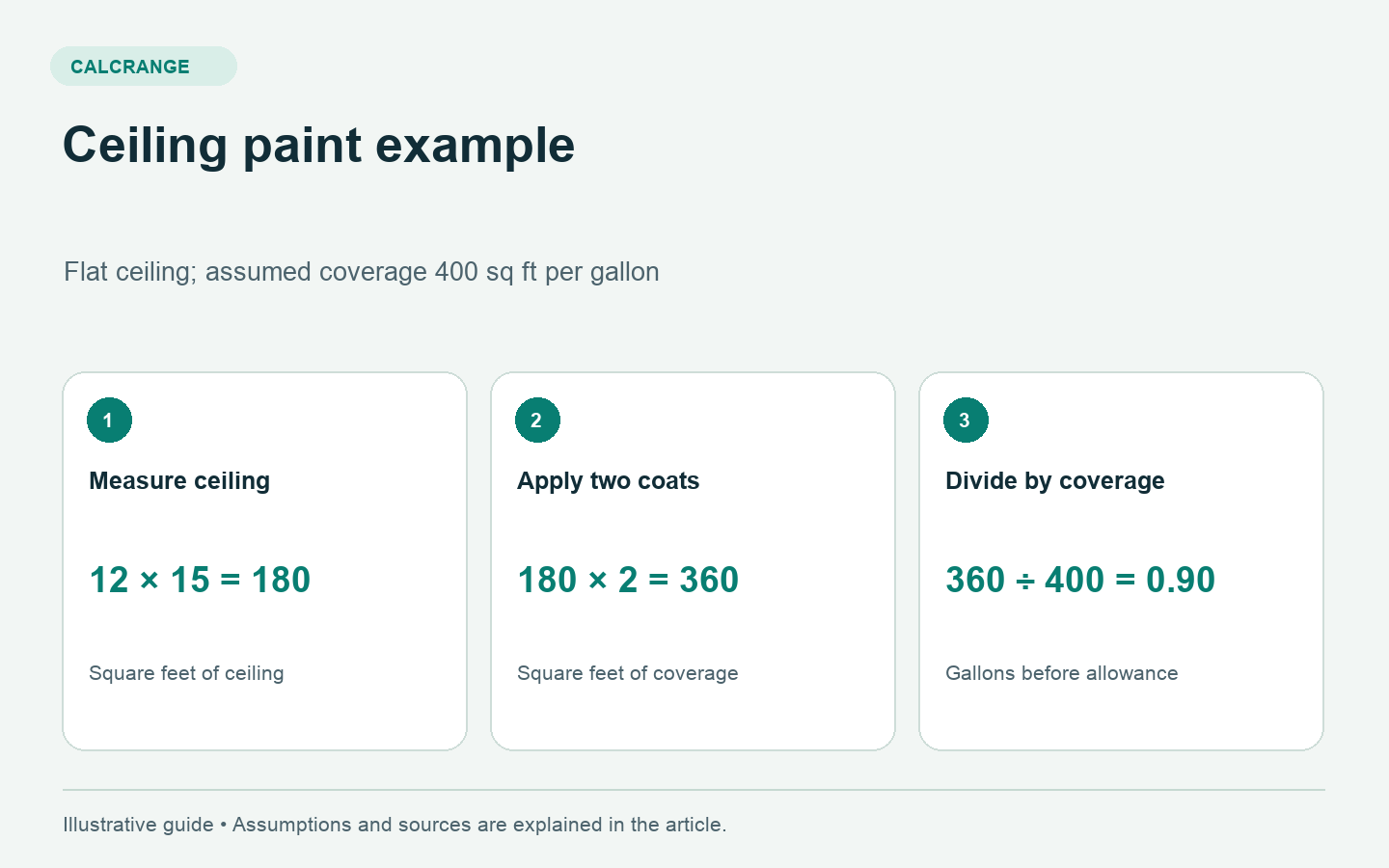
The basic formula is paint quantity = ceiling area × coats ÷ coverage. The Paint Calculator supports paint-quantity planning, while the calculation below makes the ceiling portion easy to check separately from walls.
A 12-by-15-foot ceiling example
Assume a flat ceiling measuring 12 feet by 15 feet, two coats, and a selected paint with a coverage rate of 400 square feet per gallon on the relevant surface.
- Ceiling area: 12 × 15 = 180 square feet.
- Total area across two coats: 180 × 2 = 360 square feet.
- Calculated quantity: 360 ÷ 400 = 0.90 gallon.
If you choose an illustrative 10% planning allowance for application losses and touch-ups, multiply 0.90 by 1.10 to get 0.99 gallon. In that particular example, a one-gallon container is just above the calculated amount. The allowance is a planning choice, not a universal manufacturer requirement.
Use a product-specific coverage rate
Benjamin Moore’s Waterborne Ceiling Paint technical sheet lists approximately 400–450 square feet per gallon and notes that texture and porosity affect coverage. That figure applies to the cited product and conditions; another paint can have a different spread rate.
For the same 180-square-foot ceiling and two coats, 450 square feet per gallon gives 0.80 gallon before an allowance, while 350 gives about 1.03 gallons. This comparison shows why copying a generic internet coverage number can change the shopping estimate.
Flat, sloped and stepped ceilings
A level rectangular ceiling normally has the same plan area as the rectangular floor below it. A sloped ceiling has a larger actual surface area than its horizontal footprint. Measure along the sloped surface where it can be done safely, or use reliable plans with the surface dimensions.
For a ceiling divided into panels or sections, calculate each section and add them. Two flat sections measuring 8 by 10 feet and 6 by 10 feet total 80 + 60 = 140 square feet. Avoid counting an overlapping section twice.
For a large skylight or unpainted opening, subtract the opening’s area. Small fixtures may not be worth subtracting from a rough shopping estimate, especially when the uncertainty in application losses is larger than the fixture’s area.
Keep primer as a separate line
If the product instructions and surface condition call for primer, calculate primer from its own coat count and coverage. Do not assume a gallon of primer covers the same area as a gallon of ceiling paint, and do not combine their quantities as though they were interchangeable.
In a planning worksheet, use separate rows for ceiling paint, wall paint, primer and trim. Record the product and coverage assumption next to each row. This prevents the ceiling’s 180 square feet from being accidentally added as another wall or counted again in an already combined estimate.
Round purchases after the calculation
Calculate the total amount first, then consider the available container sizes. If the estimate is 1.03 gallons before an allowance, rounding the mathematical result to 1 gallon understates the amount. If the estimate is 0.60 gallon, a gallon may still be the most practical purchasable size.
Keep some information with any leftover paint: product name, color, finish, batch details where available and the room where it was used. Follow the container’s storage instructions.
Check the assumptions before buying
Confirm the dimensions, number of coats, surface preparation and current technical data sheet. This article estimates material quantity; it does not inspect the ceiling or determine whether staining, damaged coatings or an unknown old texture needs specialist attention.
Use the Paint Calculator for the wider room estimate, keeping ceiling and wall measurements clearly labelled.