 Skip to content
A reverse percentage works backward from a final amount to the amount before a percentage change. Divide by the percentage multiplier: original = final ÷ (1 + rate) after an increase, or original = final ÷ (1 − rate) after a decrease. Write the rate as a decimal.
For example, 20% becomes 0.20. If a quantity is 240 after a 20% increase, the original is 240 ÷ 1.20 = 200. You can use the Percentage Calculator to check the percentage change from the recovered original to the final amount.
Example 1: reverse a percentage increase
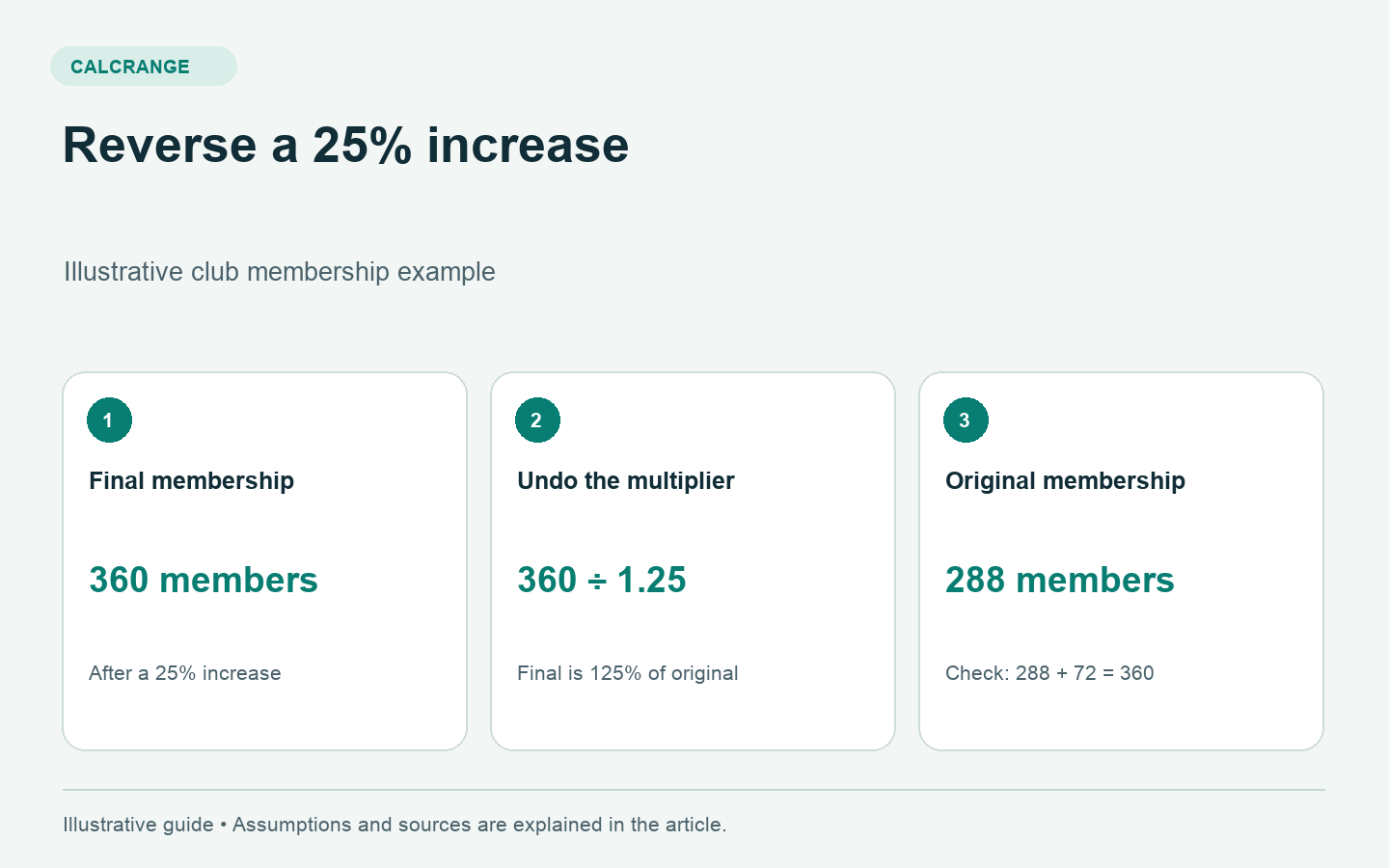
Suppose a club has 360 members after its membership increased by 25%. The final membership is 125% of the starting membership, not 100%.
- Write the multiplier: 1 + 25 ÷ 100 = 1.25.
- Divide the final amount: 360 ÷ 1.25 = 288 members.
- Check: 25% of 288 is 72; 288 + 72 = 360.
Subtracting 25% of 360 would give 270, which is wrong because it uses the final number as the percentage base. The original increase was measured against 288.
Example 2: reverse a percentage decrease
A container now holds 72 liters after its contents decreased by 10%. The remaining amount is 90% of the original, so its multiplier is 0.90.
Original volume = 72 ÷ 0.90 = 80 liters. Checking forward, 10% of 80 is 8, and 80 − 8 = 72. Adding 10% to 72 would only give 79.2 liters and would fail the check.
These are illustrative arithmetic examples. They do not model evaporation, membership behavior or any other real-world process beyond the stated percentage relationship.
A quick multiplier table
| Known change | Final as a share of original | Reverse operation |
|---|---|---|
| Increase of 5% | 105% | Divide by 1.05 |
| Increase of 20% | 120% | Divide by 1.20 |
| Decrease of 15% | 85% | Divide by 0.85 |
| Decrease of 40% | 60% | Divide by 0.60 |
The underlying relationship is final = original × multiplier. Rearranging that equation produces the reverse calculation. OpenStax’s percent applications lesson explains why the original amount is the reference for a percentage increase or decrease.
“What is 30% of?” is a related but different question
If 45 is 30% of a total, divide by 0.30: 45 ÷ 0.30 = 150. Here 30% is the portion retained in the statement, rather than a 30% decrease. If 45 were the amount after a 30% decrease, you would instead divide by 0.70.
Before calculating, rewrite the wording as “the known final amount is ___% of the original.” This small step distinguishes a percentage portion from a percentage change.
Multiple changes need multiple multipliers
If a quantity rises 10% and then falls 20%, the combined multiplier is 1.10 × 0.80 = 0.88. A final value of 176 therefore came from 176 ÷ 0.88 = 200. The two rates cannot simply be subtracted to produce a 10% fall.
When the sequence also contains fixed additions, such as adding 15 after the percentage change, reverse the operations in the opposite order. Subtract the fixed 15 first, then divide by the percentage multiplier.
Limits and rounding checks
A 100% decrease leaves zero, so its multiplier is zero. You cannot recover a unique original amount by dividing zero by zero. You also need the change rate; a final amount alone has many possible starting values.
Keep extra precision until the final step, then round appropriately for the quantity. Always multiply your answer forward to see whether it recreates the stated final amount. For another check, compare both amounts with the Percentage Calculator.