 Skip to content
Gross income is a starting point, while taxable income is the amount left after the adjustments and deductions allowed by the applicable tax system. In a US federal individual return, adjusted gross income, or AGI, is an intermediate figure. These numbers should not be used interchangeably.
The Income Tax Calculator can illustrate bracket calculations and custom deductions. Before entering an amount, identify which stage of the calculation that field expects and which country’s rules you are modeling.
Three labels that prevent confusion
The IRS defines AGI as total gross income from all sources minus certain adjustments, calculated before the standard or itemized deduction. Wages can be only one component of total income; other reportable income may also need to be included.
Taxable income is calculated after the applicable deductions from AGI. The current return and its instructions determine which deductions are available and where they belong. A paycheck’s gross-pay label is therefore not automatically the final tax-return income figure.
| Figure | Question it answers |
|---|---|
| Gross or total income | What income is included before these tax-return adjustments? |
| Adjusted gross income | What remains after eligible adjustments? |
| Taxable income | What remains after the further applicable deductions? |
An illustrative worksheet
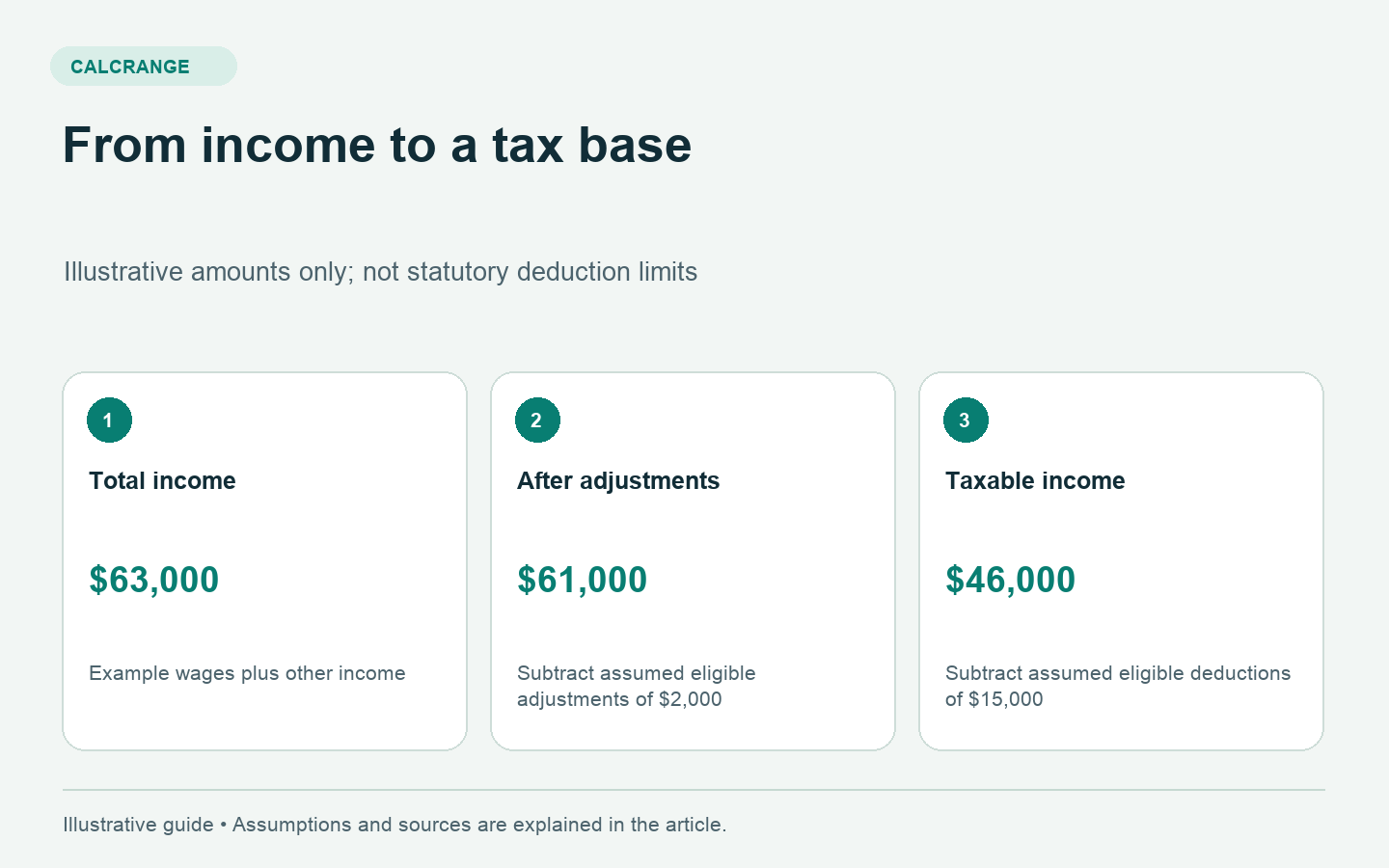
This example uses invented amounts to explain the sequence. The $15,000 deduction below is an assumption, not a statement of any year’s statutory standard deduction. Assume all income has been classified correctly and each adjustment and deduction is eligible.
- Wages included in income: $60,000.
- Other included income: $3,000.
- Total income: $60,000 + $3,000 = $63,000.
- Eligible adjustments: $2,000.
- Adjusted gross income: $63,000 − $2,000 = $61,000.
- Eligible deductions after AGI: $15,000.
- Taxable income: $61,000 − $15,000 = $46,000.
The $46,000 is the model’s taxable base. It is not the person’s take-home pay, tax bill or bank balance. Those are separate calculations. If a calculator asks for gross income and deductions separately, entering $46,000 and subtracting the same $17,000 again would count the reductions twice.
Taxable income still is not tax owed
To make the next distinction visible, imagine a completely fictional system that taxes the first $20,000 of taxable income at 10% and the remainder at 20%. The model’s tax before credits would be $2,000 + ($26,000 × 20%) = $7,200. These brackets do not represent US law or any tax-year estimate.
If that hypothetical system allowed a $500 credit, the resulting tax would be $6,700, subject to whatever credit rules the imagined system uses. If $7,000 had already been paid, the arithmetic difference would be $300. This example separates the tax base, calculated tax and payments rather than mixing all three into “taxable income.”
Use documents for the right year
Choose the country, tax year, filing status and applicable forms first. The IRS Form 1040 instructions identify the deductions and computation steps for the year displayed on that page. Do not assume a previous year’s figures remain current, or that a site title containing a year makes every preset appropriate to your return.
Use IRS Publication 525 when checking whether a particular kind of income is taxable or excluded. A payment’s everyday name, such as a gift, reimbursement or benefit, is not enough to determine its treatment without the relevant facts.
Common worksheet errors
Do not subtract the same retirement contribution twice if it is already reflected in the wage figure used. Do not assume every expense is deductible, and do not treat a credit as an income deduction. Record uncertain items separately until eligibility is verified. For a refresher on the last distinction, read tax deductions versus credits.
Keep each input tied to a document or a clearly labeled assumption. A general calculator can help test arithmetic, but an actual return may involve additional taxes, income-specific rates, phaseouts and restrictions. Use the official forms or a qualified tax professional for the final filing calculation.
Sources and method
Source links checked September 18, 2026. Examples are original educational calculations using the assumptions stated above.