 Skip to content
A healthy-weight reference range and an “ideal weight” formula are different outputs. A range shows the weights associated with selected BMI boundaries at a given height. An ideal-weight formula returns a point estimate from its own assumptions. Neither can identify a uniquely correct body weight for an individual.
The Ideal Weight Calculator compares formulas and reference ranges. Read the labels before choosing any number as a goal, especially when different methods disagree.
What a BMI weight range actually calculates
BMI equals weight in kilograms divided by height in metres squared. Rearranging gives weight = BMI × height². The range is therefore a mathematical translation of the chosen BMI boundaries, not a separate physical examination.
NHLBI lists the adult healthy-weight category as BMI 18.5–24.9. This screening category should be interpreted in context. For growing children and teenagers, adult cutoffs are not the appropriate method.
Worked example at 170 cm
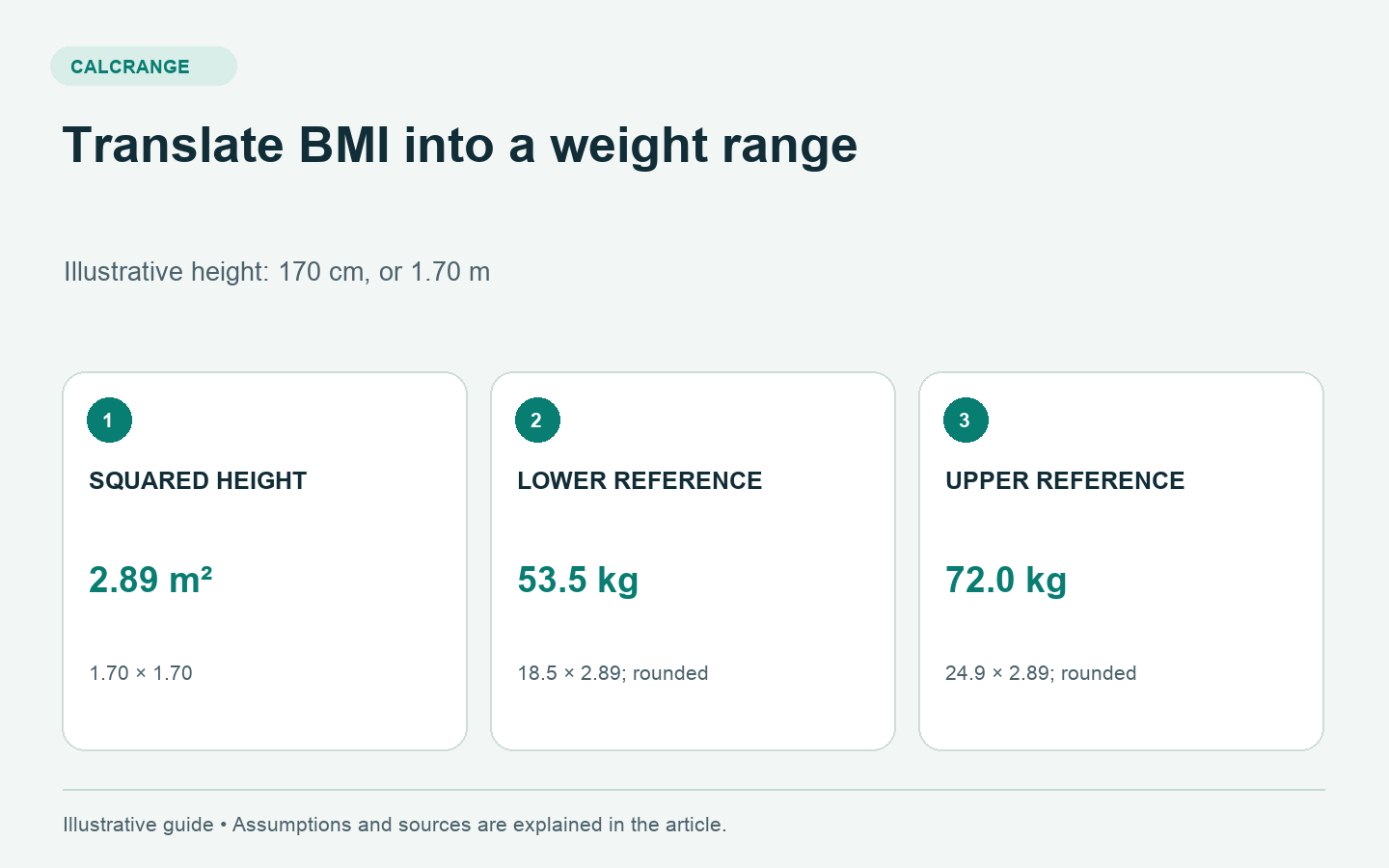
Convert 170 cm to 1.70 m and square it: 1.70² = 2.89. Multiplying by 18.5 gives 53.465 kg. Multiplying by the displayed upper reference 24.9 gives 71.961 kg. Rounded to one decimal, the reference is approximately 53.5–72.0 kg.
Notice the upper rounding: “72.0 kg” is a displayed approximation, not an exact classification threshold. BMI 25 begins at 25 × 2.89 = 72.25 kg. Keeping the unrounded calculation matters when explaining a boundary, but extra precision should not be confused with an individually precise health target.
| Calculation at 1.70 m | Unrounded result | Displayed example |
|---|---|---|
| 18.5 × 2.89 | 53.465 kg | 53.5 kg |
| 24.9 × 2.89 | 71.961 kg | 72.0 kg |
| 25 × 2.89 | 72.25 kg | Start of BMI 25 in this arithmetic |
The midpoint is not a prescription
The midpoint of the first two unrounded values is (53.465 + 71.961) ÷ 2 = 62.713 kg. That number has no special clinical status simply because it sits in the middle. A spreadsheet can calculate it, but the arithmetic does not establish that 62.7 kg is better for this person than another weight.
Similarly, if two ideal-weight formulas return different numbers, averaging them does not create a medically validated answer. The difference reflects the models’ assumptions. For the history and equations, see our guide to ideal body-weight formulas.
Separate three questions
- What does the formula return? This is a reproducible calculation from the selected inputs.
- What does the reference category mean? This requires the source’s population and screening context.
- What goal is appropriate for me? This depends on health history, circumstances and individual assessment.
Writing those questions separately helps prevent an output labeled “ideal” from becoming an automatic instruction to gain or lose weight. It also makes a discussion with a clinician more concrete: bring the inputs, model name and result rather than only the final number.
Use the range as context
CDC advises considering BMI with other factors, such as blood pressure, cholesterol and examination findings. Height-and-weight calculations do not directly measure fat distribution, muscle or overall health.
If a calculator displays several formula outputs, compare them as references and read their limitations. Do not use an adult weight-range calculation to set a pregnancy, pediatric, athletic or medically complex nutrition plan. When the practical decision concerns your own health, the appropriate next step is individual interpretation rather than searching for the formula that produces the most appealing target.
Sources and method
Sources checked September 18, 2026. Numerical examples are illustrative calculations, not patient or animal records.