
Variation in mare gestation across seasons is a reason to examine the evidence behind a due-date estimate, not a reason to add or subtract a fixed number of days for every mare. A pattern in a particular study population does not automatically become a reliable correction for another breed, climate or individual.
The Horse Gestation Calculator currently uses a 340-day central planning setting that can be edited. An editable field does not mean an unsourced seasonal adjustment is appropriate. Keep the default or any veterinarian-supported assumption clearly labeled, with the reproductive event used as the starting date.
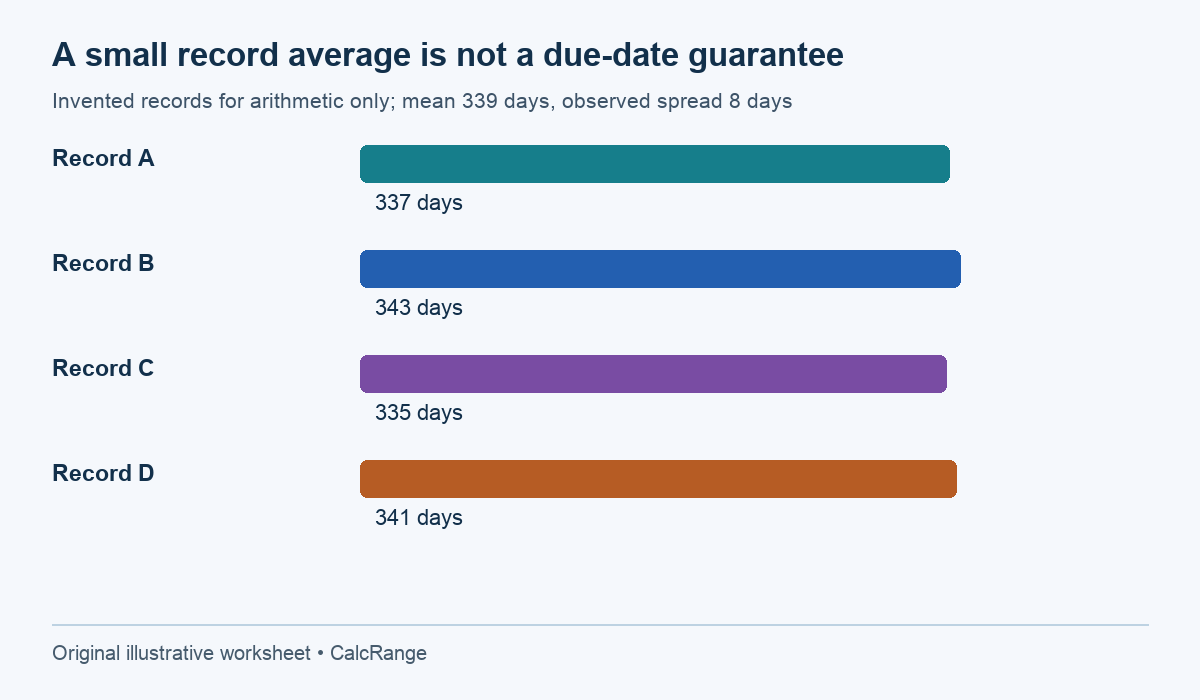
Table of Contents
What one mare gestation study actually examined
A study by Moraes and colleagues, “Climatic factors affecting gestational length in mares under subtropical climate”, analyzed 470 gestations from 202 Criollo mares at a Southern Hemisphere breeding farm. It measured gestation from ovulation to parturition. The reported mean was 337 days, with observed values from 311 to 363 days.
The authors reported associations involving climatic conditions, maternal group and stallion. These were retrospective observations in that population. The study is evidence that context matters; it is not a ready-made table telling every owner how many days to move a particular mare’s expected date.
Read the population and measurement definition before taking a number from a paper. A study’s mean, observed range and uncertainty around its mean answer different questions. None is automatically a safe waiting interval for an individual animal.
Why a seasonal mare gestation pattern cannot simply be copied
First ask whether the study and your record use the same starting event. Ovulation-to-foaling duration is not necessarily the same as last-service-to-foaling duration. A difference in labels can look like a biological difference when the records are measuring different intervals.
Next ask what “season” means in the setting. A month name is not a universal measure of daylight, temperature or management. March in one hemisphere is not the same seasonal context as March in the other. A label copied without its location loses information.
Finally, distinguish association from an individual forecasting rule. To use a proposed adjustment responsibly, you would need a defined model, the required inputs, evidence that it applies to the relevant population and a way to describe prediction error. A general statement that timing varies does not provide those pieces.
| Question | Why it matters |
|---|---|
| Which reproductive event starts the count? | Different date bases can shift the measured interval |
| Which animals and location were studied? | The sample may differ from the mare and setting being planned for |
| Is this a mean, range or individual prediction? | Those numbers have different interpretations |
| Is a usable prediction model actually supplied? | A reported association alone cannot generate a justified correction |
A small record-review example: useful description, weak prediction
Consider four entirely fictional, consistently dated mare records with durations of 337, 343, 335 and 341 days. Their mean is (337 + 343 + 335 + 341) ÷ 4 = 339 days. The shortest-to-longest difference is eight days.
| Record | Consistent recorded interval | Difference from this sample’s mean |
|---|---|---|
| A | 337 days | −2 days |
| B | 343 days | +4 days |
| C | 335 days | −4 days |
| D | 341 days | +2 days |
Those calculations accurately describe the invented four records. They do not establish a seasonal effect, an eight-day universal range or a 339-day prediction for the next mare. Without more information, even whether the records belong to different mares or repeated pregnancies is unknown.
If two happened in one season and two in another, the sample would still be too thin to separate season from individual animals, dating quality and other differences. Do not use a spreadsheet’s ability to calculate an average as proof that the average deserves clinical authority.
The useful next step is to improve the record: confirm IDs, event definitions, dates and any revisions. That makes later review more informative without pretending that a small set of personal observations replaces veterinary assessment.
Check the date basis in a mare gestation record
A record called “breeding date” may refer to first service, last service or an insemination. A veterinary report may instead identify ovulation timing. Write the exact term used in the source record. Do not silently rename all of them “conception.”
For example, if two documented service dates are five days apart, selecting the later one moves a fixed 340-day calendar estimate five days later. That shift comes from the input date, not a seasonal change in the animal. Checking this simple source of variation should come before inventing a climate correction.
Our mare due-date guide explains fixed-day addition and the difference from adding eleven calendar months. Preserve the year and date format so records remain comparable across seasons.
Build a mare gestation worksheet for veterinary review
For each pregnancy record, keep the mare identifier, breed, reproductive event, event date, evidence source, examination references and actual foaling date. Add location and season as descriptive fields, without treating them as automatic corrections.
Include a revision column. “Date corrected from copied diary entry” is different from “dating estimate revised after examination.” If both changes are flattened into one final date, a later review cannot distinguish data cleaning from new clinical information.
Ask the veterinarian which records are meaningful to compare and whether an individual history supports a different planning assumption. Keep the answer with its date. If no justified adjustment is available, retain the uncertainty rather than replacing it with a more precise-looking number.
Three checks before comparing mare gestation records
Check 1: compare intervals measured from the same event
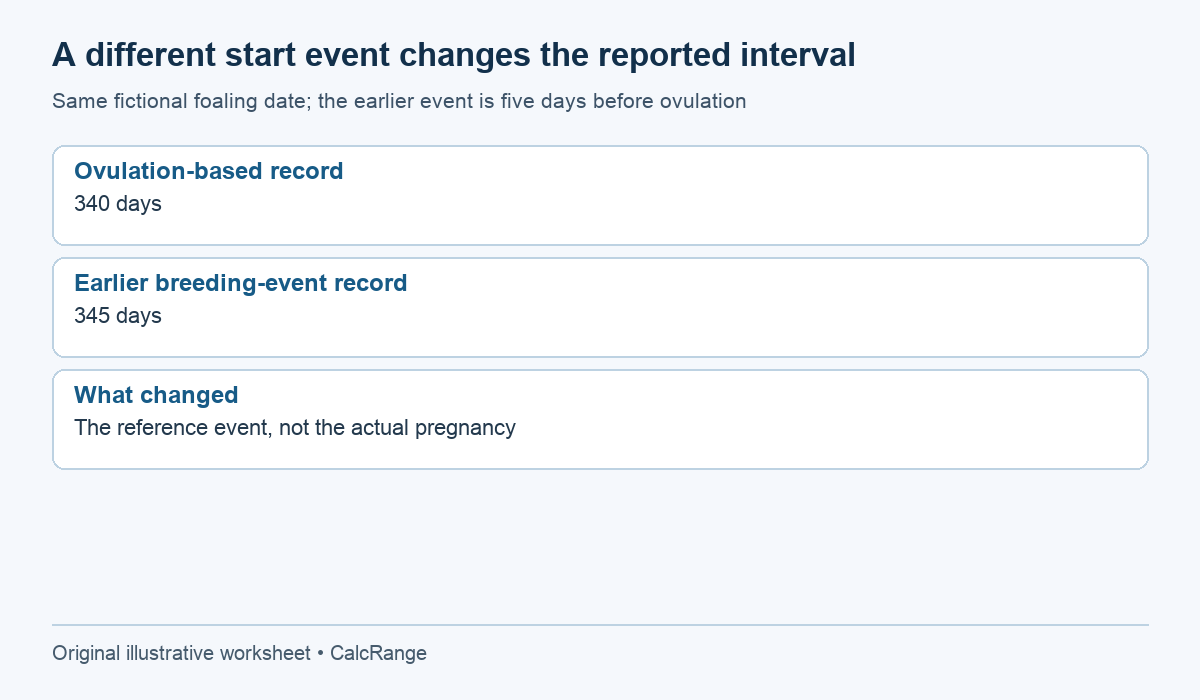
Suppose one record measures 340 days from a documented ovulation date to foaling. Another person copies a breeding event five days earlier as the start and reports 345 days to the same foaling date. The five-day difference is a change in the reference event, not a change in the pregnancy that actually occurred.
Write the start-event definition beside every duration before comparing animals or seasons. If the event was estimated, label that too. A table mixing observed ovulation, first breeding, last breeding and an inferred conception date does not automatically contain comparable intervals, even when all values are expressed in days.
This is why the study’s dating method belongs beside its summary statistics. An ovulation-to-parturition study cannot be applied to a service-date calculator without acknowledging the difference. The example here illustrates measurement definitions; it does not provide a correction that should be applied to a particular mare.
Check 2: a mean does not describe every individual record
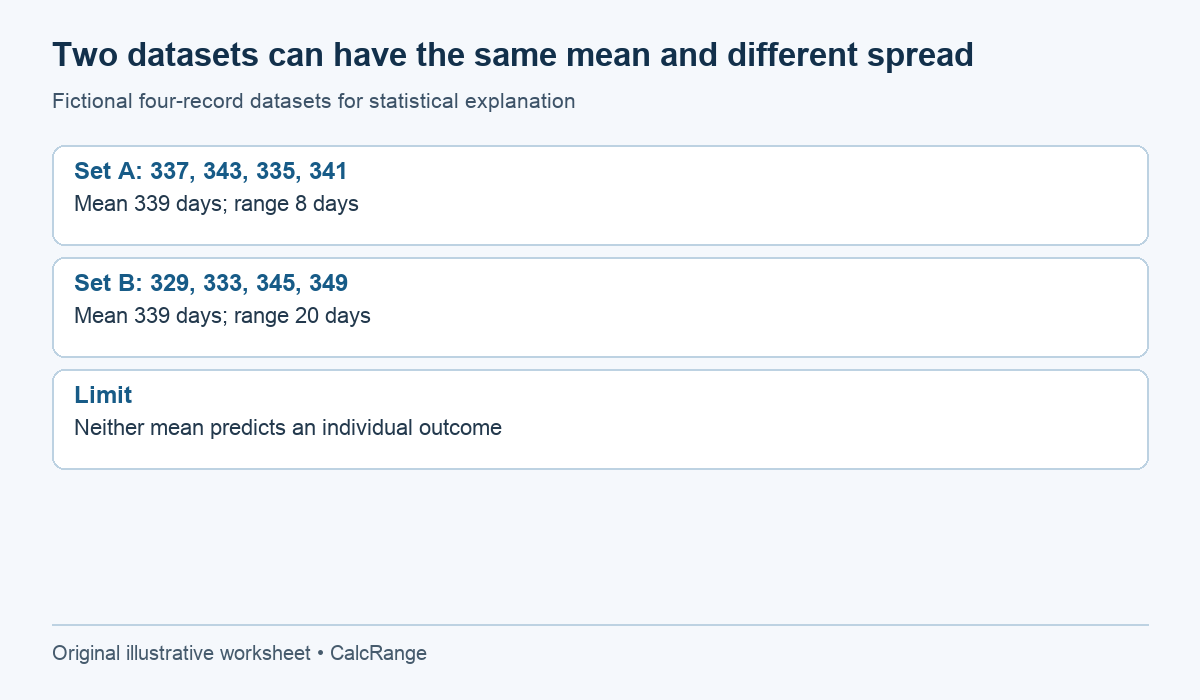
Consider the four fictional durations used earlier: 337, 343, 335 and 341 days. Their total is 1,356 and their mean is 339. None of the four observations is exactly 339. The range from 335 to 343 is eight elapsed days.
Now compare a second fictional set: 329, 333, 345 and 349. It has the same total and the same mean of 339, but its range is 20 days. A single average therefore cannot describe how tightly observations cluster, and it cannot establish the outcome for the next individual animal.
These tiny invented datasets are not clinical reference intervals. They show a general statistical limitation: two groups can share an average while differing substantially in spread. A real analysis needs its actual sample, dating method, missing records and study conditions; an average alone is not enough to create an individual care threshold.
Check 3: separate a season association from a usable prediction rule
A study finding an association with season can suggest a question for further investigation. It does not by itself supply a universal instruction to add or subtract a fixed number of days for every mare bred in a named month. The population, location, management and other recorded factors matter.
Before copying a seasonal mare gestation comparison, identify what “season” means in that study. A month name does not carry the same climate context in both hemispheres. Even within one region, records from different years or management systems may not support the same inference.
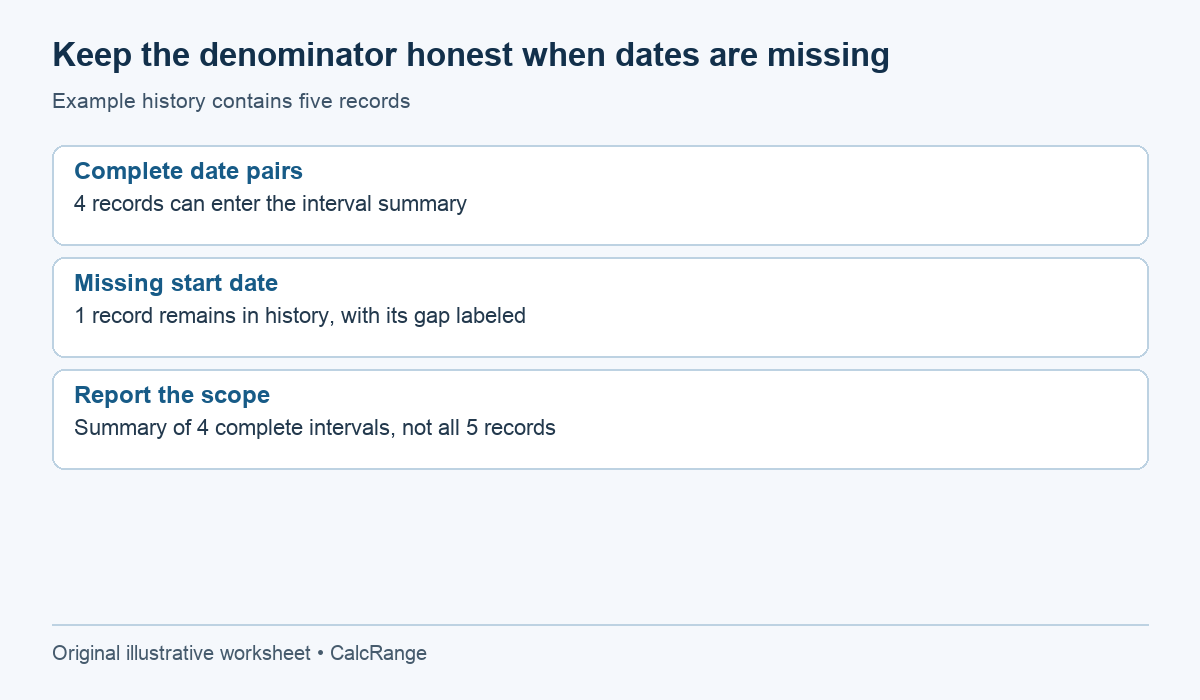
For a mare gestation worksheet, keep the raw event dates and let the veterinary team interpret the current mare’s history. If you summarize previous records, state the number of observations and identify any that lack a reliable start date. Excluding an incomplete record from an interval calculation is different from declaring it biologically unusual.
For example, if five foaling records are available but one has no usable start date, describe the duration summary as based on four complete intervals, not five. Keep the incomplete record in the history with its missing field visible. Do not fill in an average start date merely to increase the sample count.
Finally, distinguish an administrative review from a care decision. A record can be checked for arithmetic, identifiers and missing fields without concluding that the mare is safe, overdue or in need of an intervention. Those decisions require the animal’s current circumstances and veterinary assessment, not a season-adjusted calendar alone.
Use the mare gestation calculator as a planning record
Enter the best documented starting event and the supported interval. Save the assumption with the resulting calendar date. Do not describe the tool’s broad displayed window as a statistical confidence interval unless a validated model actually establishes that interpretation.
A central estimate passing does not by itself determine fetal maturity, diagnose a problem or justify induction. Equally, being inside a displayed range does not guarantee that an animal is well. Concerns about the mare or foal require veterinary assessment rather than another adjustment to the date field.
The breeding-record worksheet provides a consistent handover format. Use seasonal evidence to ask better questions and maintain better records, while leaving individual clinical interpretation with the veterinary team.