
Full-time equivalent (FTE) salary puts a part-time salary on the employer’s full-time hours basis. If a job pays £30,000 for 24 hours a week and the comparable full-time week is 40 hours, its FTE is 24 ÷ 40 = 0.60. The equivalent full-time salary is £30,000 ÷ 0.60 = £50,000.
You would still receive the contracted £30,000 gross annual salary, not £50,000. FTE is a comparison figure. Keep it separate from actual pay, hourly pay and take-home pay when deciding whether an offer fits your budget.
The Salary Calculator can convert an actual pay amount between periods. Calculate the FTE hours ratio separately using the employer’s stated full-time schedule; the tool does not establish what that employer means by full time.
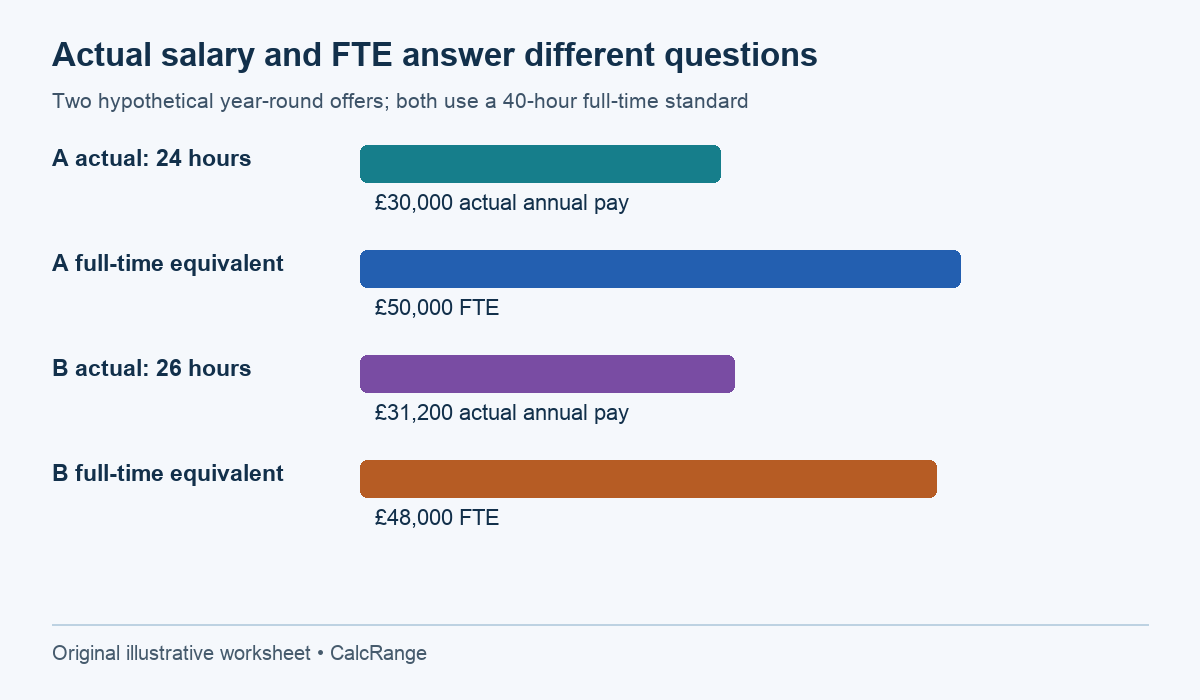
Table of Contents
1. Collect comparable inputs
Write down contracted paid hours per week, the comparable full-time paid hours, actual gross annual pay and the number of paid weeks covered. Use the same definition of hours in both the numerator and denominator. If an unpaid lunch is excluded from one schedule, do not include it in the other.
The UK Department for Education’s workforce methodology describes FTE as a proportion of a full working week. That supports the ratio, but its sector definitions do not set a universal full-time week for every job. Ask the employer rather than automatically inserting 40 hours.
Read the advertisement carefully. “£50,000 FTE, pro rata” may already state the full-time reference. “£30,000 for 24 hours” may state actual part-time pay. Applying the ratio in the wrong direction can produce a large error while still looking mathematically tidy.
| Field | Example | Source to check |
|---|---|---|
| Actual annual gross pay | £30,000 | Written offer |
| Contracted weekly hours | 24 | Working pattern |
| Comparable full-time hours | 40 | Employer’s reference contract |
| Paid period | Full year | Year-round rather than term-time terms |
2. Calculate full time equivalent salary
First find the employment fraction: 24 ÷ 40 = 0.60, or 60% of the full-time hours. Next divide actual annual salary by that fraction: £30,000 ÷ 0.60 = £50,000 FTE.
The reverse check is £50,000 × 0.60 = £30,000. This is useful when an employer quotes only the FTE figure. It confirms the arithmetic, but any separate paid-week adjustment or contractual supplement must still be included according to the offer.
Both weekly-hours figures must be positive. If the role has variable hours, use a documented comparable average period rather than a particularly busy or quiet week. A zero-hour arrangement cannot be converted to a reliable annual FTE salary by dividing by an arbitrary number of hoped-for hours.
3. Compare two offers using the same basis
Offer A pays £30,000 for 24 hours per week, with 40 hours defined as full time. Offer B pays £31,200 for 26 hours, also against 40 hours. Although B pays £1,200 more in actual annual salary, it requires two additional hours each week.
| Measure | Offer A | Offer B |
|---|---|---|
| Actual gross annual salary | £30,000 | £31,200 |
| Weekly contracted hours | 24 | 26 |
| FTE fraction | 0.60 | 0.65 |
| FTE annual salary | £50,000 | £48,000 |
| Gross hourly equivalent using 52 weeks | £24.04 | £23.08 |
For this comparison, the hourly figures are £30,000 ÷ (24 × 52) and £31,200 ÷ (26 × 52), rounded to pennies. They use paid scheduled hours across a 52-week year, not only hours physically worked after paid leave. Do not subtract paid leave again unless you deliberately want a different “per hour actually worked” measure.
Offer A has the higher normalized pay rate; B provides more total salary. Neither conclusion decides which job is better. Predictable hours, duties, commute, paid leave, pension contributions and progression may change your decision. Keep those items alongside the numerical comparison rather than forcing them into an unsupported single score.
4. Return to actual pay for your budget
An FTE salary is not the amount available for rent or bills. Use actual gross salary in a pay converter or tax estimate. Entering £50,000 when the contract pays £30,000 would model a different income.
In the Salary Calculator’s Pay Converter, select the currency and annual period, then enter the actual annual amount and the corresponding hours. Review the stated holiday/vacation convention: the tool treats weekly and longer-period inputs as already adjusted. For the simple comparison above, use the written annual salary and do not deduct paid holidays a second time.
The tool’s tax tab also has a specific country/year scope and excludes other payroll deductions. For a real deposit estimate, account separately for contributions, pensions and other applicable items. Our gross versus net salary guide explains why gross annual figures cannot be compared directly with bank deposits.
Check term-time, compressed-hours and overtime exceptions
Hours-based FTE alone may not describe a term-time contract. Suppose a stated reference salary is adjusted both for weekly hours and for a shorter paid period. Obtain the employer’s actual annual-pay calculation. Do not assume that weeks worked, weeks paid and calendar weeks all mean the same thing.
Compressed full-time hours are another common source of confusion. A person working 40 hours over four days can still be 1.0 FTE against a 40-hour standard. Four days out of five does not automatically mean 0.8 FTE when daily hours differ.
Keep overtime and bonuses separate from basic contracted pay. If £30,000 includes uncertain overtime while another offer quotes guaranteed base salary, the initial comparison is mismatched. Compare guaranteed amounts first, then model variable compensation as an explicitly labeled scenario.
Two employers may use different full-time hours. A salary of £45,000 at 37.5 hours and £45,000 at 40 hours have the same stated annual amount but different hourly equivalents. An FTE label alone cannot remove that difference. Our hourly-to-salary guide shows the period conversion separately.
Three offer checks before using the FTE figure
A quoted FTE salary must be converted in the correct direction
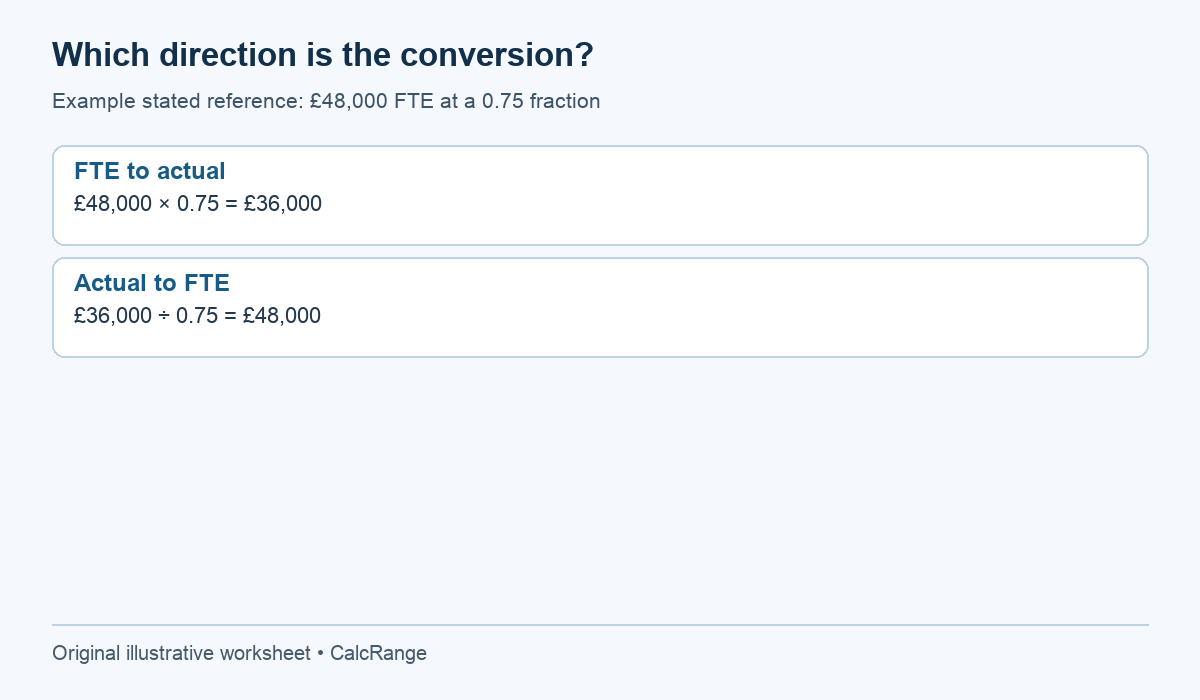
Suppose an advertisement states “£48,000 FTE, 0.75 contract.” If the fraction applies directly to the annual reference salary, the corresponding actual gross amount is £48,000 × 0.75 = £36,000. Dividing £48,000 by 0.75 would produce £64,000, but that answers the wrong question: it treats the already full-time figure as though it were the part-time amount.
Label the starting number before choosing an operation. From actual pay to FTE, divide by the fraction. From FTE to actual pay, multiply by the fraction. Write both quantities on the comparison sheet so a later reader does not mistake the normalized figure for promised earnings.
Confirm the employer’s actual amount in writing, especially if the offer also contains a paid-weeks adjustment, supplement or allowance. The simple multiplication assumes those other components do not change the stated relationship. A result that conflicts with the written offer is a reason to ask for clarification, not to substitute the calculator’s number into a contract.
Different full-time schedules require an hourly cross-check
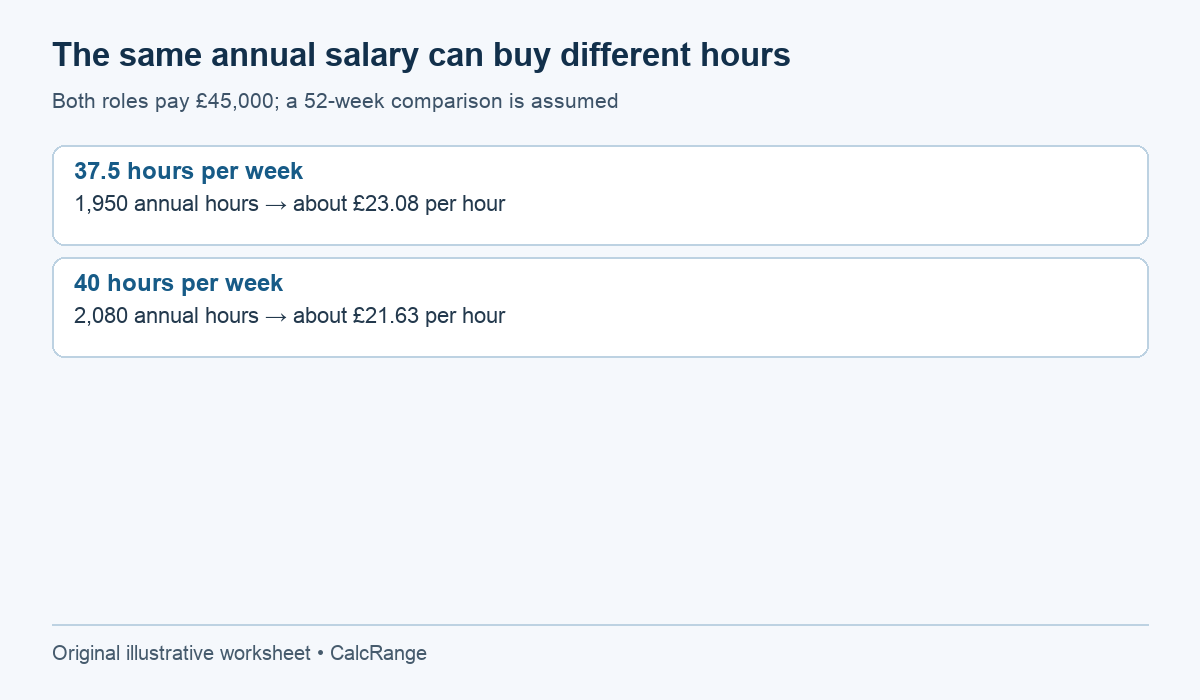
Two full-time roles both advertise £45,000 per year, but one uses 37.5 paid hours per week and the other 40. Using the same 52-week convention, their hourly equivalents are £45,000 ÷ 1,950 = approximately £23.08 and £45,000 ÷ 2,080 = approximately £21.63.
Both can truthfully be described as full-time salaries under their respective contracts. The difference does not mean either FTE calculation is wrong; it means “1.0 FTE” uses a different denominator. Keep the weekly-hours figure next to the salary when comparing organizations.
A part-time offer of £27,000 for 22.5 hours against a 37.5-hour standard is 0.60 FTE and implies £45,000 FTE. If someone incorrectly uses 40 hours as the denominator, they get an FTE salary of £48,000. That inflated comparison comes entirely from replacing the employer’s standard with an unsupported assumption.
Separate actual earnings from a temporary working pattern
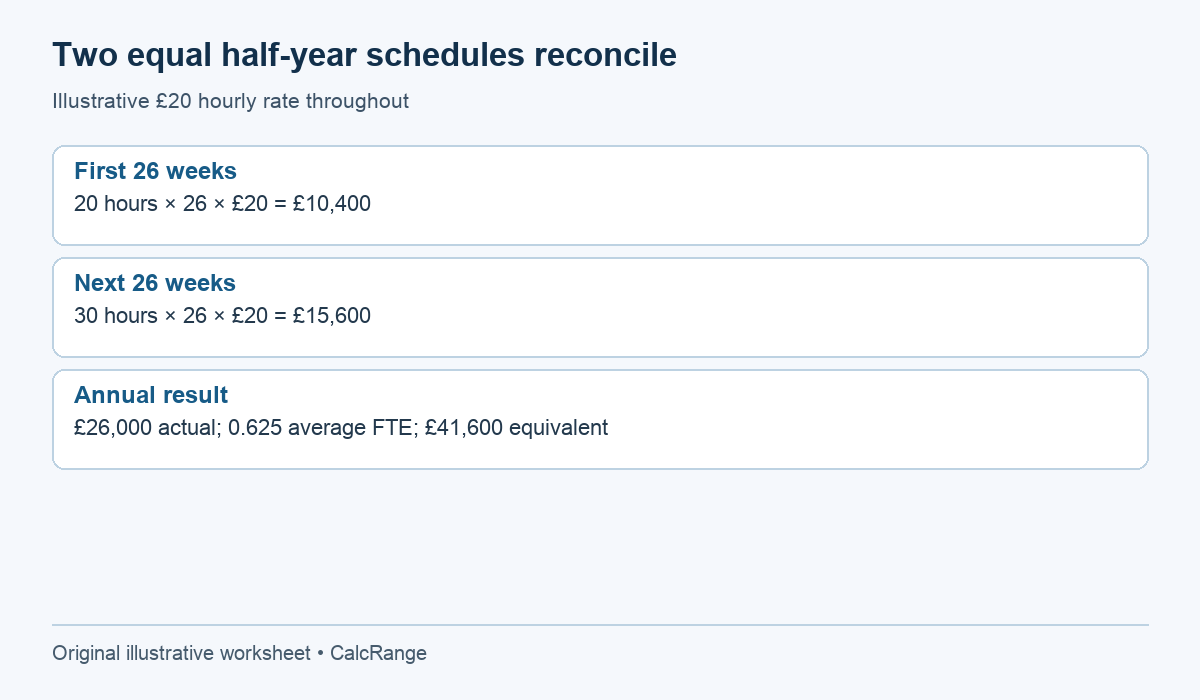
Imagine a person works 20 hours for half the year and 30 for the other half, with a consistent £20 hourly rate and 26 paid weeks in each period. The first period pays 20 × 26 × £20 = £10,400; the second pays 30 × 26 × £20 = £15,600. The combined gross amount is £26,000.
The average scheduled week is 25 hours across those equal periods. Against a 40-hour standard, the average fraction is 0.625. Dividing £26,000 by 0.625 gives £41,600 FTE, matching £20 × 40 × 52. This reconciliation works because the periods, rate and paid-week assumptions were specified consistently.
If the periods have different lengths, use an hours-weighted calculation rather than averaging the two weekly schedules equally. If the hourly rate also changes, keep separate period earnings. A single current schedule may describe the job now while failing to describe the year’s actual pay.
Questions to send the employer before accepting
- Is the quoted salary actual pay or the full-time reference?
- What paid weekly hours define 1.0 FTE for this role?
- Does the annual amount cover the full year, including paid leave?
- Are overtime, allowances or bonuses included or additional?
- What actual gross monthly or other-period salary will appear on the contract?
Save the answers with the calculation. An hours ratio is easy to reproduce once its assumptions are clear. If you also want to compare the time commitment beyond contracted hours, use the time-value worksheet as a separate personal decision tool, not a substitute for the employer’s pay terms.