
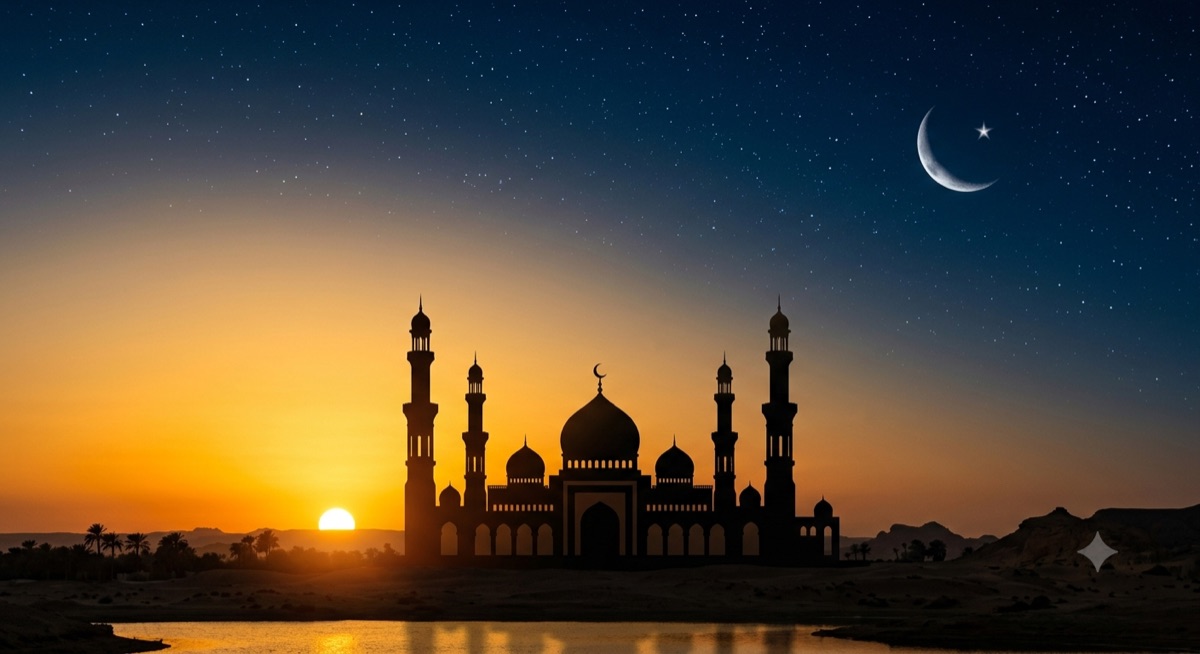
The Maghrib to Isha time gap is the wait between sunset and the end of twilight — usually about 60 to 90 minutes.
Maghrib is the one prayer time almost everyone can see happen — the sun goes down and it’s time. Isha is trickier, because it waits for the last of the daylight to disappear. The gap between them isn’t fixed, and here’s what decides it.
Maghrib to Isha time: the quick answer
Maghrib begins right at sunset — no delay. Isha begins when evening twilight fades, which is roughly 60 to 90 minutes after sunset in most places, though it varies with your latitude, season and calculation method.
Maghrib: right at sunset
Maghrib enters the moment the sun’s disc dips fully below the horizon. Because it’s tied to a clear, visible event, Maghrib times barely differ between apps for the same location — there’s no calculation method to argue over, only tiny corrections for elevation and horizon. That’s also why it’s the anchor for Iftar in Ramadan.
Isha: when twilight disappears
After sunset the sky doesn’t go dark instantly — there’s a lingering glow called twilight. Isha begins when that glow is gone, defined by the sun reaching a set angle below the horizon (commonly 17° or 18°, depending on method). The bigger the Isha angle, the longer you wait after Maghrib. That’s the whole reason Isha times differ between apps — the Isha angle your method uses.
Why the gap changes
The Maghrib-to-Isha gap isn’t a fixed number because twilight length changes with:
| Factor | Effect on the gap |
|---|---|
| Latitude (distance from equator) | Higher latitudes have longer twilight, so a bigger gap |
| Season | Summer twilight lasts longer than winter twilight |
| Calculation method | A 18° Isha waits longer than a 15° or 17° Isha |
Near the equator the gap stays close to 70–80 minutes year-round; far from it, summer twilight can stretch the wait well beyond 90 minutes.
The special case: Umm al-Qura
Not every method uses an angle for Isha. The Umm al-Qura method (used in Saudi Arabia) sets Isha at a fixed 90 minutes after Maghrib (120 minutes in Ramadan), sidestepping the twilight angle entirely. See how the methods compare in prayer calculation methods compared.
Very high latitudes
Far north or south in summer, twilight may never fully end — the sun never drops far enough below the horizon — so a pure angle can’t produce an Isha time. Special approximation rules then kick in, which is why apps sometimes show unusual Isha times in those regions.
How it all fits
Maghrib and Isha are the evening half of the daily cycle. For the full system — including Dhuhr and Asr — see how Islamic prayer times are calculated.
Frequently asked questions
How long after sunset is Maghrib?
There’s no wait — Maghrib begins right at sunset.
How long after Maghrib is Isha?
Usually about 60–90 minutes, depending on your latitude, the season, and the Isha angle your method uses.
Why is Isha so late in summer where I live?
At higher latitudes summer twilight lasts much longer, so the sun takes more time to reach the Isha angle after sunset.
Does Maghrib depend on the calculation method?
No. Maghrib is set by sunset and is essentially the same across methods; only Isha depends on the twilight angle.
For more background, see Isha prayer on Wikipedia.
Want exact Maghrib and Isha times for your city? Use the free prayer times calculator and pick the method your community follows.