
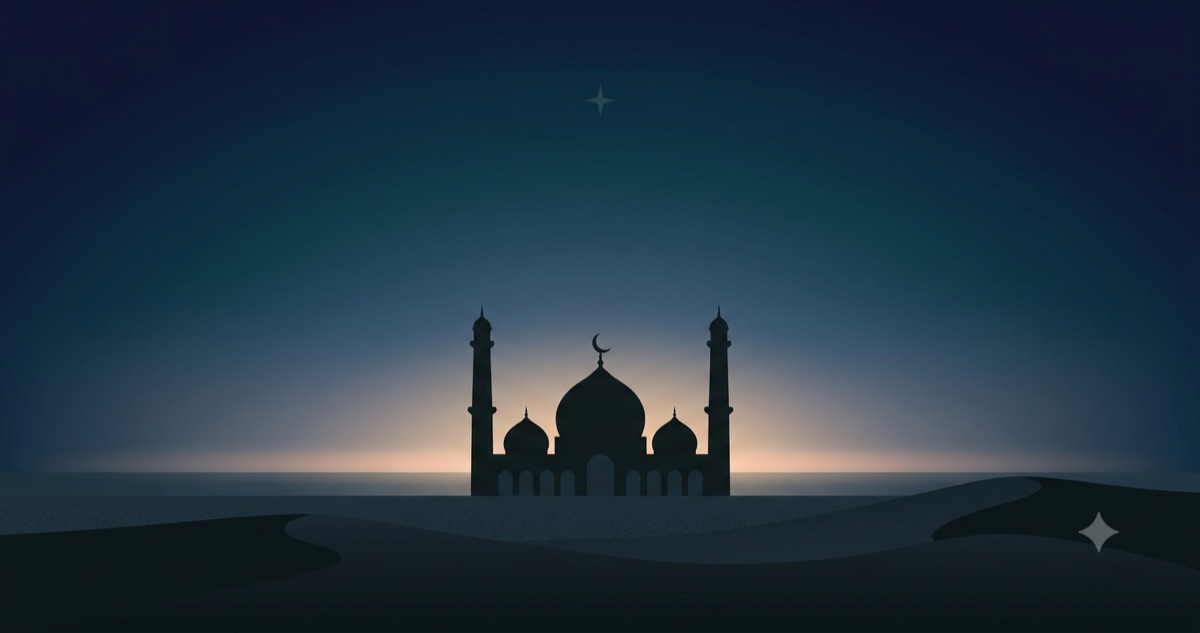
When does Fajr start? At true dawn (Subh Sadiq) — the moment a band of light spreads along the horizon before sunrise.
Fajr is the prayer people most often want pinned down precisely — it decides when you can start praying and, in Ramadan, when Suhoor ends. The catch is that dawn doesn’t arrive all at once. Here’s what actually marks the start of Fajr.
When does Fajr start? The quick answer
Fajr begins at true dawn (Subh Sadiq) — the moment a horizontal band of light spreads across the horizon, well before the sun rises. Astronomically, this is when the sun reaches a set angle below the horizon, commonly 18° (some methods use 15° or 19.5°). Fajr then ends at sunrise.
True dawn vs. false dawn
Classical scholars described two dawns, and telling them apart is the whole point.
False dawn (Subh Kadhib): A faint vertical column of light that rises upward, then fades and leaves the sky dark again. Prayer does not begin here, and in Ramadan you may still eat.
True dawn (Subh Sadiq): A white light that spreads horizontally along the horizon and keeps growing into daylight. This is when Fajr begins and Suhoor ends.
The difference is direction and permanence: false dawn is a fading vertical glow; true dawn is a spreading horizontal brightness that doesn’t go away.
The sun angles behind Fajr
Because “the light spreads” is hard to time by eye, methods translate true dawn into a sun depression angle. The larger the angle, the earlier (darker) Fajr is calculated.
| Method | Fajr angle |
|---|---|
| ISNA (North America) | 15° |
| Muslim World League | 18° |
| Karachi | 18° |
| Umm al-Qura (Makkah) | 18.5° |
| Egyptian Authority | 19.5° |
A 15° method gives a later Fajr than an 18° or 19.5° method. That single choice is why two apps can show Fajr several minutes — sometimes more — apart. We go deeper in Fajr and Isha angles explained.
Why your Fajr might feel “too early” or “too late”
If your app’s Fajr feels off compared to your local mosque, it’s almost always the method. Mosques usually follow a specific national or community standard; matching your app to the same method fixes the mismatch. For the full picture of how each prayer is derived, see how prayer times are calculated.
Fajr and Ramadan
In Ramadan, Fajr is doubly important because Suhoor ends at Subh Sadiq. Many people stop eating a few minutes before the calculated Fajr as a precaution. The same dawn math also sets your Suhoor deadline — more in how Suhoor and Iftar times are calculated.
Frequently asked questions
What is Subh Sadiq?
It’s true dawn — the horizontal spread of light along the horizon that marks the start of Fajr and the end of Suhoor.
Why do Fajr times differ between apps?
They use different Fajr angles (15°, 18°, 18.5°, 19.5°). A larger angle produces an earlier Fajr.
Can I pray Fajr before Subh Sadiq?
No. Fajr cannot begin before true dawn. That’s why choosing an accurate method for your location matters.
When does Fajr end?
At sunrise (Shuruq). After the sun’s edge appears on the horizon, the Fajr window closes.
For more background, see Fajr prayer on Wikipedia.
Want an accurate Fajr for your city and method? Use the free prayer times calculator and choose the angle your community follows.