 Skip to content
A longer loan term generally lowers the required monthly payment when the amount borrowed and interest rate stay the same. It also keeps part of the principal outstanding for longer, which increases total interest in a standard amortizing loan.
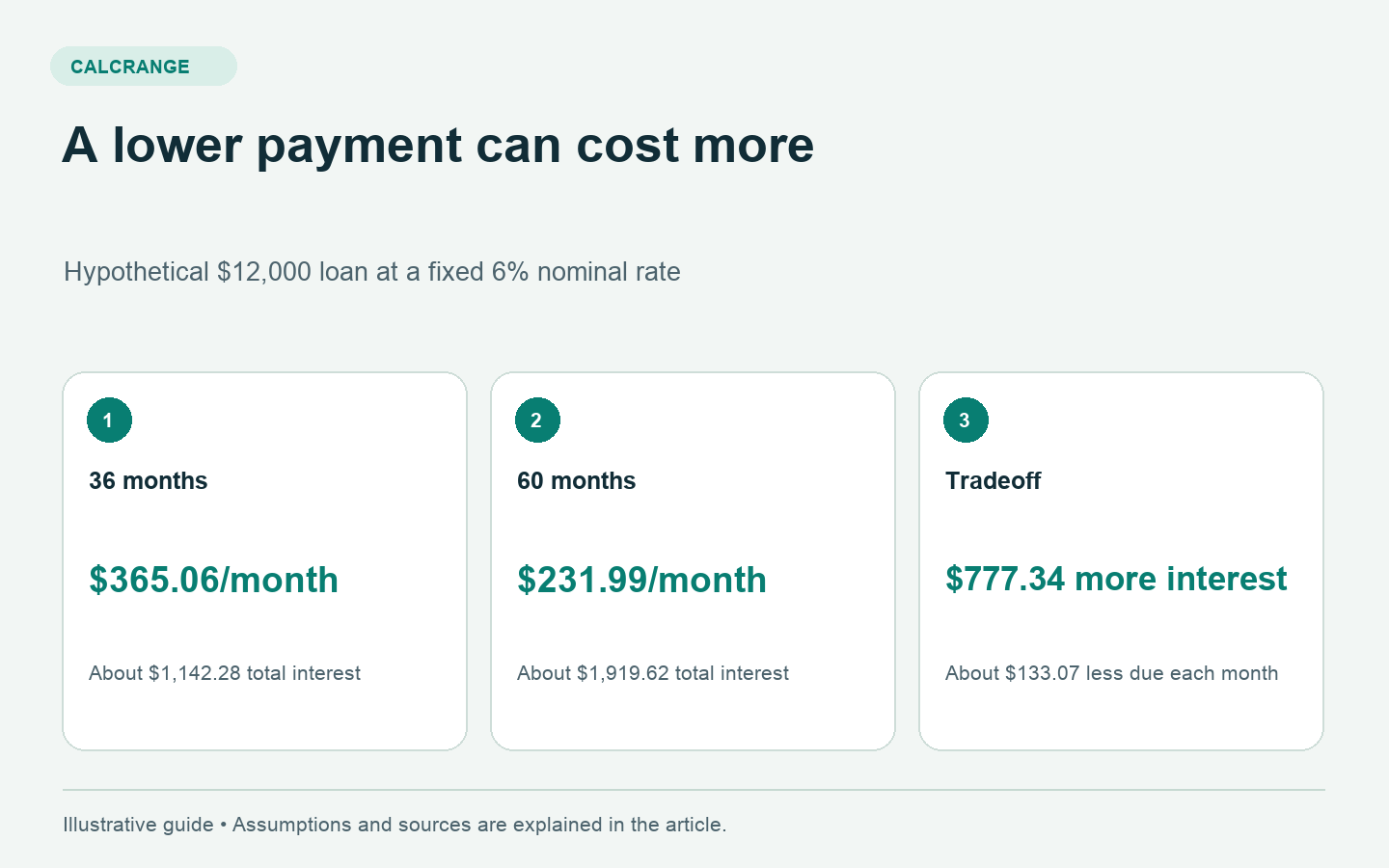
The EMI Calculator lets you isolate this tradeoff. Start by changing only the term. Then compare actual lender quotes, which may have different rates, fees and repayment conditions.
Keep these assumptions the same
A useful comparison needs the same principal, fixed nominal annual rate, payment frequency and repayment model. The example below assumes equal monthly payments, interest calculated at the annual nominal rate divided by 12, and no fees, early repayment, missed payments or balloon balance.
EMI means equated monthly installment. The payment in this simplified model covers principal and interest. Insurance or other charges included in a lender’s quoted installment may require separate treatment.
A $12,000 example across three terms
Suppose the principal is $12,000 and the fixed nominal annual rate is 6%. The monthly rate is 0.06 ÷ 12 = 0.005. For n monthly payments, use payment = principal × monthly rate ÷ [1 − (1 + monthly rate)−n].
| Term | Monthly principal and interest | Total interest | Total repaid |
|---|---|---|---|
| 36 months | $365.06 | $1,142.28 | $13,142.28 |
| 48 months | $281.82 | $1,527.38 | $13,527.38 |
| 60 months | $231.99 | $1,919.62 | $13,919.62 |
Extending from 36 to 60 months reduces the modeled monthly payment by about $133.07, but increases total interest by about $777.34. Total interest here is the unrounded payment multiplied by the number of payments, minus principal. A real lender’s cent rounding can change the final payment.
The intermediate term illustrates that this is a range of choices. Forty-eight months reduces the required payment by about $83.24 relative to 36 months and adds about $385.10 of interest under the same assumptions.
Why the interest difference appears
In every example, the first month’s interest is $12,000 × 0.005 = $60. Under the 36-month schedule, about $305.06 of the first payment reduces principal. Under the 60-month schedule, about $171.99 does. The longer schedule therefore enters the next month with more principal still owed.
Repeating this process explains the cumulative difference. It is not an extra penalty created by the calculator; it follows from a slower principal reduction at the assumed positive rate.
Compare complete offers, not just this table
The CFPB’s loan comparison guidance recommends considering the amount financed, APR, interest rate, term and monthly payment together. A real 60-month offer may carry a different rate from a 36-month offer. Recalculate with those actual terms before drawing a conclusion.
Record upfront fees, financed fees, optional products, any final balloon and prepayment rules. Adding a $600 fee to the loan makes the financed principal $12,600, not $12,000. Paying it upfront keeps the payment formula’s principal unchanged but still increases the total cash cost.
A manageable payment needs a wider budget
For a car, loan repayment is only one part of ownership. The CFPB affordability guide includes costs such as insurance, maintenance and fuel. Enter those separately in a personal budget so the lowest installment does not become a misleading affordability test.
For example, if a hypothetical monthly budget has $450 available for all vehicle costs and $180 is reserved for non-loan costs, only $270 remains for the payment. This is a constraint in that invented budget, not a recommended spending limit. Changing the vehicle price or down payment is another scenario to examine.
How to use the result
Run the shortest and longest realistic terms, record payment and total interest, and then check the middle options. Save the inputs with each result. Use the numbers to ask a lender precise questions, not as approval for borrowing: the calculator cannot verify eligibility, contract terms or what payment is suitable for your circumstances.
Sources and method
Source links checked September 18, 2026. Examples are original educational calculations using the assumptions stated above.