 Skip to content
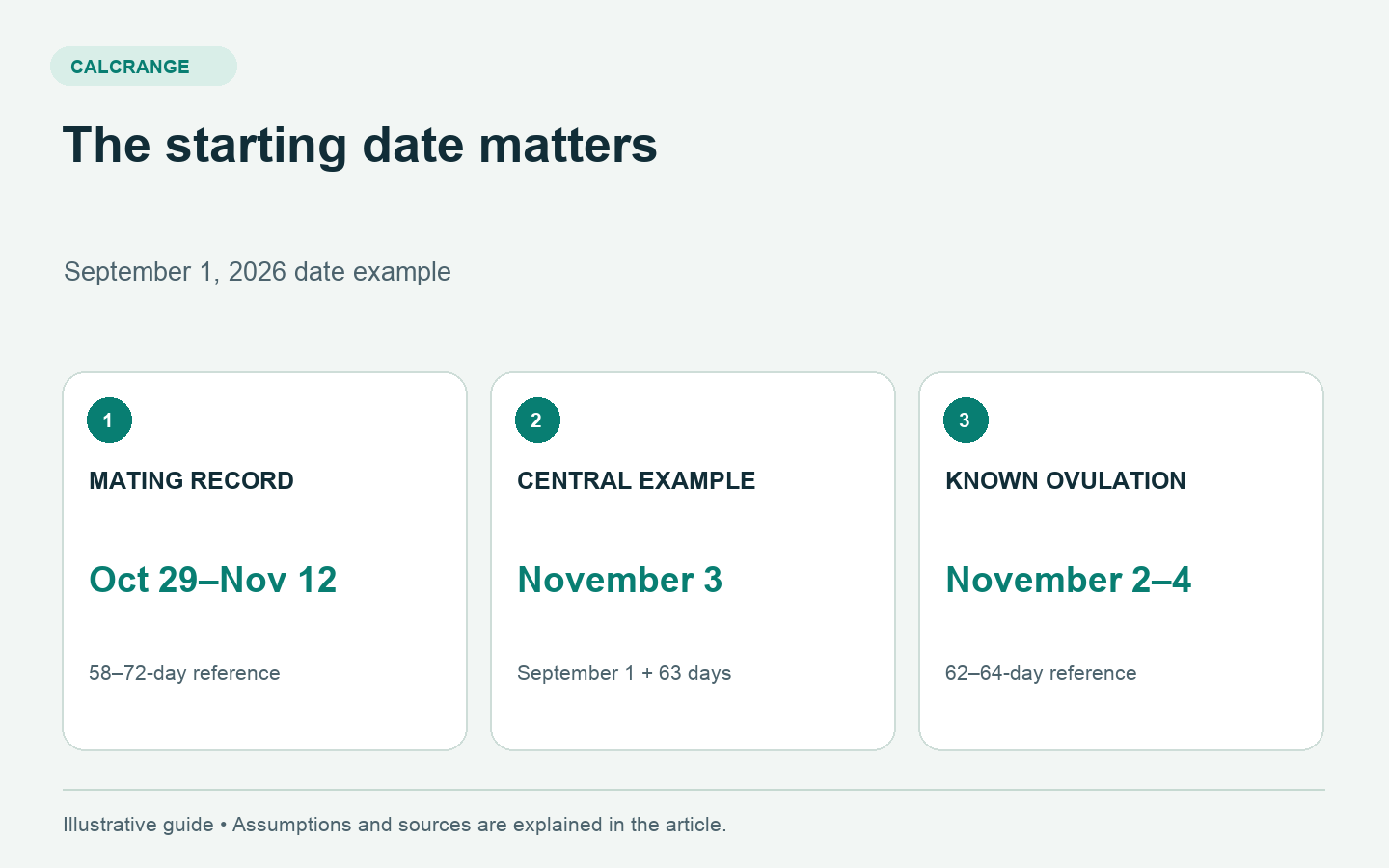
A dog pregnancy timeline should begin by naming its starting point. Merck Veterinary Manual lists approximately 62–64 days from ovulation, compared with a broader 58–72-day reference when breeding occurred at an unknown stage of the cycle. A mating date therefore cannot always support a precise “63 days later” prediction.
Use the Dog Pregnancy Calculator with the date type that matches the record. Do not select ovulation merely to obtain a narrower window unless a veterinarian has established that timing.
Three different dates to keep separate
Mating date records when breeding occurred. Ovulation date refers to the reproductive event, which may be estimated through veterinary testing. Pregnancy-check date is when an examination or test was performed. These are not interchangeable.
If several matings occurred, retain every date. A later positive examination establishes pregnancy at that time; it does not turn the examination date into conception day. The record should state what was observed or measured, not what an app inferred.
Worked example from a mating date
Suppose the only reliable record is a mating on September 1, 2026. Adding 63 days gives November 3. However, using the broader 58–72-day reference gives October 29 through November 12.
| Date calculation | Result | Interpretation |
|---|---|---|
| September 1 + 58 days | October 29 | Lower reference from uncertain mating timing |
| September 1 + 63 days | November 3 | Illustrative central date |
| September 1 + 72 days | November 12 | Upper reference from uncertain mating timing |
The dates are planning references, not permission to wait until November 12 if the dog seems unwell. A central estimate also does not mean November 3 is the most likely date for this individual; that would require more information than the mating record supplies.
What changes with known ovulation?
If the veterinarian established ovulation on September 1, the 62–64-day reference instead corresponds to November 2–4. The calendar calculation is simple; the extra precision comes from better reproductive information, not a more sophisticated date formula.
Keep the veterinary report with the estimated dates and ask which monitoring schedule is appropriate. If the report uses another event or convention, follow that explanation rather than relabeling it as ovulation. Small differences in terminology can move the interpretation of the whole timeline.
Where veterinary checks fit
Merck’s owner guidance describes ultrasound detection around 25–35 days and notes that later radiographs can help determine litter size, with films after about day 55 most useful for counting. Your veterinarian decides when and whether a test is appropriate.
Ask the clinic to write down the question each examination answers: confirmation of pregnancy, assessment of fetal viability, an estimated stage or an expected litter count. One result does not automatically answer all four. Avoid trying to confirm pregnancy by pressing the abdomen yourself.
Make a practical timeline rather than a day-by-day promise
Use separate rows for breeding records, examination appointments, preparation discussions and the expected delivery period. Add the clinic’s emergency contact and the veterinarian’s specific instructions for this dog. This is more useful during a handover than generic claims about what every puppy must look like on each day.
Discuss nutrition, medication and the delivery plan with the veterinary team. A calculator cannot diagnose illness, predict the number of puppies or manage difficult labor. Distress, abnormal discharge, failure to progress or other concerns require prompt veterinary contact rather than recalculating the date.
After delivery, record the actual date and litter information. Comparing it with the original, clearly labeled starting event can improve future records. Do not retroactively label a mating date “confirmed ovulation” just because the birth happened close to the estimate.
Sources and method
Sources checked September 18, 2026. Numerical examples are illustrative calculations, not patient or animal records.