
Cylinder volume from circumference is V = C²h ÷ (4π), where C is circumference and h is the cylinder’s length or height in the same unit. This is useful when you can wrap a tape around a cylinder more easily than measure across its end. The Volume Calculator asks for radius and height, so derive the radius as C ÷ (2π) before using its Cylinder option.
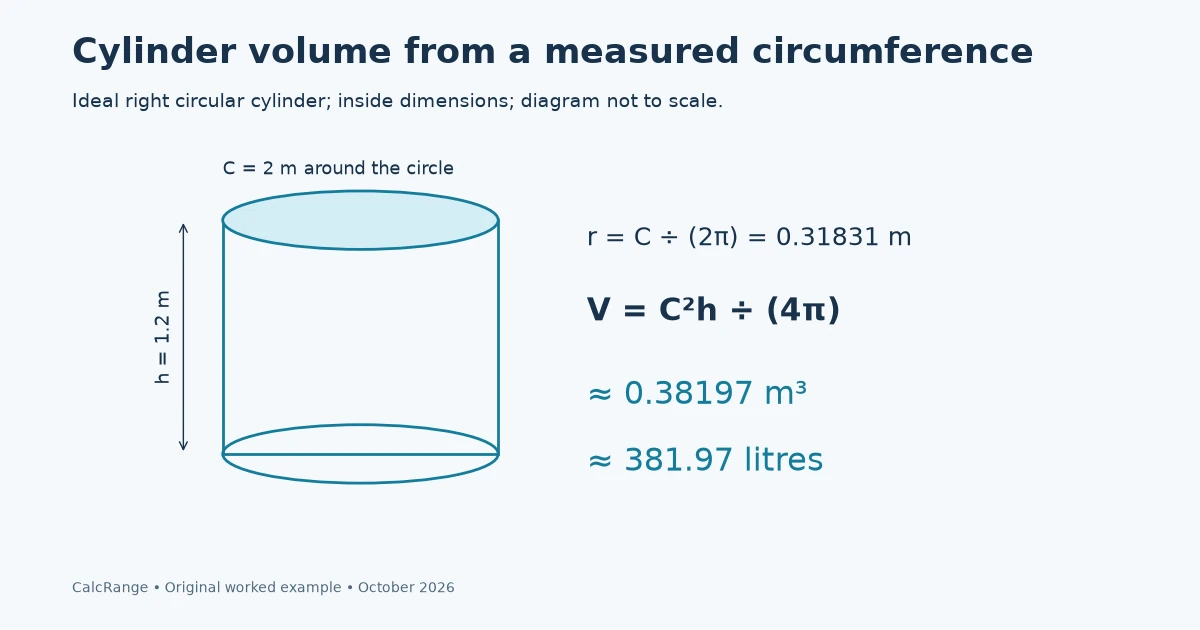
Table of Contents
Derive cylinder volume from circumference
A circle’s circumference is C = 2πr. Rearranging gives r = C ÷ (2π). Substitute that into V = πr²h:
V = π × [C ÷ (2π)]² × h = C²h ÷ (4π)
The squared circumference matters. Doubling circumference while keeping height fixed multiplies volume by four, not two. This is the same radius-squared relationship used in the volume formulas guide, expressed in terms of a measurement you can actually obtain.
The formula assumes a circular, straight-sided cylinder with a constant cross-section and flat ends. A tapered barrel, oval tank, domed end or corrugated container may need a different model. A single tape measurement cannot establish those missing shape details.
Volume from circumference: a 2 m worked example
Assume the circumference and height describe the internal space of an ideal full cylinder. Take C = 2 m and h = 1.2 m. The calculations below retain π until the final display.
| Step | Calculation | Result |
|---|---|---|
| Radius | 2 ÷ (2π) | 0.318309886 m |
| Diameter | 2 ÷ π | 0.636619772 m |
| Volume | 2² × 1.2 ÷ (4π) | 0.381971863 m³ |
| Litres | 0.381971863 × 1,000 | 381.971863 L |
The approximate result is 382 litres. In the calculator, choose Cylinder and metres, then enter radius approximately 0.318309886 and height 1.2. Entering 2 as the radius would be a different cylinder; the tool does not interpret that field as circumference.
A rounded radius such as 0.32 m gives about 386.04 L. That is roughly 4.07 L higher than the calculation using the original circumference. Keep extra digits in the intermediate radius and round the capacity only at the end.
Volume from circumference in centimetres
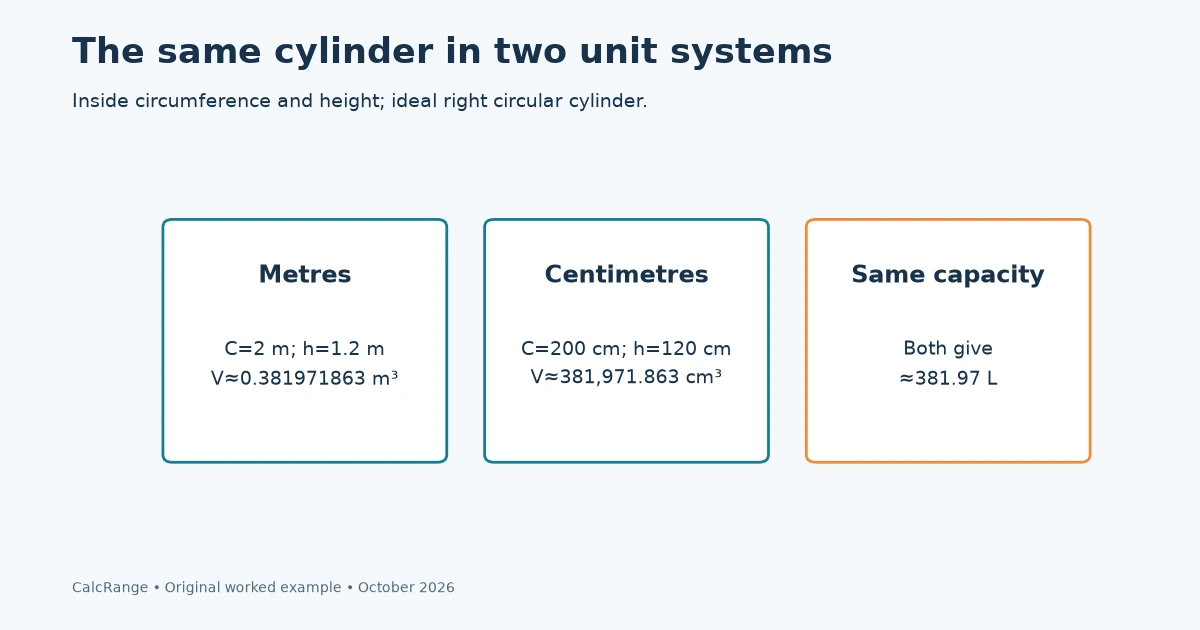
The same measurements are 200 cm around and 120 cm high. Using the circumference formula gives 200² × 120 ÷ (4π) = approximately 381,971.863 cm³. Divide by 1,000 to obtain 381.971863 L.
Do not combine C = 200 cm with h = 1.2 m in the same multiplication. Either convert both to metres first or both to centimetres. The cubic unit follows the units used in all length inputs.
| Circumference | Height | Volume unit | Conversion to litres |
|---|---|---|---|
| 2 m | 1.2 m | m³ | Multiply by 1,000 |
| 200 cm | 120 cm | cm³ | Divide by 1,000 |
| 2,000 mm | 1,200 mm | mm³ | Divide by 1,000,000 |
For a capacity in gallons, identify US or imperial gallons explicitly. The Unit Converter can convert a known volume after the geometry is settled. Changing output units does not correct an external measurement used in place of an internal one.
External circumference is not internal capacity
A tape wrapped around the outside measures the outside surface. For a simple uniform wall thickness t, an idealized internal radius is Coutside ÷ (2π) − t. Height must also describe the usable internal space. Do not subtract the wall thickness directly from circumference as if it were a diameter.
Suppose an outside circumference is 2 m, wall thickness is known to be 0.005 m, and internal height is independently known to be 1.2 m. The corrected radius is approximately 0.313309886 m. Its ideal internal volume is about 370.07 L, rather than the 381.97 L obtained by treating the outside circumference as internal.
That example assumes a uniform cylindrical wall and ignores fittings, bottom shape and other intrusions. If thickness or internal geometry is unknown, report an outside-volume estimate instead of labeling it an exact tank capacity. Use manufacturer dimensions or a suitable direct internal measurement when available.
Do not enter or open a tank, remove a protective cover or work at height merely to obtain a measurement. This arithmetic guide does not establish a safe inspection procedure.
Volume from circumference: a measurement record
- Identify the object and whether the tape follows the inside or outside surface.
- Wrap the tape in a plane perpendicular to the cylinder’s axis; an angled path is not the intended circumference.
- Check that the tape is not slack and the cross-section is genuinely circular.
- Record circumference, axial length or height, units and any known wall correction.
- Calculate radius, then volume, and state the ideal-shape and fill assumptions with the result.
For a full horizontal cylinder, its orientation does not change the full geometric volume. A partly filled horizontal cylinder is different: liquid depth does not occupy the same fraction of volume. See the water-tank capacity guide before treating partial depth as a simple percentage.
Measurement uncertainty also matters more than extra displayed decimals. With height fixed, a 1% higher circumference gives 1.01² = 1.0201 times the volume, a 2.01% increase. This is a sensitivity example, not an estimate of your tape’s accuracy.
Reproduce the result entirely in centimetres
A unit cross-check can expose an error before a capacity estimate is used. Convert the original 2 m circumference to 200 cm and the 1.2 m inside height to 120 cm. Use the same formula without mixing metres and centimetres.
Volume is 200² × 120 ÷ (4π), approximately 381,971.863 cm³. Since 1,000 cm³ is 1 L, this becomes approximately 381.97 L, matching the metre-based result.
| Input or result | Metre calculation | Centimetre calculation |
|---|---|---|
| Circumference | 2 m | 200 cm |
| Height | 1.2 m | 120 cm |
| Volume | 0.381971863 m³ | 381,971.863 cm³ |
| Capacity | 381.971863 L | 381.971863 L |
Now consider the wrong mixed calculation: entering circumference 200 but height 1.2 without converting either label. The formula will still return a number, but no coherent cubic unit can be assigned to that combination. A calculator cannot rescue dimensions whose units were stripped off before entry.
Write the unit beside every original measurement. Convert to one length system, calculate the cubic volume, and only then convert that result to litres or the desired capacity unit.
Volume from circumference: check a measurement range
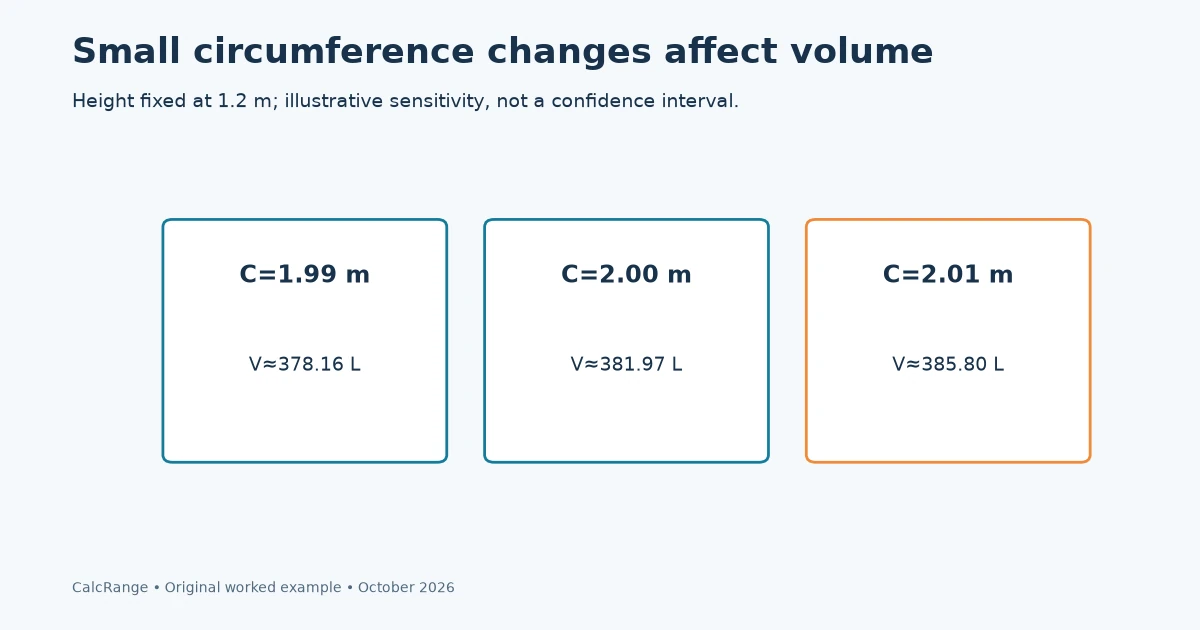
If a measurement is recorded as 2.00 m but you think the actual circumference could be between 1.99 and 2.01 m, calculate those endpoints with the same 1.2 m height. This is a sensitivity example, not a statistically established confidence interval.
At 1.99 m, the ideal volume is about 378.16 L. At 2.00 m it is 381.97 L. At 2.01 m it is about 385.80 L. The range shows how a small circumference difference propagates through the square in the formula.
Do not turn “about 382 L” into “381.971863 L capacity” merely because the calculator displays many digits. A precise calculation can be built on an approximate measurement. The last digits describe the arithmetic, not the reliability of the tape reading or the manufactured shape.
If height is also uncertain, vary it separately or state a combined range explicitly. Holding height fixed while changing circumference is useful for understanding one input, but it does not account for every uncertainty in a real container.
Check whether the cylinder model fits the object
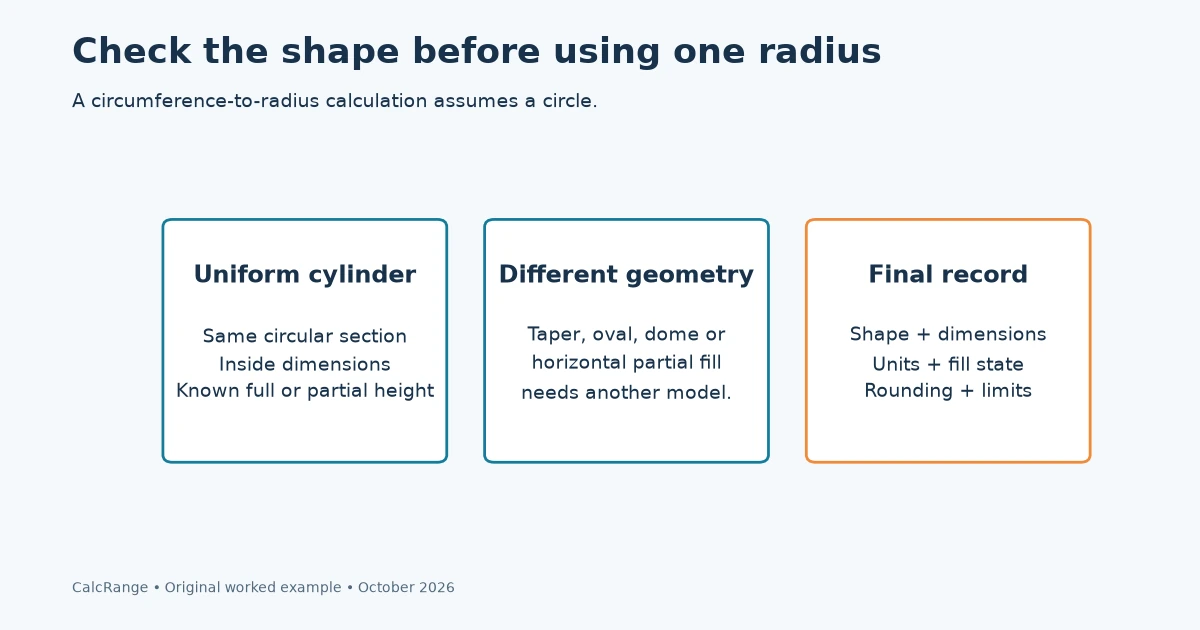
Measure around the same cross-section where the assumed radius applies. A tapered vessel can have different circumferences at different heights; applying one circumference to its entire height treats it as a shape it is not.
Check for a rounded base, a domed end, internal fittings or a fill line below the top. Each can separate gross geometric volume from usable capacity. This guide does not provide a structural or pressure rating, and a volume estimate does not establish that a vessel can safely hold a substance.
An oval cross-section is another important boundary. The circle relation C = 2πr does not establish a single circular radius for an ellipse. A circumference measurement alone should not be used to invent the missing shape dimensions.
For a vertical, flat-bottomed circular cylinder, replacing full height with an actual vertical liquid depth gives a partial volume under that geometry. A horizontal cylinder’s liquid depth does not work that way; its circular segment must be accounted for. The linked tank guide covers that distinction.
A good final note lists the inside dimensions, assumed shape, full or partial-fill state, units and rounding. That makes the estimate auditable and shows where a different measurement or formula would be needed.
Volume from circumference: common questions
Can I enter circumference directly in the Volume Calculator?
The Cylinder form uses radius and height. Divide circumference by 2π first, keep the same length unit, and enter the resulting radius.
Does the formula work for an oval cylinder?
No. Circumference alone does not determine an oval cross-section’s area. Use a shape model and dimensions appropriate to the actual object.
Is the result usable water capacity?
Only if the internal geometry and usable fill range match the assumptions. Freeboard, fittings and unfilled space can reduce capacity.
Sources and calculation notes
Formulas are standard geometry; the numeric examples and sensitivity comparison were independently recalculated. No measured object or guaranteed usable capacity is represented. Sources checked October 30, 2026.