
Baker’s percentages express each ingredient as a percentage of total flour weight. Flour is 100%, even though it is not 100% of the dough. This makes it possible to resize a formula without changing its ratios. The Recipe Scaler multiplies ingredient amounts by a serving factor; the worksheet below shows how to derive that factor from flour or total dough weight first.
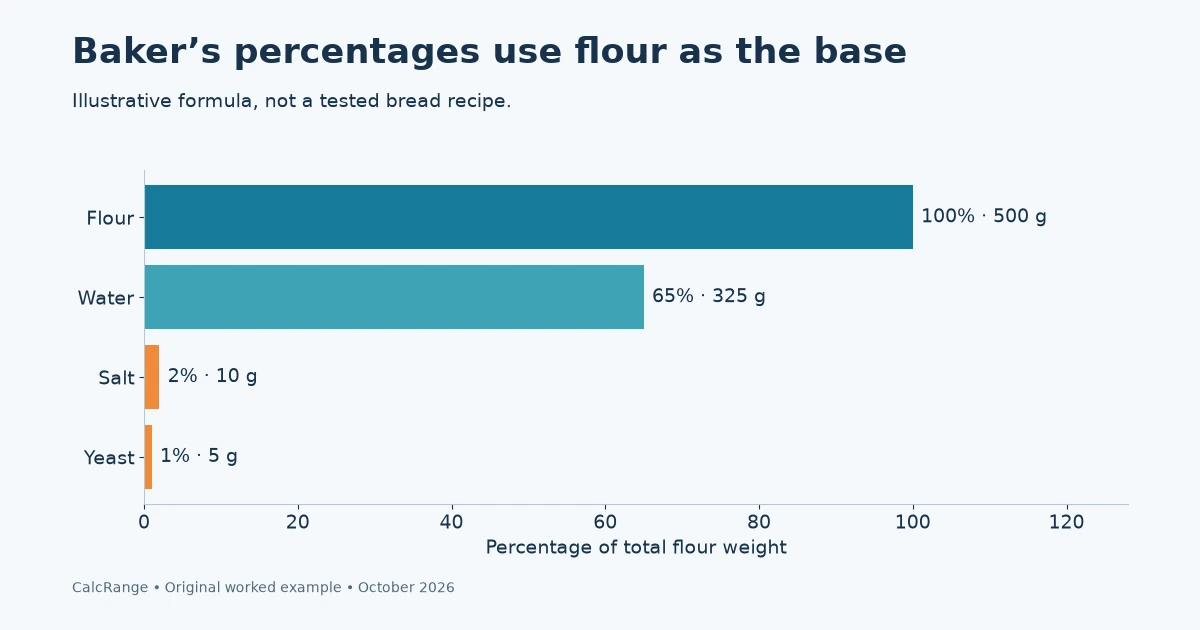
Table of Contents
Why baker’s percentages use flour as the base
King Arthur Baking’s professional reference defines the flour-based system. For each ingredient, divide its weight by total flour weight and multiply by 100. Keep all weights in the same unit.
Suppose an illustrative straight dough uses 500 g flour, 325 g water, 10 g salt and 5 g yeast. Water is 325 ÷ 500 × 100 = 65%; salt is 2%; yeast is 1%. These quantities are a calculation example, not a tested recipe or fermentation schedule.
| Ingredient | Weight | Baker’s percentage |
|---|---|---|
| Flour | 500 g | 100% |
| Water | 325 g | 65% |
| Salt | 10 g | 2% |
| Yeast | 5 g | 1% |
| Total | 840 g | 168% |
The percentages total 168%, which is expected. They share flour as the denominator; they are not shares of the total dough. If you instead divide 325 g water by 840 g dough, you get about 38.69%. That answers a different question.
Baker’s percentages for the flour you have
If you want to use 750 g flour instead of 500 g, the factor is 750 ÷ 500 = 1.5. Multiply every ingredient by that same factor to preserve this formula:
| Ingredient | Original | Factor | New weight |
|---|---|---|---|
| Flour | 500 g | 1.5 | 750 g |
| Water | 325 g | 1.5 | 487.5 g |
| Salt | 10 g | 1.5 | 15 g |
| Yeast | 5 g | 1.5 | 7.5 g |
| Total | 840 g | 1.5 | 1,260 g |
You can also calculate directly from the percentages: 750 × 0.65 = 487.5 g water. Checking one ingredient by both methods is a useful way to catch a mistaken denominator.
For mixed flours, add all flour weights before setting the 100% base. If a formula contains 400 g white flour and 100 g wholemeal flour, total flour is still 500 g. The two flour components are 80% and 20% of that base; each is not separately 100%.
Baker’s percentages for a target dough weight
To make 1,000 g of the illustrative 168% dough, first convert the total percentage to a multiplier: 168 ÷ 100 = 1.68. Flour required is target dough weight ÷ multiplier, so 1,000 ÷ 1.68 = approximately 595.2381 g.
| Ingredient | Calculation | Weight rounded to 2 decimals |
|---|---|---|
| Flour | 1,000 ÷ 1.68 | 595.24 g |
| Water | 595.2381 × 0.65 | 386.90 g |
| Salt | 595.2381 × 0.02 | 11.90 g |
| Yeast | 595.2381 × 0.01 | 5.95 g |
The rounded rows total 999.99 g because each display was rounded separately. That 0.01 g difference is a rounding artifact, not an instruction to adjust a real kitchen scale to hundredths of a gram. Retain full precision during the calculation and choose sensible weighing precision for the equipment and ingredient.
This target is mixed dough weight. It does not predict baked loaf weight, since the calculation contains no baking loss model. If a loaf tin or process specifies dough pieces of a certain weight, use that specification; do not equate a 1 kg dough piece with a guaranteed 1 kg finished loaf.
Enter a derived factor in the Recipe Scaler
For a 1.5 factor, enter original servings as 2 and target servings as 3, then enter the original ingredient weights. Those serving numbers are a convenient way to express the ratio, not a claim about how many portions the bread must provide. Alternatively, use the recipe’s real yield and multiply that yield by 1.5.
The scaler does not have a dedicated baker’s-percentage or target-dough field. Calculate the factor here first. For the 1,000 g target, the factor is 1,000 ÷ 840, approximately 1.19047619. Apply it consistently to the ingredient weights rather than entering 168 as a serving count.
Clear the kitchen-fraction option if you prefer the tool’s decimal display, which is rounded to two places. Check very small salt or yeast amounts against your scale’s resolution. The general recipe-scaling guide covers serving ratios; this worksheet uses a flour or dough-weight constraint instead.
Check what is inside the flour and water totals
A preferment or starter contains ingredients already. If your formula includes one, determine how much flour and water it contributes before claiming an overall flour base or hydration. Counting the starter as a single extra ingredient while also counting its flour again can double-count part of the recipe.
For example, an explicitly 100%-hydration starter containing only flour and water has equal weights of each: 200 g consists of 100 g flour plus 100 g water. That is an accounting example conditional on the stated composition, not a description of every starter.
Milk, eggs and other ingredients should not automatically be treated as pure water. This simple worksheet does not analyze their composition. Use a recipe author’s defined hydration convention if one is supplied.
Keeping ingredient ratios does not keep fermentation time, mixing capacity or baking time unchanged. Preserve the tested recipe’s process guidance and make changes deliberately. Avoid a blanket rule to reduce all yeast or leavening whenever a batch is enlarged. For a pan change, consult the pan-size guide, while remembering that its area comparison does not establish a bread’s fermentation schedule.
Baker’s percentages for a batch of loaves and rolls
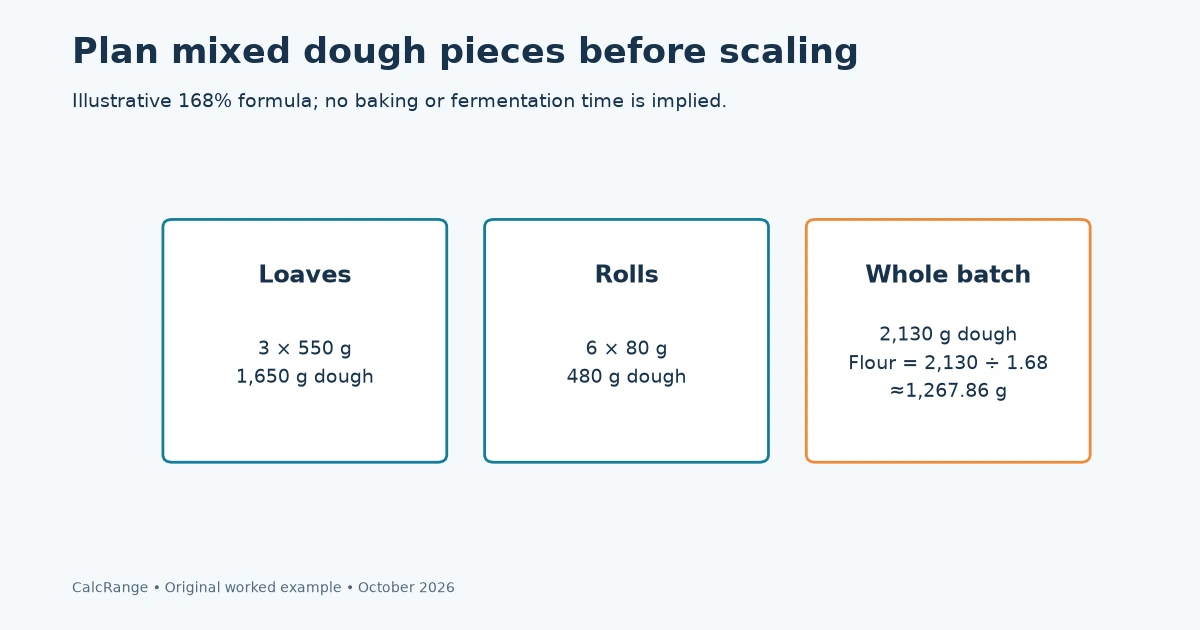
A target batch can contain several piece sizes. Add the desired dough weights first, then apply the formula once. Do not calculate separate flour totals using incompatible percentage bases.
Suppose a production note calls for three dough pieces of 550 g and six pieces of 80 g. The target mixed dough is 3 × 550 + 6 × 80 = 2,130 g. With the illustrative 168% formula, required flour is 2,130 ÷ 1.68 = 1,267.857142… g.
| Ingredient | Unrounded calculation | Rounded display |
|---|---|---|
| Flour | 2,130 ÷ 1.68 | 1,267.86 g |
| Water | Flour × 0.65 | 824.11 g |
| Salt | Flour × 0.02 | 25.36 g |
| Yeast | Flour × 0.01 | 12.68 g |
The rounded ingredient rows total 2,130.01 g. As in the smaller example, the display difference is a rounding artifact. Use a sensible weighing plan for the equipment rather than pretending that hundredths of a gram are necessary for every ingredient.
This batch plan assumes the desired pieces sum to the available dough. If some dough will remain on equipment, record a separate, justified process allowance. Do not disguise an arbitrary allowance by changing the hydration or salt percentage.
Account for a starter before adding new flour and water
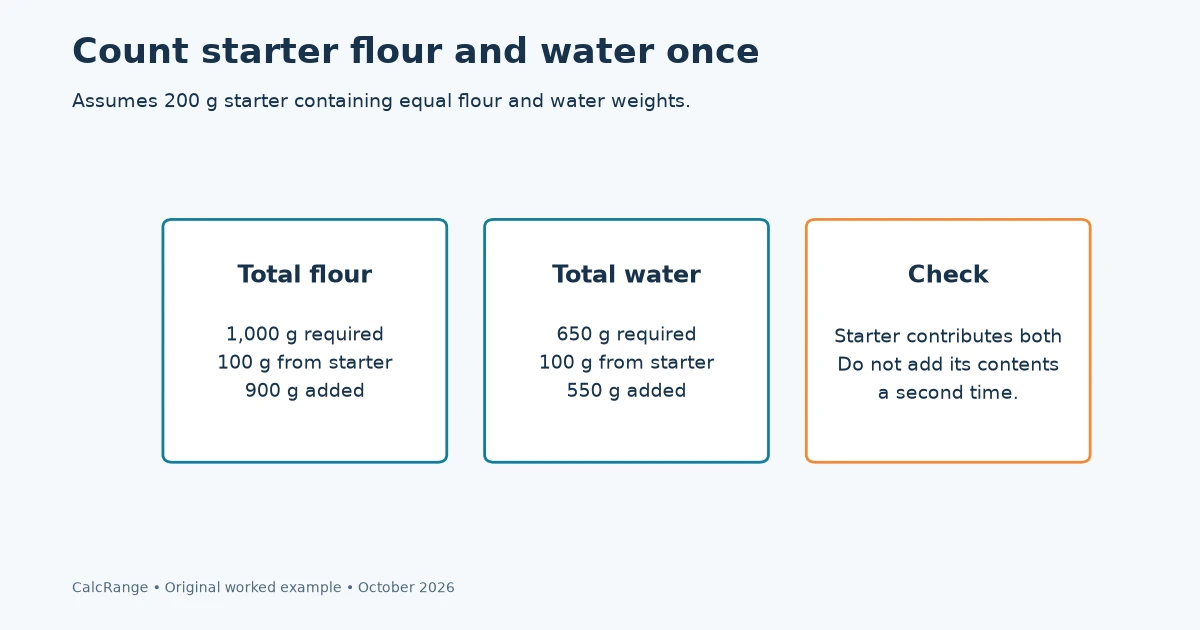
Consider another explicitly hypothetical formula with 1,000 g total flour and 65% total water. Suppose it includes 200 g of a starter known to contain equal weights of flour and water. That starter contributes 100 g flour and 100 g water.
The separate additions are therefore 900 g flour and 550 g water, because the desired totals are 1,000 g flour and 650 g water. Adding a further 1,000 g flour and 650 g water would count the starter’s contents on top of those totals.
| Component | From starter | Added separately | Total |
|---|---|---|---|
| Flour | 100 g | 900 g | 1,000 g |
| Water | 100 g | 550 g | 650 g |
Keep this accounting sheet separate from the serving-factor input. The Recipe Scaler can multiply an already specified ingredient list; it does not inspect the starter or discover its composition. A starter with a different hydration needs a different split.
When comparing two formulas, also check whether the author includes prefermented flour in the stated total. A number called “hydration” is only comparable when the flour and water boundaries are defined consistently.
Do not confuse mixed dough, divided dough and baked yield
Three weights can all be useful: mixed dough in the bowl, the pieces placed into pans, and finished bread after baking and cooling. They occur at different stages. Baker’s percentages describe ingredient ratios; they do not by themselves predict the loss between those stages.
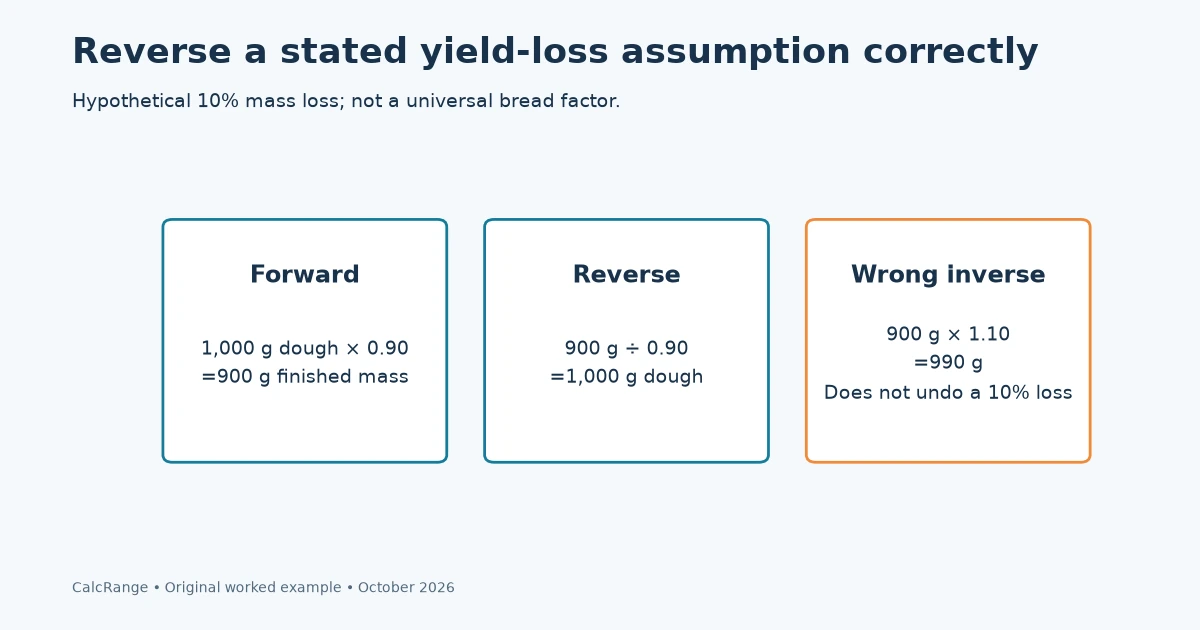
If a process record explicitly assumes a 10% mass loss from a 1,000 g dough piece, the arithmetic finished mass would be 1,000 × 0.90 = 900 g. Working backward from that same assumed 900 g finished mass gives 900 ÷ 0.90 = 1,000 g dough. Adding 10% to 900 gives 990 g and does not invert the calculation.
The 10% figure is only a worked assumption. It is not a recommended baking-loss factor for every loaf. Use measured records from the relevant recipe and process if finished-weight planning is necessary.
Before scaling, write down the quantity you are trying to control: flour available, mixed dough required, piece weights or finished yield. This one line determines the denominator and prevents a correct-looking factor from answering the wrong question.
Baker’s percentages: common questions
Why can baker’s percentages exceed 100%?
Every ingredient is compared with flour weight, not total dough weight. Flour already contributes 100%, and water and other ingredients add further percentages.
Does 65% water mean 65% of the dough is water?
No. In baker’s percentages, it means 65 g water per 100 g total flour. Water’s share of the complete dough uses a different denominator.
Will doubling the formula double proofing time?
The percentage calculation does not predict time. Follow the recipe’s fermentation and baking guidance and account for equipment and dough conditions.
Sources and calculation notes
Ingredient amounts and target-weight examples are original illustrative arithmetic, not a tested bread recipe. No baking-time or food-storage claim is inferred from the scaling factor. Sources checked October 30, 2026.