
Consistent body weight measurements start with a repeatable setup: the same suitable scale, a stable surface, comparable timing and clear units. This makes records easier to interpret, but it does not turn a scale reading into an “ideal” weight. The Ideal Weight Calculator compares educational formulas; it cannot decide a uniquely correct weight for an individual.
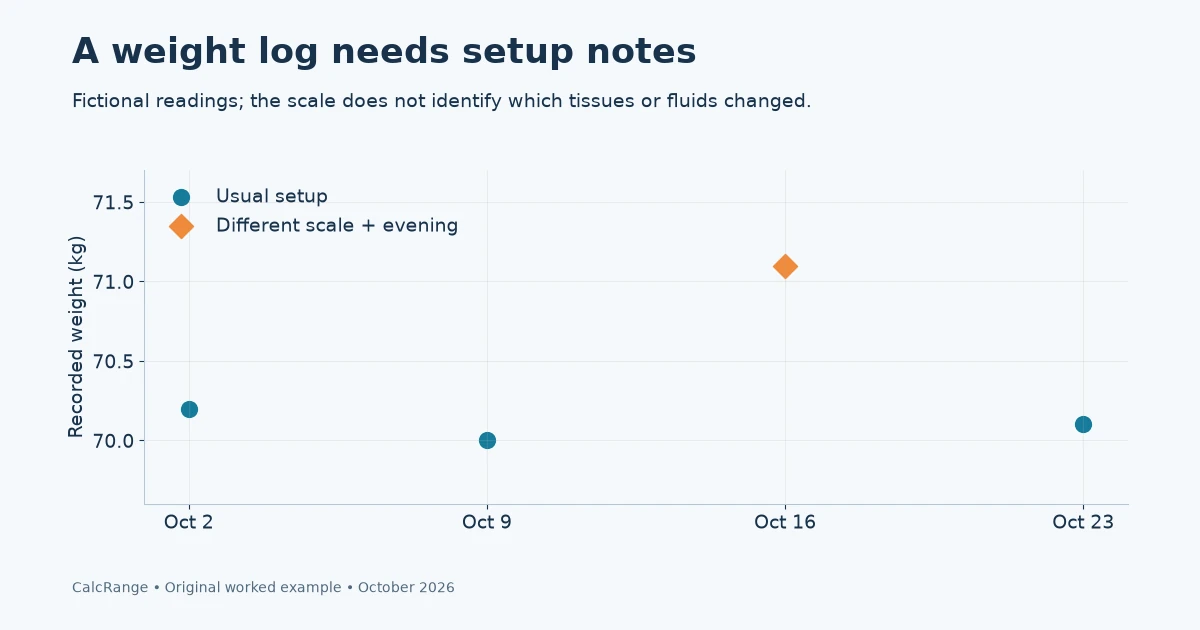
Table of Contents
Use a repeatable setup for body weight measurements
NHS England’s recording guidance recommends a consistent time, preferably morning, the same scales and location, and similar light clothing. Follow the scale manufacturer’s placement instructions and any monitoring schedule supplied by your healthcare team.
For a household log, record the setup once and note exceptions. This is more useful than assuming every reading was taken under identical conditions.
| Field | Example entry |
|---|---|
| Scale | Same household scale; model recorded privately |
| Location | Same firm, level surface |
| Timing | Chosen morning routine |
| Clothing | Similar light clothing; no shoes |
| Units | Kilograms |
| Frequency | Chosen schedule or clinician’s instructions |
The schedule matters less to this worksheet than consistency and an appropriate reason for monitoring. More frequent weighing is not automatically more useful. If weighing is distressing or part of a medical plan, agree a suitable method with the relevant professional.
Preserve body weight measurements and their context
Use a short table rather than relying on memory. Keep the original value and unit; if you later convert it, store the conversion in a separate column.
| Date | Reading | Setup note | Comparable with usual record? |
|---|---|---|---|
| October 2 | 70.2 kg | Usual setup | Yes, subject to ordinary variation |
| October 9 | 70.0 kg | Usual setup | Yes |
| October 16 | 71.1 kg | Different scale; evening | Flag as a different setup |
| October 23 | 70.1 kg | Usual setup | Yes |
This invented sequence is a record-keeping demonstration, not evidence of fat gain or loss. The different-scale reading should remain visible with its note. Deleting it silently removes information; treating it as directly equivalent can also mislead.
The three usual-setup readings average (70.2 + 70.0 + 70.1) ÷ 3 = 70.1 kg. If you calculate this summary, state which readings it includes and why. Do not choose only the smallest values to manufacture a preferred trend.
Check units before comparing body weight measurements
A display in kilograms and a display in pounds can look dramatically different while describing the same mass. The exact conversion is 1 lb = 0.45359237 kg. Thus 70 kg is approximately 154.32 lb.
Use the Unit Converter if needed, and retain the source unit. A rounded 154 lb conversion will not return exactly 70.000 kg; that is ordinary rounding.
A scale displaying one decimal place has a display resolution of 0.1 kg. That fact alone does not establish its measurement accuracy. Avoid reporting three decimal places after conversion when the original scale gave only one.
Check that a stone-and-pounds entry has not been read as decimal stones. For example, 11 stone 2 pounds is 156 pounds, not 11.2 × 14 = 156.8 pounds. Write both components explicitly.
Compare with formulas without turning them into goals
The current Ideal Weight Calculator takes height and other context to show formula comparisons. Its current-weight field helps place an observed number beside those estimates; it does not validate the scale or establish a treatment goal.
Keep three labels distinct: measured weight, formula estimate, and an individually agreed goal. A worksheet can display all three, but they come from different sources and should not be merged into one supposedly authoritative number.
For example, record “measured 70.1 kg under the usual setup” separately from “formula result using height 175 cm.” If you change the height input or formula selection, the comparison changes even when the scale reading does not.
Our range-versus-point-estimate guide explains those outputs. The weight-by-height guide distinguishes descriptive averages from screening references.
What body weight measurements cannot establish
A scale measures total mass under its operating conditions. It does not separately identify fat, muscle, fluid or the reason for a change. A precisely recorded number is still not a diagnosis.
When a result differs unexpectedly, first check the scale’s position, unit selection and setup record. Do not assume a new reading demonstrates a particular tissue change or requires an immediate diet adjustment.
Medical monitoring can have specific instructions that differ from a general household routine. If you are following such a plan, use its timing, thresholds and contact advice rather than substituting this illustrative log.
The practical aim is a trustworthy input record: what was measured, when, with which units and under what conditions. That makes a later conversation or formula comparison clearer without assigning clinical meaning that the scale cannot supply.
Keep the original unit when exporting a record
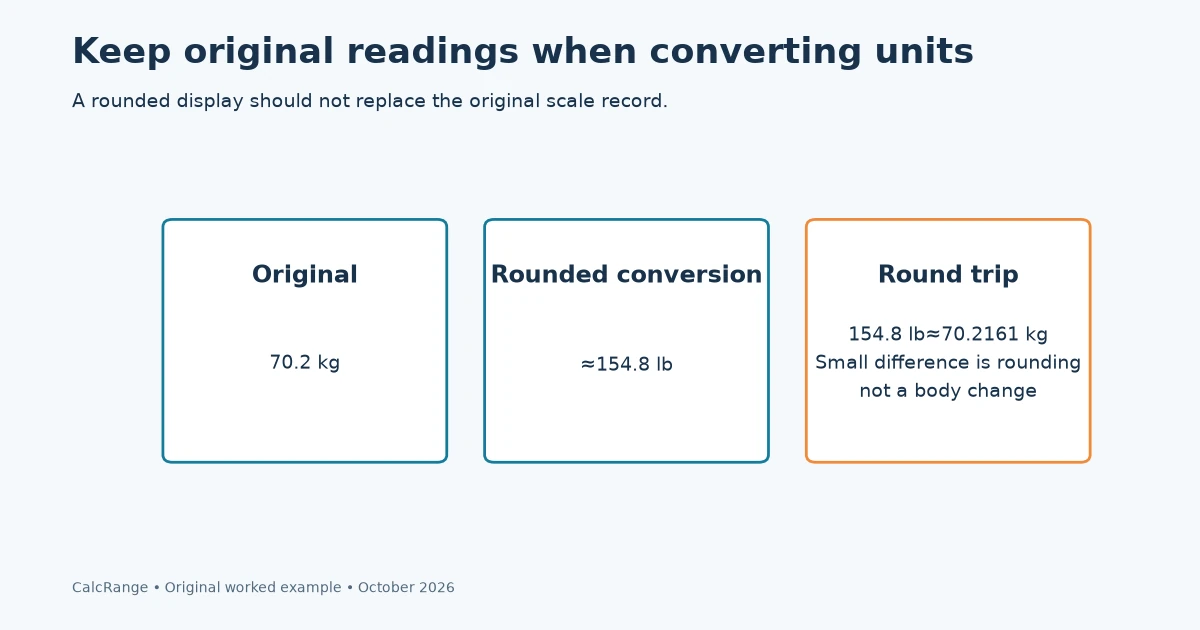
A unit conversion is best treated as an added column, not a replacement for the original reading. For example, 70.2 kg converts to approximately 154.7645 lb. Displaying 154.8 lb is a presentation choice; it should not overwrite the original 70.2 kg entry.
If you later convert the rounded 154.8 lb back to kilograms, it becomes about 70.2161 kg. The small difference comes from display rounding. It does not indicate that the scale changed or that body mass increased between exports.
| Original reading | Conversion calculation | Rounded display |
|---|---|---|
| 70.2 kg | 70.2 ÷ 0.45359237 | 154.8 lb |
| 154.8 lb, rounded text | 154.8 × 0.45359237 | 70.2161 kg before rounding |
When importing a spreadsheet, check whether the unit applies to the whole column or is stored with each row. A sheet containing both kilograms and pounds in one unlabeled numeric column can produce an apparently dramatic trend that is only a data error.
Keep the date format explicit too. A value recorded on March 4 can be confused with April 3 when a file changes regional settings. Date and unit errors should be resolved before discussing the biological meaning of a trend.
Treat a new scale or location as a documented change
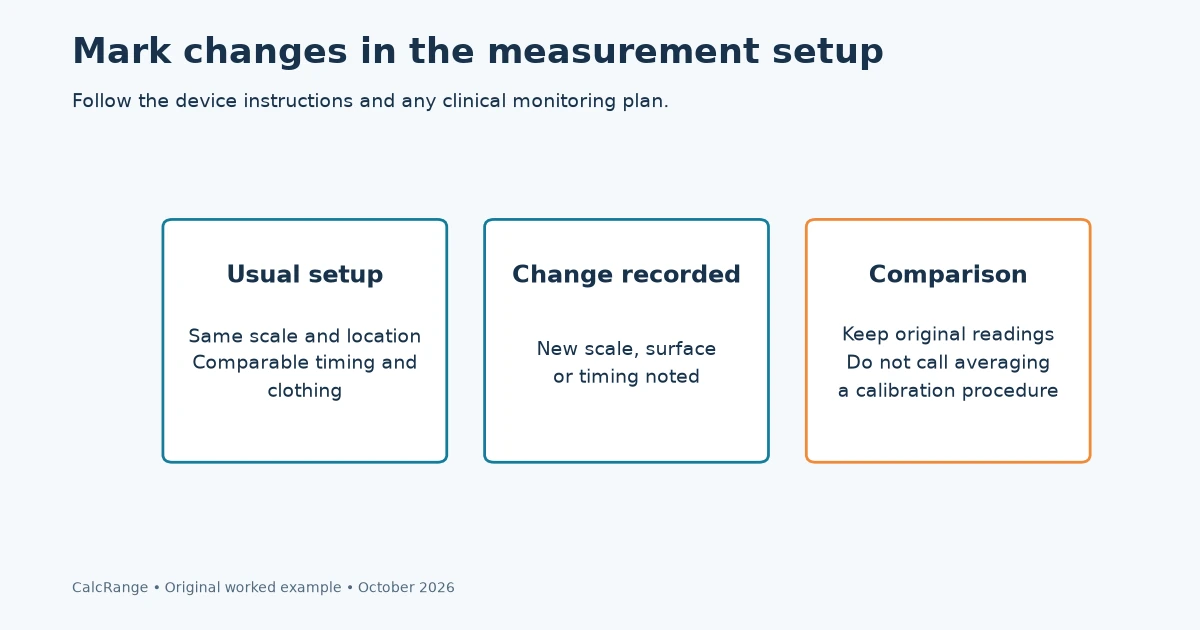
Moving a scale to a different surface or changing devices introduces a new setup. Follow the device instructions, then record when the change occurred. Do not join the old and new values without a note that the measurement conditions changed.
If two devices disagree, this worksheet cannot identify which is accurate from the difference alone. Check their instructions, condition and suitable verification options. Averaging the two readings is not a calibration procedure.
A simple equipment note can include the scale identifier you use privately, the location and the date of replacement. It does not need a photograph containing identifying personal information.
If the setup cannot be kept identical, describe what changed and keep the reading rather than pretending the record is uniform. For example, a travel-day measurement might remain useful as a labelled observation while being unsuitable for a direct comparison with the usual household setup.
Clinical weighing instructions may specify particular equipment or circumstances. Follow those instructions instead of using a general comparison log to override them.
Summarize body weight measurements with their conditions
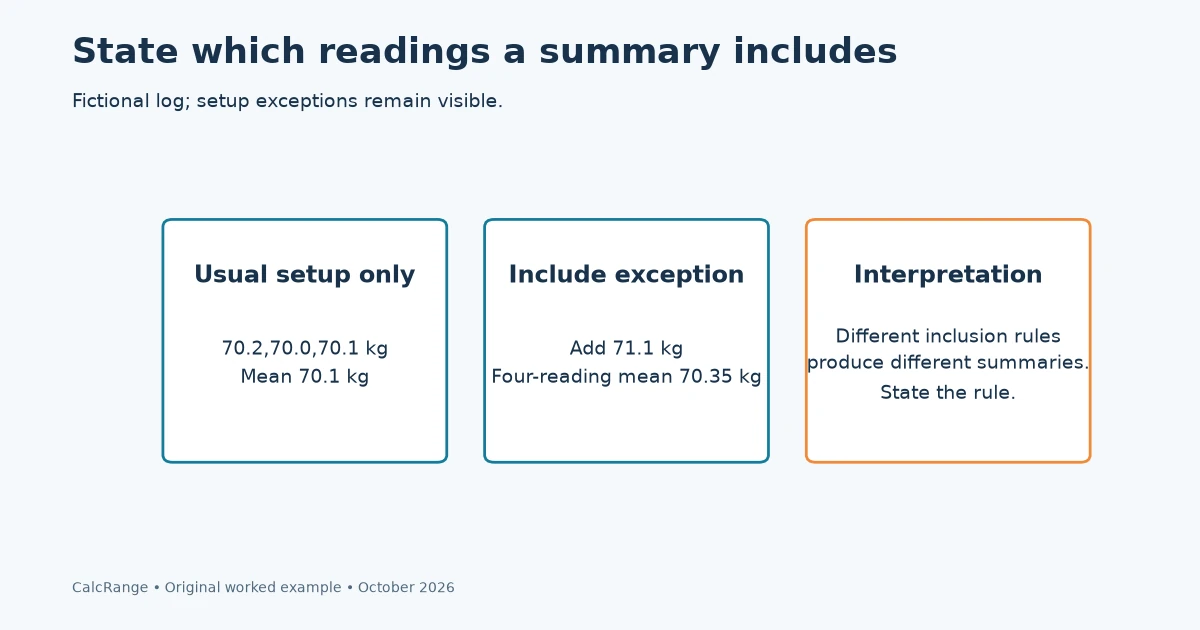
For the three usual-setup fictional readings, 70.2, 70.0 and 70.1 kg, the mean is 70.1 kg and the median is also 70.1 kg. Their range is 0.2 kg. These are descriptions of the recorded values, not a clinically meaningful variability threshold.
If the different-setup 71.1 kg value is included, the four-reading mean becomes 70.35 kg. That calculation is mathematically valid, but its interpretation must acknowledge the mixed setup. Do not compare it with a summary that quietly excluded the same kind of exception.
State the inclusion rule before looking for a preferred result. A note such as “mean of three readings under the usual setup; one travel-scale reading listed separately” lets another person understand the choice.
A single summary cannot preserve every detail. Keep the dated rows available, especially if a healthcare professional is reviewing a pattern. A chart should show a flagged reading as flagged, rather than remove it merely because it disrupts a line.
The calculator comparison is the final, separate step. Use a verified input record, identify the selected formula and keep any individual healthcare goal distinct from both the measured values and the formula output.
Body weight measurements: common questions
Should I use a different scale to confirm every reading?
A different scale introduces another measurement setup. Follow the device instructions and your healthcare team’s advice; keep routine comparisons identifiable by scale.
Does a small overnight change prove fat gain?
No. A total-weight reading does not identify which components changed or establish a cause.
Is the lowest formula result my ideal target?
No. Formula outputs are educational estimates, not a uniquely correct individual target. Keep them separate from any goal agreed with a healthcare professional.
Sources and calculation notes
The dated log and arithmetic are original fictional examples. This guide standardizes record keeping; it does not prescribe a weighing frequency or a personal weight target. Sources checked October 30, 2026.