
A weekly calorie average is the total recorded calories divided by the number of days represented. For a complete seven-day record, divide by seven. If a day is missing, dividing the known total by seven treats that missing day as zero and understates the recorded-day average. The Calorie Calculator estimates energy needs from personal inputs; it does not import or validate a food diary.
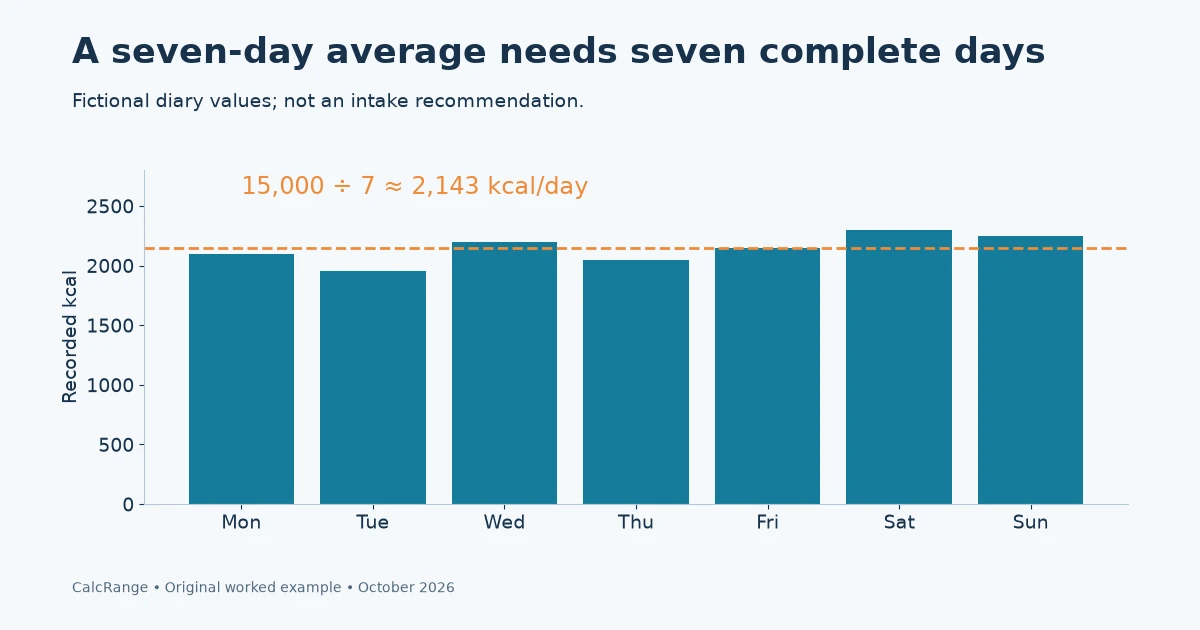
Table of Contents
Calculate a complete weekly calorie average
Here is an original arithmetic example using fictional daily totals. The numbers are not recommended intake levels, a meal plan or a record from a real person.
| Day | Recorded kcal |
|---|---|
| Monday | 2,100 |
| Tuesday | 1,950 |
| Wednesday | 2,200 |
| Thursday | 2,050 |
| Friday | 2,150 |
| Saturday | 2,300 |
| Sunday | 2,250 |
| Total | 15,000 |
Divide 15,000 by 7 to obtain approximately 2,142.86 kcal per day. Reporting this as about 2,143 kcal/day is enough to communicate the arithmetic; it does not make the diary accurate to the nearest calorie.
Use the same unit for every row. On common nutrition labels, Calories refer to kilocalories. If a source lists kilojoules, convert them before adding them to a kcal column. Do not add a kJ figure directly to a kcal total.
The average describes the recorded week. It does not say what happened on a typical workday, establish an energy requirement or predict a precise weight change.
Calorie average check: keep a missing day visibly missing
Suppose Wednesday’s 2,200 kcal entry was never recorded. The other six entries total 12,800 kcal. Their mean is 12,800 ÷ 6 = approximately 2,133.33 kcal/day across six recorded days.
| Calculation | Result | Correct description |
|---|---|---|
| 12,800 ÷ 6 | 2,133.33 kcal/day | Mean of six recorded days |
| 12,800 ÷ 7 | 1,828.57 kcal/day | Incorrect full-week mean if the missing day was not zero |
| (12,800 + missing-day total) ÷ 7 | Unknown until the entry is supplied | Complete seven-day mean |
Use “missing” or a blank field rather than zero when the information is unknown. A partial day is also incomplete: breakfast alone is not a daily total.
If you later reconstruct an entry from receipts or notes, label it estimated and preserve its basis. Do not insert the other six days’ average merely to make the spreadsheet look complete without stating the assumption.
Check the entries before interpreting a calorie average
NIDDK’s portion guidance discusses recording foods and beverages and paying attention to portion size. For this worksheet, the practical task is making the inputs consistent, not pursuing perfect tracking.
- Check whether each label value is per serving, per package or per 100 g.
- Use the amount actually recorded as eaten, not automatically the whole container.
- Keep raw, cooked and prepared-food entries on their stated basis.
- Check that a meal imported from another app was not entered twice.
- Flag incomplete days instead of converting them into zeros.
An accurate division cannot correct a mistaken serving multiplier. If a food is listed at 200 kcal per serving and the recorded amount is 1.5 servings, its contribution is 300 kcal. Entering 200 changes the diary before the weekly calculation starts.
Keep short notes on unusually uncertain entries. A restaurant estimate and a weighed packaged portion may have different uncertainty, even when both display whole numbers.
Compare calorie averages without losing the daily pattern
If one week includes seven days and another only four workdays, label them differently. A direct difference between those averages may partly reflect which days were recorded.
For a seven-day moving average, each new day replaces the oldest day. That is different from a calendar-week average, which resets at a chosen weekly boundary. Write which convention you use and keep it consistent.
The example’s five weekdays total 10,450 kcal, giving 2,090 kcal/day. Its two weekend days total 4,550 kcal, giving 2,275 kcal/day. The complete-week mean correctly weights five weekdays and two weekend days.
Averaging those two subgroup means equally gives 2,182.5, which is not the full-week mean. The unequal group sizes require weighting: (2,090 × 5 + 2,275 × 2) ÷ 7 = 2,142.86.
Keep an observed calorie average separate from a target
A food diary and an energy-needs equation answer different questions. One summarizes recorded intake; the other predicts a requirement from assumptions about the person and activity. A gap between them does not by itself prove a precise energy deficit.
Do not “repay” a higher day by skipping meals to hit this example’s average. The worksheet is descriptive arithmetic. If tracking creates distress or you need a medical nutrition plan, discuss an appropriate approach with a qualified professional.
The guide to calorie estimates concerns the planning side. The Protein Calculator addresses a separate nutrient estimate; neither tool verifies the diary’s completeness.
A useful final line is “15,000 recorded kcal across seven complete days, mean 2,143 kcal/day.” It states the numerator, denominator and coverage so the result can be checked without implying more certainty than the record supports.
Combine two periods with different numbers of recorded days
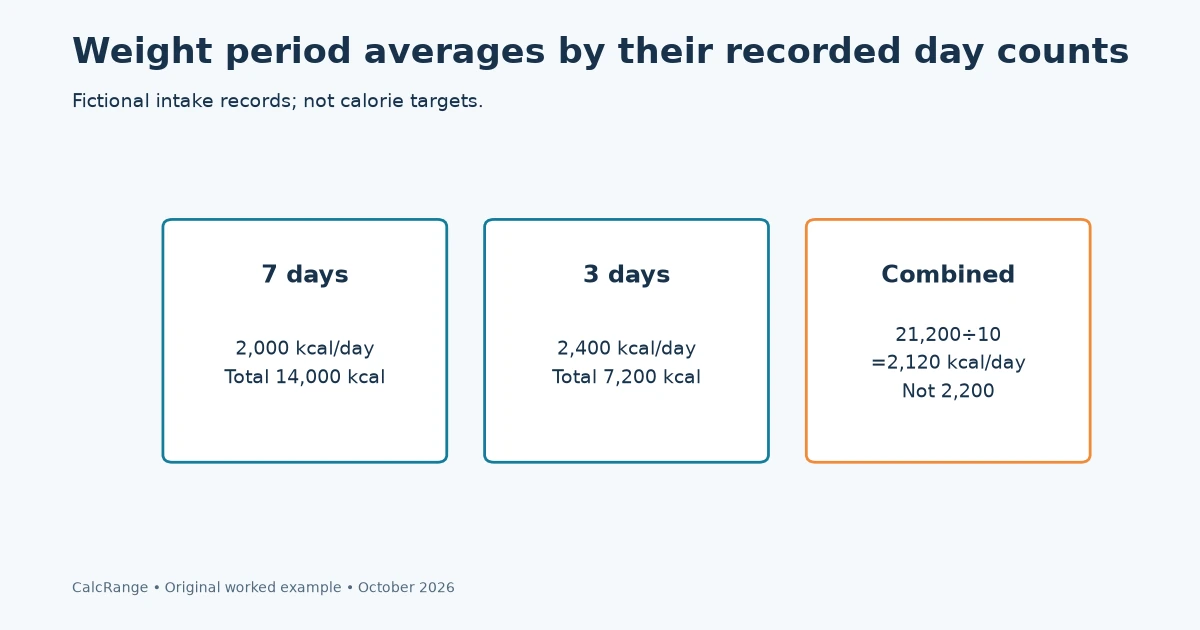
Suppose one complete seven-day record averages 2,000 kcal/day and a separate three-day record averages 2,400 kcal/day. Their combined recorded intake is 7 × 2,000 + 3 × 2,400 = 21,200 kcal across ten recorded days.
The combined recorded-day mean is 21,200 ÷ 10 = 2,120 kcal/day. Averaging 2,000 and 2,400 equally gives 2,200 and incorrectly treats the three-day period as large as the seven-day period.
| Period | Recorded days | Mean | Implied total |
|---|---|---|---|
| A | 7 | 2,000 kcal/day | 14,000 kcal |
| B | 3 | 2,400 kcal/day | 7,200 kcal |
| Combined | 10 | 2,120 kcal/day | 21,200 kcal |
This remains a ten-recorded-day summary, not necessarily the mean of a continuous ten-day interval. If the three-day record came from a later month or omitted several days, say so.
Use the count of actual complete observations as the weight. A period label such as “week two” does not prove that seven daily entries are present. The denominator needs to match the records, not the heading.
Calculate one step of a seven-day moving average
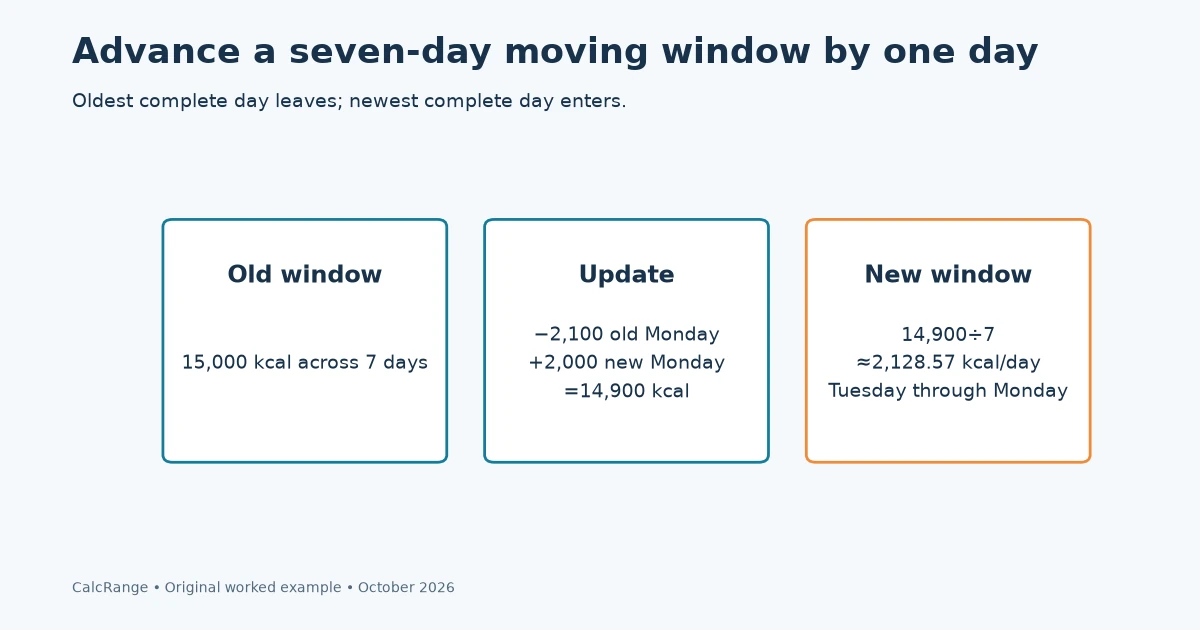
Start with the complete 15,000 kcal example. Suppose the next Monday is recorded as 2,000 kcal. A seven-day moving total drops the oldest Monday’s 2,100 and adds the new Monday’s 2,000: 15,000 − 2,100 + 2,000 = 14,900 kcal.
The new moving average is 14,900 ÷ 7, approximately 2,128.57 kcal/day. It covers Tuesday through the following Monday, whereas the original calendar-week average covered Monday through Sunday.
A moving average can make a plotted record smoother, but it does not create new independent observations. Consecutive seven-day windows share six days. Avoid treating every small daily movement in that smoothed line as a separate physiological event.
If any day inside the window is incomplete, mark that window incomplete or clearly describe a recorded-day calculation. Do not keep the label “seven-day average” while silently dividing six known entries by seven.
Save the window’s start and end dates with the result. This prevents two people from comparing different sets of days while assuming that “this week” has the same meaning.
Keep a correction log when an input changes
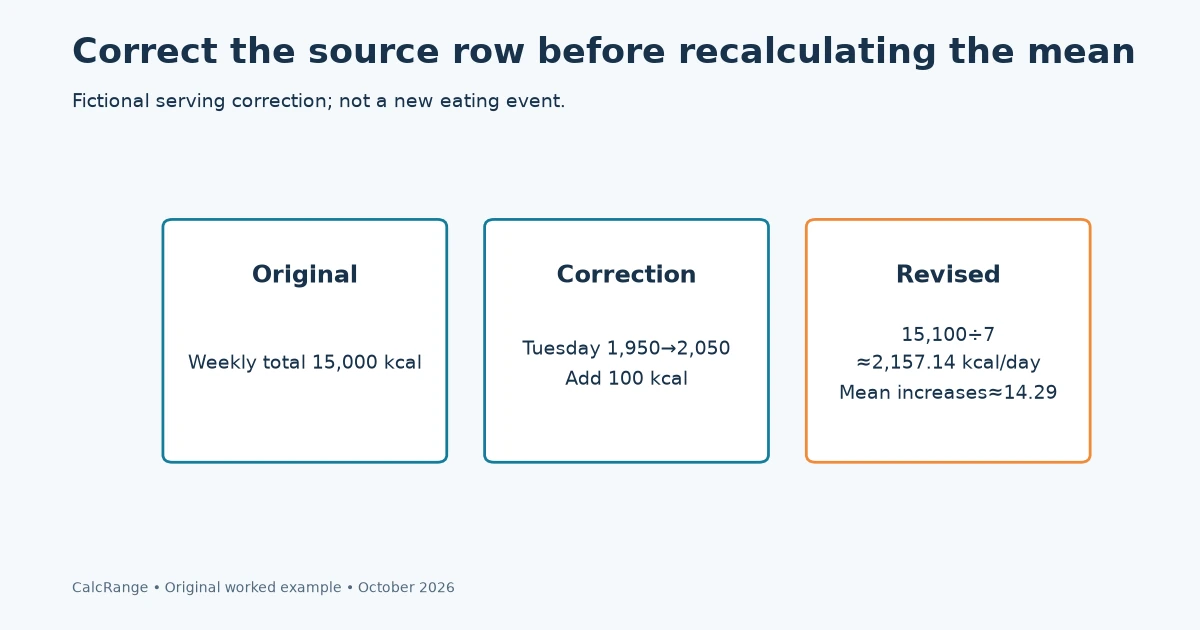
Suppose a serving check finds that Tuesday’s fictional total should have been 2,050 rather than 1,950 kcal. The correction adds 100 kcal to the weekly total, producing 15,100 kcal and a mean of approximately 2,157.14 kcal/day.
The mean changes by 100 ÷ 7, approximately 14.29 kcal/day. This is a corrected record, not a new eating event. Keep the original entry, revised entry and reason together if the record is being reviewed later.
Common arithmetic corrections include a duplicated meal, the wrong number of servings and a package-versus-serving value. Correct the source row first and recompute the total; do not manually change the final average while leaving the diary inconsistent.
If an amount cannot be reconstructed reliably, label it uncertain. A narrower-looking number is not necessarily a better estimate. The aim is an honest record, not a perfectly smooth graph.
Finish by reporting coverage and method: calendar week or moving window, complete days represented, total recorded kcal and rounding. That makes the weekly calorie average checkable without converting it into a weight-loss promise or a rule to compensate for a previous day.
Calorie average questions
Should a missing day count as zero?
No. Keep it missing. Report the mean of the recorded complete days with its day count, or wait until a defensible entry is available.
Can I average weekday and weekend averages equally?
Only if the groups contain the same number of days. Otherwise weight each subgroup mean by its number of days.
Is my weekly average my maintenance calorie requirement?
No. It summarizes recorded intake and does not directly measure energy expenditure or establish an individual target.
Sources and calculation notes
All daily values are fictional arithmetic inputs. The article does not prescribe restriction, a calorie goal or a compensatory eating pattern. Sources checked October 30, 2026.