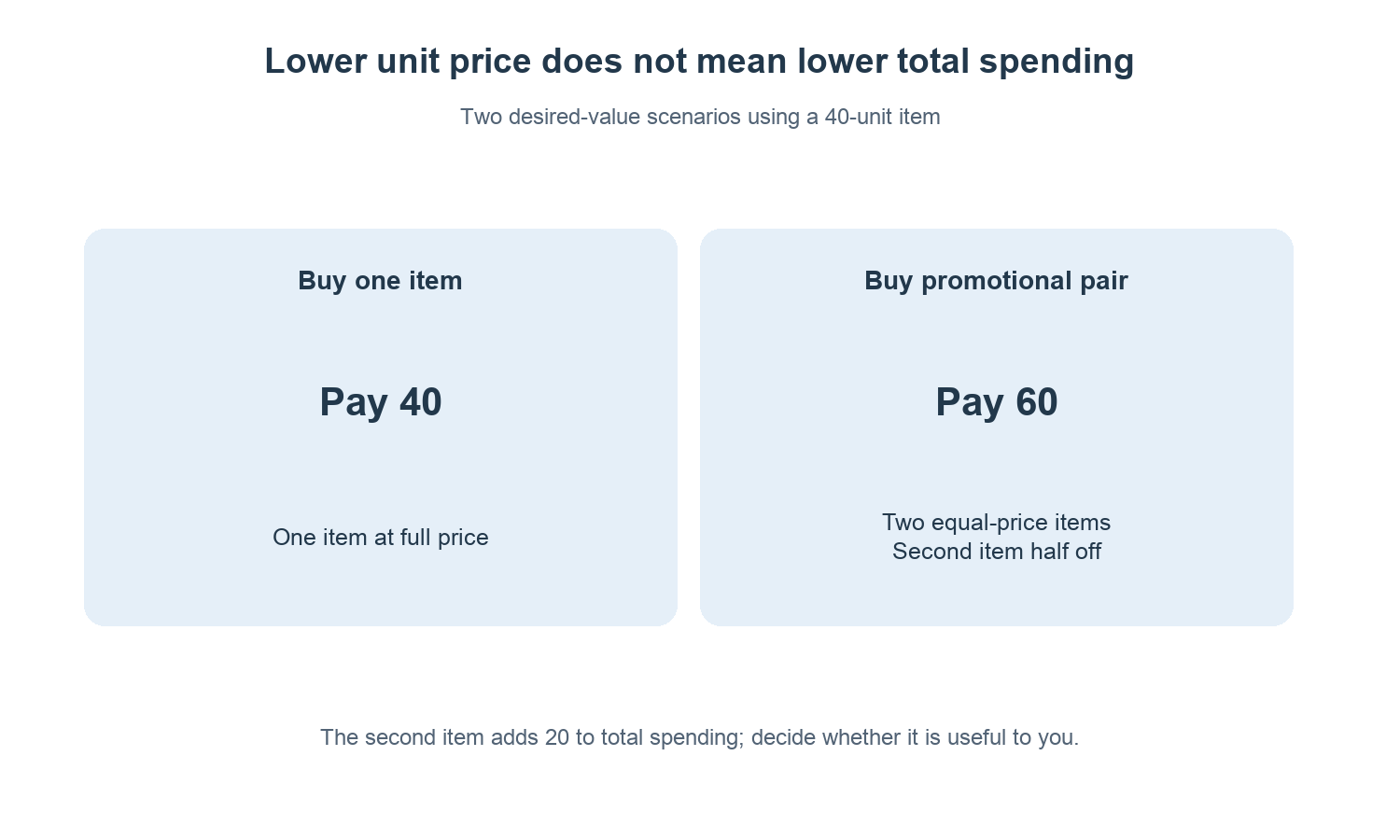
A buy one, get one half off deal, called a half-off deal here, gives a 25% discount across two equally priced items, assuming one is full price and the other is half price. If each item normally costs 40, you pay 40 +20 =60 instead of 80. The saving is 20 ÷80 ×100 =25%.
When the prices differ, the overall percentage depends on which item gets the discount. A half-off deal often discounts the cheaper eligible item, but the retailer’s actual terms decide that. This guide treats that rule as an explicit example, not a promise about every offer.
Use the discount calculator to find the discounted item’s price, then compare the total basket against its undiscounted total. Do not enter 50% against the whole basket unless the offer really discounts every item by 50%.
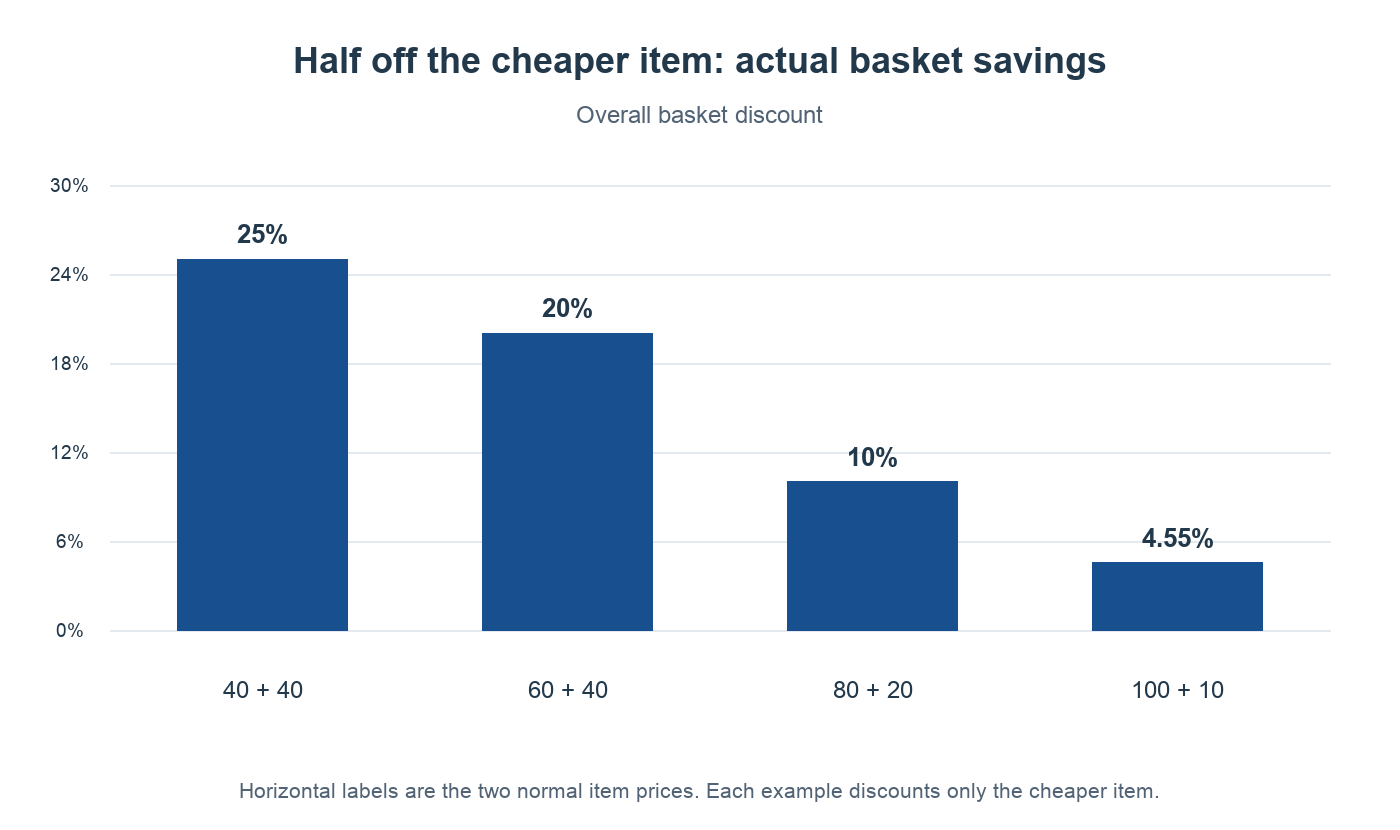
Table of Contents
The half-off deal calculation
Start with the eligible items’ normal prices. Add them to find the reference basket total. Next, calculate the discount on the item to which the offer applies. Subtract that saving from the reference total.
Basket discount (%) = total saving ÷ undiscounted basket total ×100.
For two items with prices A and B, where B is the discounted item, the half-off deal saves 0.5 ×B. The basket percentage is therefore 0.5 ×B ÷ (A +B) ×100. This formula works only when those are the actual prices and the offer has no additional restrictions affecting the calculation.
If the retailer shows a changed “original” price, first establish what comparison you want to make. A mathematically correct percentage against an inflated or unfamiliar reference price does not prove that the purchase is a good deal.
A half-off deal on equal-price items: the 25% case
| Item | Normal price | Amount paid | Saving |
|---|---|---|---|
| First item | 40 | 40 | 0 |
| Second item | 40 | 20 | 20 |
| Total | 80 | 60 | 20 |
The saving is 20 out of an 80-unit basket, or 25%. The average amount paid per item is 30. That average is useful when the items are identical, but it does not mean the retailer has priced each line at 30; the receipt may show 40 on one and 20 on the other.
A straight 25% discount on both 40-unit items also produces a 60-unit total. The two offers are mathematically equivalent in this particular case. Returns, eligibility restrictions and other terms can still differ.
Different prices produce a smaller basket percentage
Suppose the first item costs 60 and the second costs 40. Under a cheaper-item-half-off rule, the second item is reduced to 20. You pay 80 instead of 100. The actual basket discount is 20%, not 25% or 50%.
| Normal prices | Saving | Basket paid | Overall discount |
|---|---|---|---|
| 40 +40 | 20 | 60 | 25% |
| 60 +40 | 20 | 80 | 20% |
| 80 +20 | 10 | 90 | 10% |
| 100 +10 | 5 | 105 | 4.55% |
The larger the gap between the two prices, the smaller the half-price item is relative to the whole purchase. For two positive prices where only the cheaper item is half off,25% is the largest possible overall discount. It occurs when the prices are equal.
This also explains why “save up to 25% across the pair” and “second item 50% off” can describe the same arithmetic while emphasizing different numbers. Read the eligibility and pairing terms rather than assuming the largest printed percentage applies to everything.
Compare a half-off deal using the same basket
Return to the 60-and 40 pair. A blanket 25% off both items would cost 75. The half-off deal costs 80. The blanket offer is 5 cheaper for that exact pair.
For two 40-unit items, both offers cost 60. Neither comparison tells you what happens if one item is excluded, a loyalty membership is required, delivery charges differ, or a coupon cannot be combined with the promotion. Add those costs only when they apply, and label them separately.
If packs have different quantities, compare the final price per unit as well. Our unit-price comparison guide explains why a bigger headline discount can still leave a higher price per gram, litre or item.
A half-off deal may limit the number of eligible pairs
Read the quantity limit before extending a two-item calculation to a larger basket. Suppose four eligible items each cost 50. If the offer applies to two pairs, each pair saves 25, so the four-item basket costs 200 − 50 = 150.
If the stated promotion permits only one discounted pair, the same basket saves 25 and costs 175. That is a 12.5% saving across all four items, even though the one eligible pair still receives a 25% reduction. The limit changes which lines qualify; it does not change the price calculation within that pair.
Keep the item’s eligibility, pair allocation and promotion limit as separate columns when checking a receipt. A product can belong to the promotion but remain full price because the allowed number of discounted items has already been reached. The actual terms and checkout allocation determine whether that explanation applies.
Check the purchase, not just the percentage
- Need: would you otherwise buy both items? Buying a second item you will not use increases spending even when its price is reduced.
- Reference: are the normal prices genuine prices you would consider paying?
- Eligibility: are both sizes, colours or brands included?
- Pairing: which item receives the reduction when prices differ?
- Additional costs: have delivery, mandatory fees and applicable taxes been handled consistently?
- Returns: how does returning one item affect the promotion?
Taxes and coupon order can require a separate calculation under the merchant’s terms and local rules. Do not add a second discount percentage directly to the first; see our stacked-discount guide for sequential reductions.
To check your pair, calculate half of the discounted item’s normal price, subtract that saving from the basket total, then divide the saving by that original total. The discount calculator helps with the item calculation; your receipt and the offer’s terms determine which item belongs in it.
Mathematical reference: OpenStax, percent applications. All basket examples are fictional and independently calculated; no retailer’s current offer is being advertised.
A half-off deal with four differently priced items
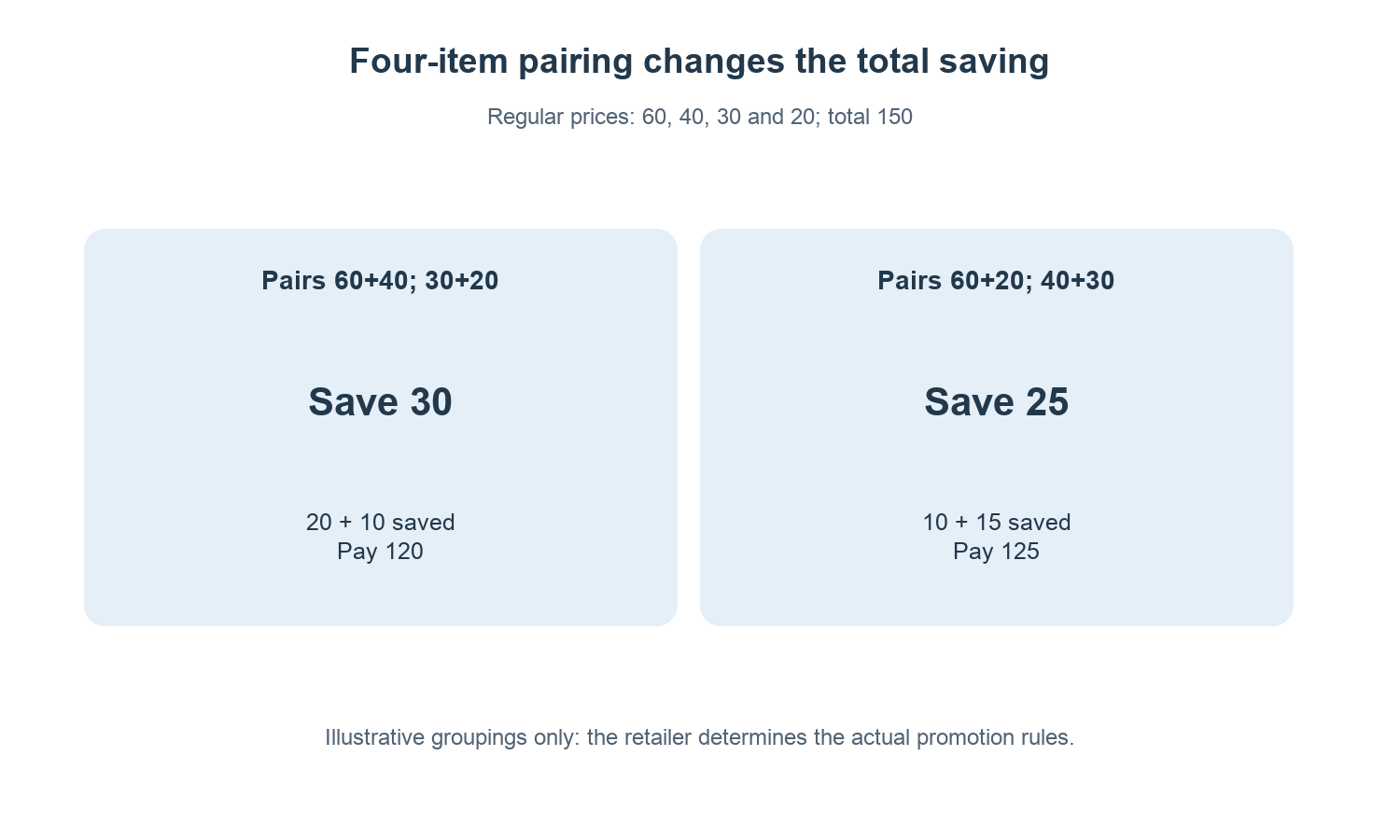
The retailer’s pairing rule matters when more than two items qualify. Consider four regular prices: 60, 40, 30 and 20. Their combined undiscounted price is 150. Assume half off the cheaper item in each eligible pair, with no other charges.
| Stated pairing | Discounts | Total saving | Amount paid |
|---|---|---|---|
| 60 with 40; 30 with 20 | 20 and 10 | 30 | 120 |
| 60 with 20; 40 with 30 | 10 and 15 | 25 | 125 |
The first pairing saves 30 ÷ 150 = 20%. The second saves 25 ÷ 150 ≈ 16.67%. These are alternative arithmetic arrangements, not a claim that a shopper can choose either pairing at checkout. A half-off deal may define its own sorting, grouping, exclusions or maximum number of discounted items.
Keep the receipt’s actual allocation if you need to check the result later. A headline reading “buy one get one half off” is not enough to reconstruct a four-item receipt when the grouping rule is missing.
Separate the promotional pair from the whole basket
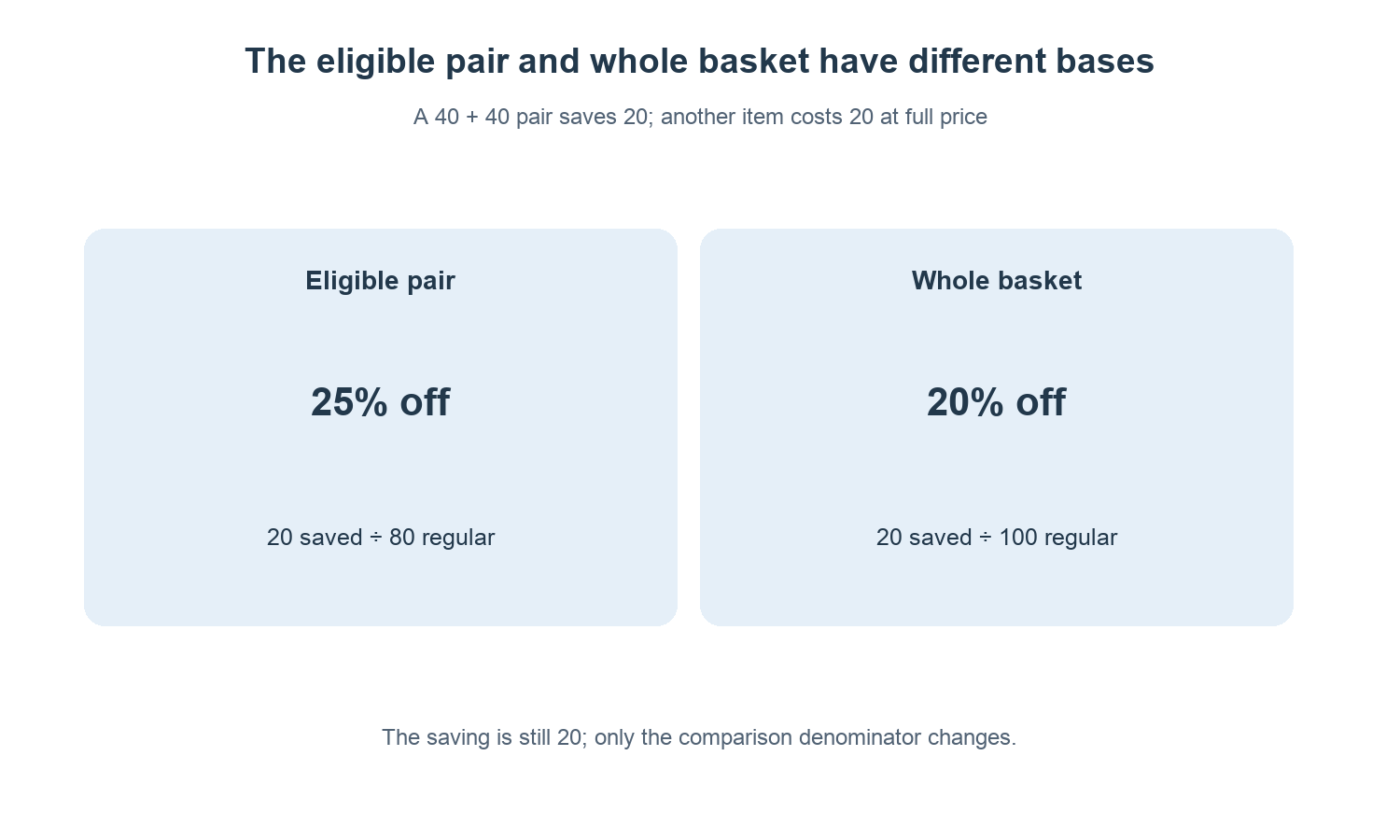
Suppose an eligible 40 + 40 pair saves 20, and the same purchase includes an unrelated 20-unit item at full price. The pair’s discount is 20 ÷ 80 = 25%. The entire basket’s discount is 20 ÷ 100 = 20%.
Both percentages are correct because they describe different denominators. Label “eligible pair” and “whole basket” separately. Do not apply the pair’s 25% reduction to the unrelated full-price item when estimating the checkout total.
Shipping can change the all-in comparison too. If the discounted items cost 60 but require 8 shipping, the checkout amount is 68 before any applicable tax. Comparing that with a local 65-unit offer requires including the same cost categories on both sides. A half-off deal does not guarantee a lower final bill after other charges.
Keep returns and additional offers outside the simple formula
A partial return may trigger a recalculation under the seller’s promotion terms. The receipt may allocate the discount across both products or identify a particular discounted line. You cannot safely infer the refund from the product’s original shelf price alone.
Similarly, an extra percentage coupon may apply before or after the pair discount, to selected lines or not at all. For a purely mathematical example, 10% off a 60-unit discounted pair makes the price 54 if that coupon is permitted on the whole 60. It is not the same as subtracting ten percentage points from a label without calculating the actual amounts.
Read the applicable terms and use the receipt’s calculation order. This article establishes the basic promotion arithmetic, not a universal refund entitlement or coupon-stacking rule.
Half-off deal check: compare the final purchase
A half-off deal only helps if the resulting purchase fits what you need. If one desired item costs 40 and buying a second produces a 60-unit total, the total spending still rises by 20. That observation is arithmetic rather than a judgement about whether the second item is worthwhile.
Write down the price of the basket you would otherwise buy, the promotional basket price and any extra useful quantity. This makes it possible to distinguish a lower unit price from lower total spending. Then use the discount calculator on the specific prices, keeping the eligibility and grouping rules beside the result.