
The recovery percentage is calculated from the reduced amount, not the original amount. If a value falls from 100 to 80, it has lost 20%. Returning from 80 to 100 requires a gain of 20 on a starting amount of 80: 20 ÷ 80 × 100 = 25%.
A recovery percentage compares the units regained with the reduced balance. The number of units lost and regained is the same. The percentage differs because its denominator changes. This guide shows the calculation, a useful recovery table, and situations where the simple formula does not answer the question you actually have. Use the percentage calculator to check the change from the lower amount back to the target.
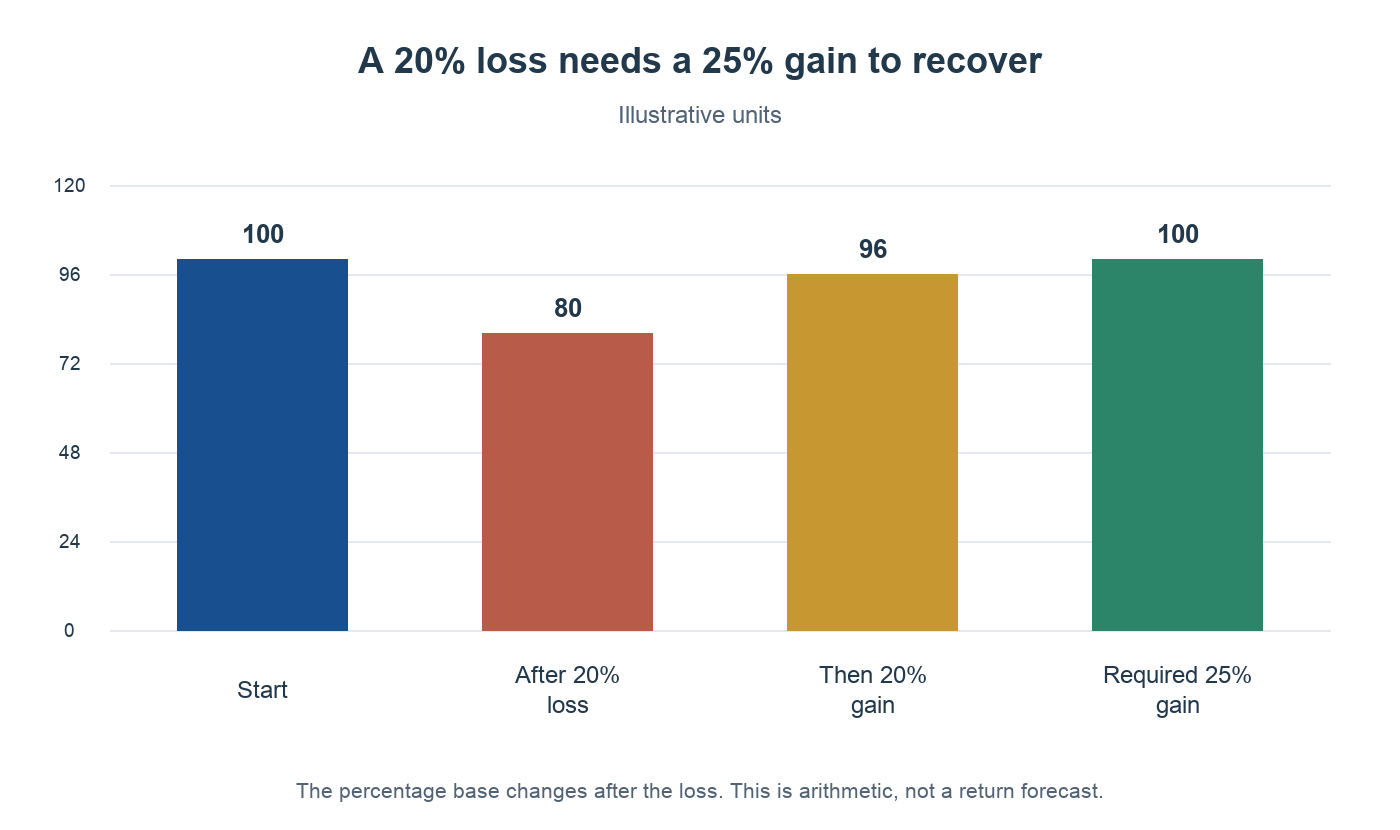
Table of Contents
Formula for the recovery percentage
When you know the actual amounts, use:
Required gain (%) = (target amount − current amount) ÷ current amount × 100.
To recover exactly to the original amount, the target is that original amount. This formula requires a positive current amount. It is simply the percentage-increase calculation with the values in the correct order.
If you know only the loss percentage L, expressed as a number such as 20 rather than 0.20, the equivalent formula is:
Recovery gain (%) = 100 × L ÷ (100 − L).
For a 20% loss, that is 100 × 20 ÷ 80 = 25%. If you work with decimal fractions instead, use loss ÷ (1 − loss) and convert the result to a percentage. Mixing the decimal and percentage forms is a common source of answers that are 100 times too large or too small.
A worked example with actual amounts
Suppose a fictional value starts at 2,000 and falls by 30%. The decrease is 2,000 × 0.30 = 600, leaving 1,400. The recovery target is the original 2,000.
| Step | Calculation | Result |
|---|---|---|
| Find the loss | 2,000 × 30% | 600 |
| Find the reduced value | 2,000 − 600 | 1,400 |
| Find the required increase | 2,000 − 1,400 | 600 |
| Use the reduced value as the base | 600 ÷ 1,400 × 100 | 42.857…% |
| Check the result | 1,400 × (1 + 0.428571…) | 2,000 |
The recovery percentage is about 42.86%, not 30%. Keep more digits while checking the arithmetic, then round the displayed percentage. If you multiply by the rounded 42.86%, you get 2,000.04; the small difference is rounding, not another loss.
These are amount-based examples, not a prediction that any price, income or investment will recover. The formula describes the increase required to reach a specified target; it says nothing about whether that increase will happen or how long it will take.
Recovery percentage comparison table
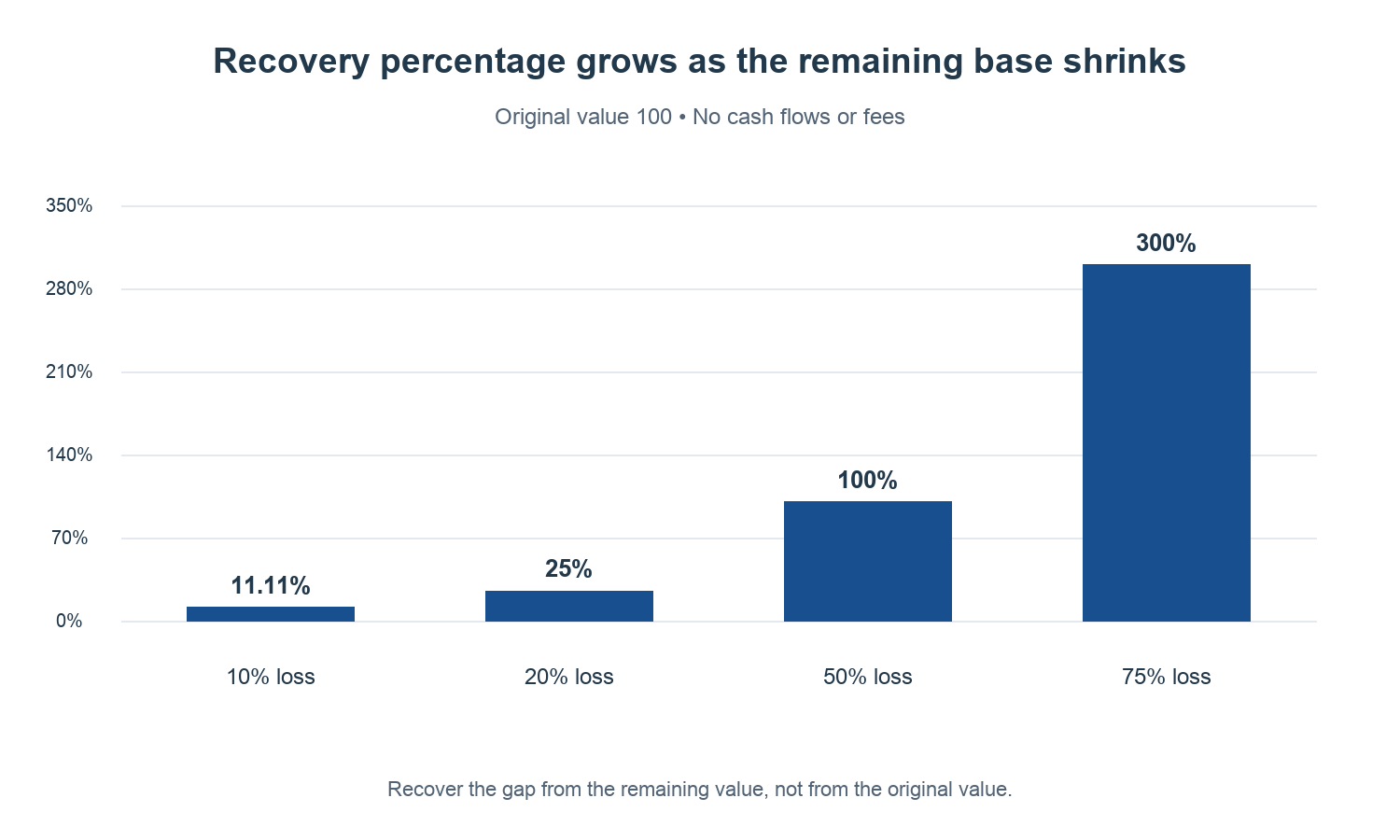
The following table starts every example at 100 units. That makes the changing denominator visible. For the recovery percentage, the current amount is what remains after the loss; the final column is the increase needed from that amount to reach 100 again.
| Loss | Amount remaining from 100 | Gain needed to return to 100 |
|---|---|---|
| 5% | 95 | 5.26% |
| 10% | 90 | 11.11% |
| 20% | 80 | 25% |
| 25% | 75 | 33.33% |
| 30% | 70 | 42.86% |
| 40% | 60 | 66.67% |
| 50% | 50 | 100% |
| 60% | 40 | 150% |
| 75% | 25 | 300% |
| 90% | 10 | 900% |
A 50% loss has a recovery percentage of 100% because the remaining amount must double. A 75% loss leaves one-quarter of the starting amount; restoring the other three quarters requires a gain equal to three times the remaining amount.
Why equal percentage changes do not cancel
Start at 100, decrease by 20%, then increase the result by 20%. The first step gives 80. The second adds 20% of 80, which is 16, leaving 96. You are still 4 below the original amount.
The calculation is 100 × 0.80 × 1.20 = 96. Adding −20% and +20% ignores that the two changes use different bases. The same problem appears in discounts and later markups. Our percentage increase and decrease guide explains how to identify the starting amount for each change.
Do not confuse this with a percentage-point change. A rate moving from 20% to 25% rises by 5 percentage points and by 25% relative to its original rate. That is a different question from recovering an amount after a 20% loss.
When the recovery percentage formula is not enough
A 100% loss leaves zero. No finite percentage increase applied to zero restores a positive amount. The recovery percentage formula has a zero denominator at that boundary, so a calculator should not produce an ordinary recovery percentage.
New contributions are not growth. If an account falls from 100 to 80 and you add 20, the balance returns to 100, but the original 80 did not earn 25%. Separating deposits, withdrawals, fees and price changes is essential before describing a result as a return.
The target may have changed. You might want to recover the original purchasing power rather than the original nominal number, or cover a transaction fee as well. In that case, set the appropriate target explicitly instead of assuming it is the old balance. This arithmetic alone does not determine taxes, investment performance reporting or suitability.
A reliable calculator check
- Write down the current positive amount and the target.
- Subtract current from target to find the units required.
- Divide those units by the current amount.
- Multiply by 100 to express the result as a percentage.
- Check that current × (1 + gain as a decimal) returns the target.
If the original amount is missing, use the reverse-percentage method first. If the target is lower than the current amount, you are calculating a decrease rather than recovery growth.
For a quick check, enter 80 as the starting amount and 100 as the ending amount in the percentage calculator. The expected increase is 25%. Repeat with your own amounts only after confirming which value is the denominator.
Method reference: OpenStax, applications of percent. Tables and examples are original arithmetic illustrations. They do not forecast financial outcomes.
Recovery percentage after two declines
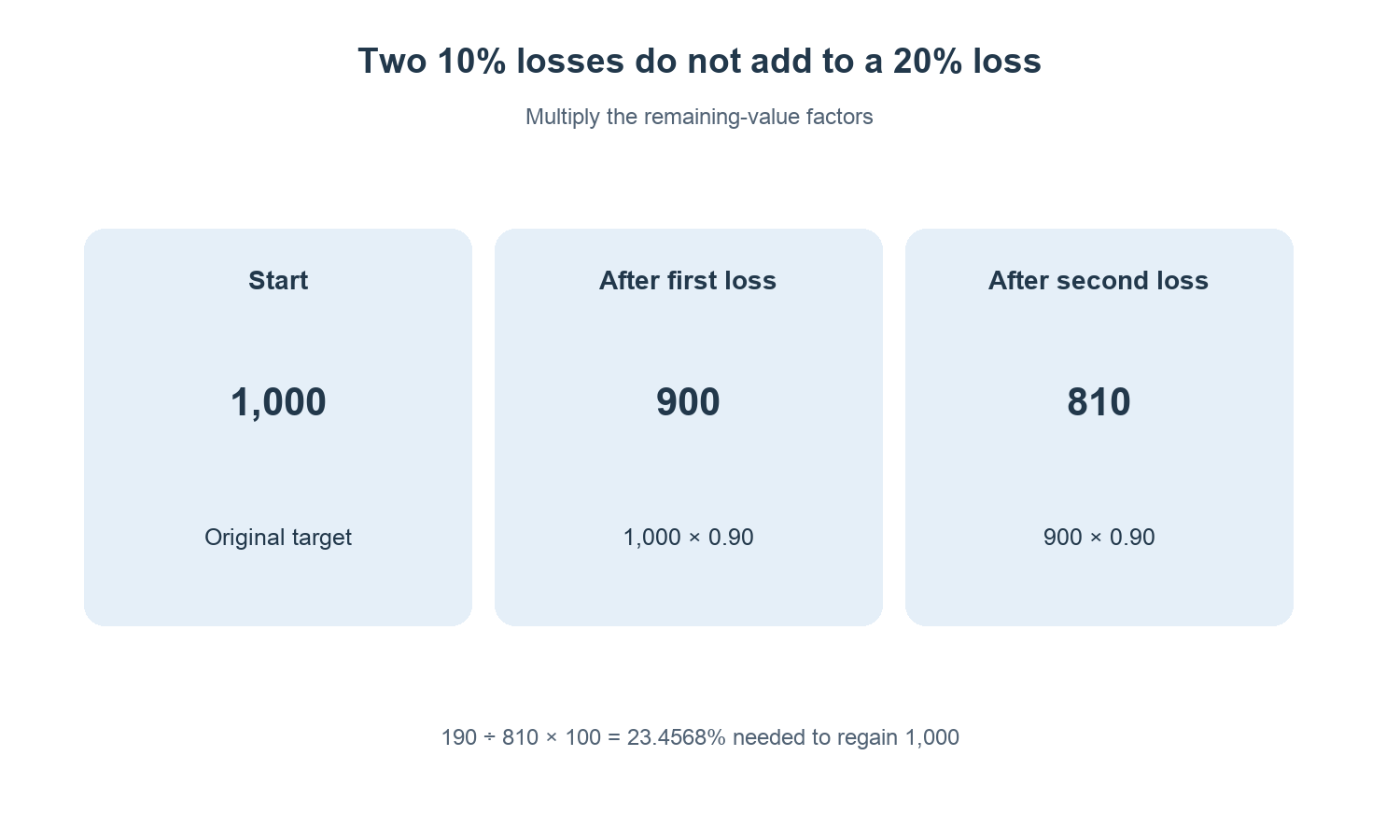
When a value falls twice, calculate the remaining value before applying the recovery formula. Two losses of 10% are not a total loss of 20%, because the second percentage acts on the reduced base.
Start with 1,000 units. A 10% loss leaves 900. A second 10% loss removes 90, leaving 810. The combined loss is 190 out of the original 1,000, or 19%. The recovery percentage of that size is 190 ÷ 810 × 100 = approximately 23.4568%.
| Step | Value | Calculation |
|---|---|---|
| Start | 1,000 | Original comparison level |
| First 10% loss | 900 | 1,000 × 0.90 |
| Second 10% loss | 810 | 900 × 0.90 |
| Recovery to 1,000 | 190 needed | 190 ÷ 810 ≈ 23.4568% |
Multiplying 810 by 1.234568 gives approximately 1,000, which checks the result. Applying a 20% gain instead would give only 972. The check should use the remaining value, not the original 1,000, as the gain’s base.
Recalculate the recovery percentage after a partial gain
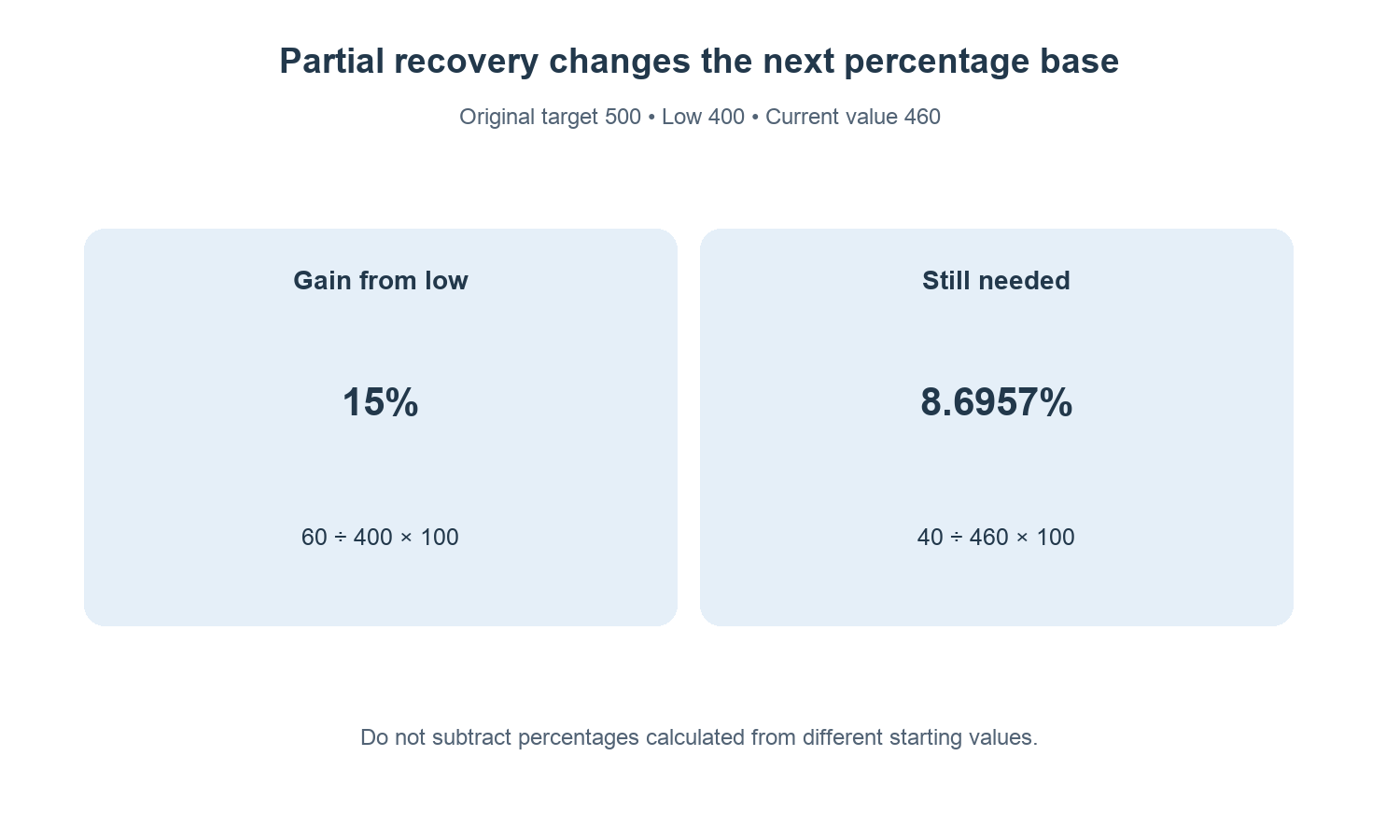
Suppose a value falls from 500 to 400, then rises to 460. It has already gained 60 ÷ 400 = 15% from its low. The remaining gap is 40, so the additional percentage gain required from the current 460 is 40 ÷ 460 × 100 = approximately 8.6957%.
It would be incorrect to say that a 25% recovery requirement minus the completed 15% gain leaves exactly 10% more. Those percentages use different bases. Applying another 10% to 460 would produce 506, above the original target.
A recovery percentage worksheet should contain three labelled values: original target, current value and gap. Update the current value whenever it changes, then recalculate the quotient. Do not keep subtracting percentage points from a requirement calculated at an earlier low.
Separate a cash addition from percentage growth
In another original example, a balance falls from 1,000 to 800. The owner then adds 100 of new money, making the balance 900 without any growth. Reaching the original 1,000 now requires 100 ÷ 900 ≈ 11.11% growth, but that does not mean the original 20% loss has been recovered by performance alone.
The extra deposit changed the cash invested and the comparison being made. If the target is instead to restore the original value plus the new contribution, the target becomes 1,100 and the gap becomes 200. From 900, that arithmetic requirement is 22.22%.
Neither target is automatically the right performance measure. The example shows why a simple recovery percentage cannot evaluate an account with deposits, withdrawals or fees without defining the question. Record those flows separately rather than describing every balance increase as a return.
For a reproducible calculation, write “from 810 to 1,000 requires about 23.46%” instead of “I need 23.46%.” Including the starting and target values makes the denominator visible and allows someone else to verify the number.
A fee can change the gross recovery target
Suppose the current value is 80, the desired net amount is 100 and an explicitly assumed 2% fee is deducted when the amount is withdrawn. The required gross value is 100 ÷ 0.98 ≈ 102.0408. From 80, reaching that gross value requires approximately 27.55% growth.
Without that fee, the same 80-to-100 recovery needs 25%. The difference comes from defining the target as net cash after the hypothetical fee. Use the actual fee basis and any other relevant costs for a real comparison; this example does not model taxes or establish an investment return.