
Total water and drinking water are not interchangeable labels. Total dietary water includes water from plain drinking water, other beverages and food. A bottle log usually records beverages, not the water contained in every meal. The Daily Fluid Planner converts a chosen fluid goal into cups and bottles; it does not calculate an individual medical water requirement.
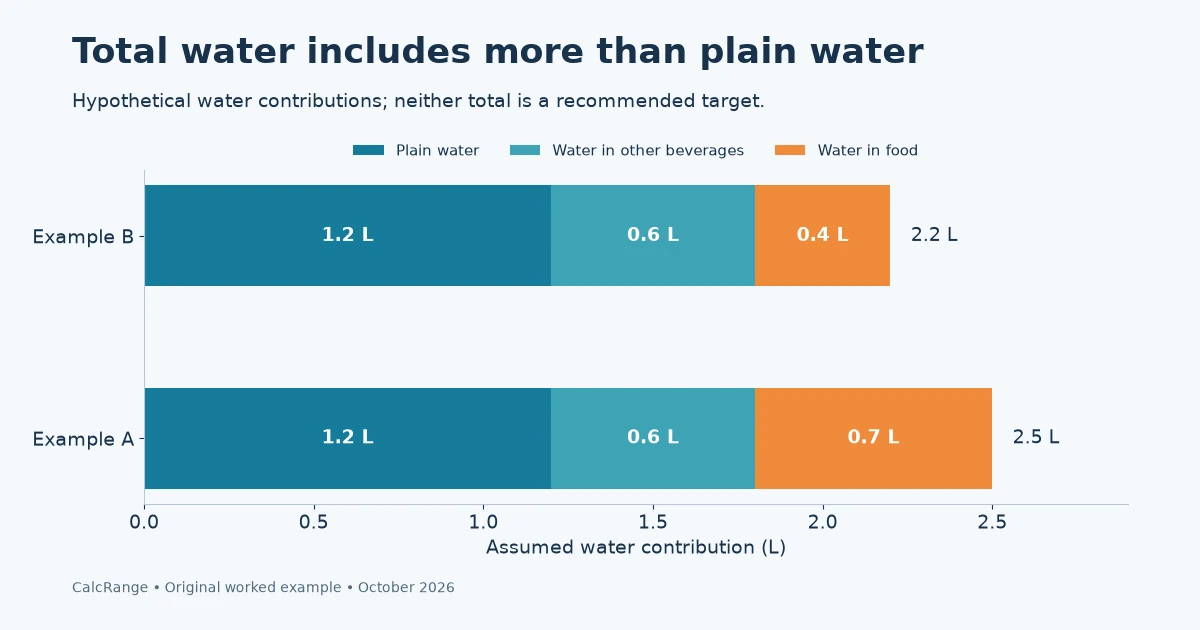
Table of Contents
Total water vs drinking water: define the column
The National Academies water reference explicitly includes drinking water, beverages and food in total water intake. Its population reference values should not be relabeled as an amount of plain water every individual must drink.
| Label | What it includes | What it does not automatically establish |
|---|---|---|
| Plain drinking water | Water consumed as water | All water from food and other drinks |
| Beverage or fluid log | The drinks recorded under the plan’s definition | A measured total of water in food |
| Total dietary water | Water from drinking water, beverages and food | An individual requirement or hydration diagnosis |
Check the wording of a recommendation before entering a number into a planner. “Total water,” “fluids” and “plain water” may refer to different scopes. If a clinician supplied a fluid limit or goal, clarify what that plan counts rather than substituting a general online definition.
A total water accounting example with explicit assumptions
The following amounts are hypothetical water contributions, not a menu analysis or a recommended target. They demonstrate the addition only.
| Source | Assumed water contribution |
|---|---|
| Plain drinking water | 1.2 L |
| Water in other beverages | 0.6 L |
| Water in food | 0.7 L |
| Total | 2.5 L |
The arithmetic is 1.2 + 0.6 + 0.7 = 2.5 L. Calling this “2.5 L of plain water” would misdescribe the example, because only 1.2 L came from that source.
If the assumed food-water contribution were 0.4 L instead, with the first two rows unchanged, the total would be 2.2 L. This is why a fixed percentage assigned to food should not be treated as a personal measurement.
The “water in other beverages” row is deliberately labeled as water content. Beverage volume and its exact water content are not identical for every drink. A general fluid log may reasonably record the drink’s volume for its own purpose, but do not claim that this is a laboratory measurement of pure water.
Do not calculate total water from food weight alone
Food contains components other than water. A 200 g food portion does not automatically contribute 200 mL of water. A defensible food-water estimate needs a composition value matched to the food and preparation state.
For a purely illustrative calculation, a 200 g portion assumed to contain 75% water contributes 200 × 0.75 = 150 g of water. That assumption must come from an appropriate source for a real food; the 75% here is invented for arithmetic, not a nutritional claim about a product.
Cooking, draining and recipe ingredients affect the relevant entry. If you do not have a suitable composition estimate, leave food water unquantified rather than filling a diary with precise-looking guesses.
For many everyday uses, a clear beverage log is enough for the task being performed. It becomes misleading only when it is presented as a complete dietary-water measurement without the missing component being acknowledged.
Use the current fluid planner on its stated basis
The tool asks for a chosen daily fluid goal in litres, drinks logged in millilitres, and cup and bottle sizes. It performs volume arithmetic. It has no food-composition database and no body-weight-based prescription field.
For a hypothetical goal of 2.0 L and 1,200 mL logged, the arithmetic remainder is 2,000 − 1,200 = 800 mL. With a 250 mL cup, that is 3.2 cups; with a 500 mL bottle, it is 1.6 bottles.
| Input or output | Value |
|---|---|
| Chosen goal | 2.0 L = 2,000 mL |
| Drinks already logged | 1,200 mL |
| Arithmetic remainder | 800 mL |
| At 250 mL per cup | 3.2 cups |
| At 500 mL per bottle | 1.6 bottles |
A decimal bottle count is a volume equivalent, not an instruction to drink it quickly or to round upward. The tool’s remainder does not account for an individual’s medical circumstances or demonstrate dehydration.
Measure the capacity of your cup rather than assuming every “glass” is the same. For other units, use the Unit Converter and distinguish US and imperial fluid measures.
Keep total water references separate from individual plans
The National Academies report explains that its adequate-intake reference was based on population intake data and should not be interpreted as a precise individual requirement. Conditions and activity can alter needs, while some people have specific clinical fluid instructions.
Do not add a population total-water figure on top of all the fluids already consumed. That would confuse a total with an additional amount. Equally, do not subtract an assumed food percentage from a prescribed fluid plan without asking how the plan is defined.
The guides on daily water references and coffee in a fluid record address related questions. This worksheet’s purpose is keeping the accounting categories clear, not selecting a universal drinking target.
Replace an assumed glass size with a measured capacity
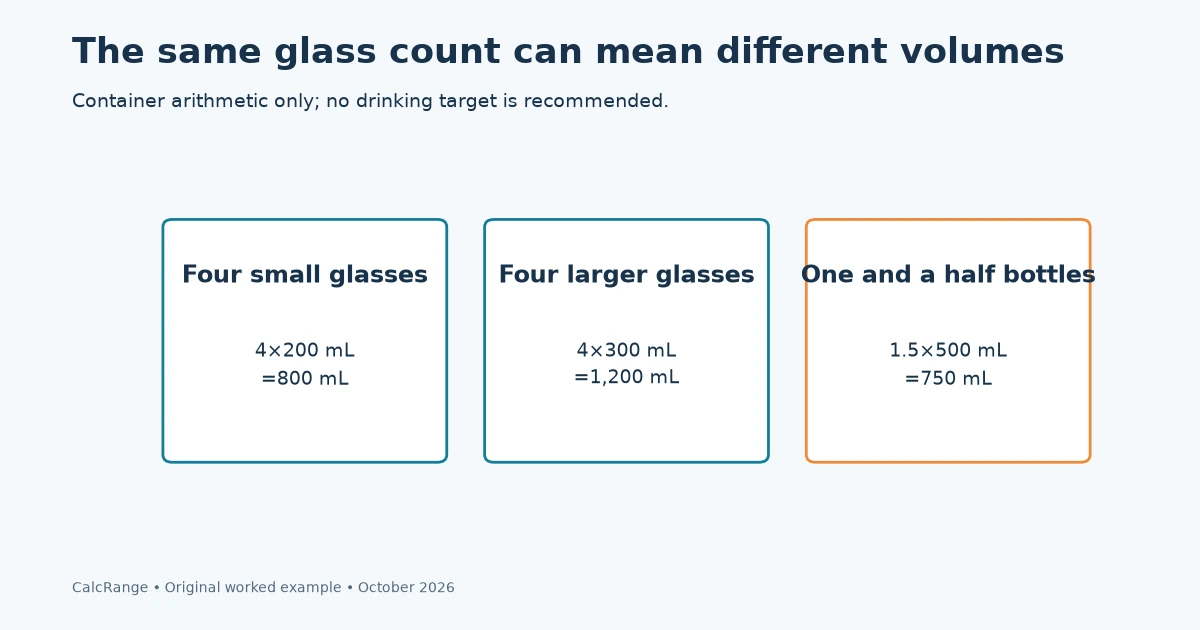
A drink count becomes a volume only after the container size is defined. Four 200 mL glasses represent 800 mL; four 300 mL glasses represent 1,200 mL. Calling both “four glasses” hides a 400 mL difference.
Record the container’s actual capacity or the amount poured, and distinguish a full container from a partially consumed one. A bottle refilled twice should be counted by the amount consumed, not automatically by the number of times it was handled.
| Record | Container size | Volume represented |
|---|---|---|
| 4 full glasses | 200 mL | 800 mL |
| 4 full glasses | 300 mL | 1,200 mL |
| 1.5 bottles | 500 mL | 750 mL |
These are bookkeeping examples, not drinking recommendations. A precise container measurement does not establish how much an individual should consume.
If a clinical fluid plan applies, ask which items and measurements it includes. Its definition may differ from a casual water-bottle log, so do not substitute this general worksheet for those instructions.
Avoid counting the same drink twice
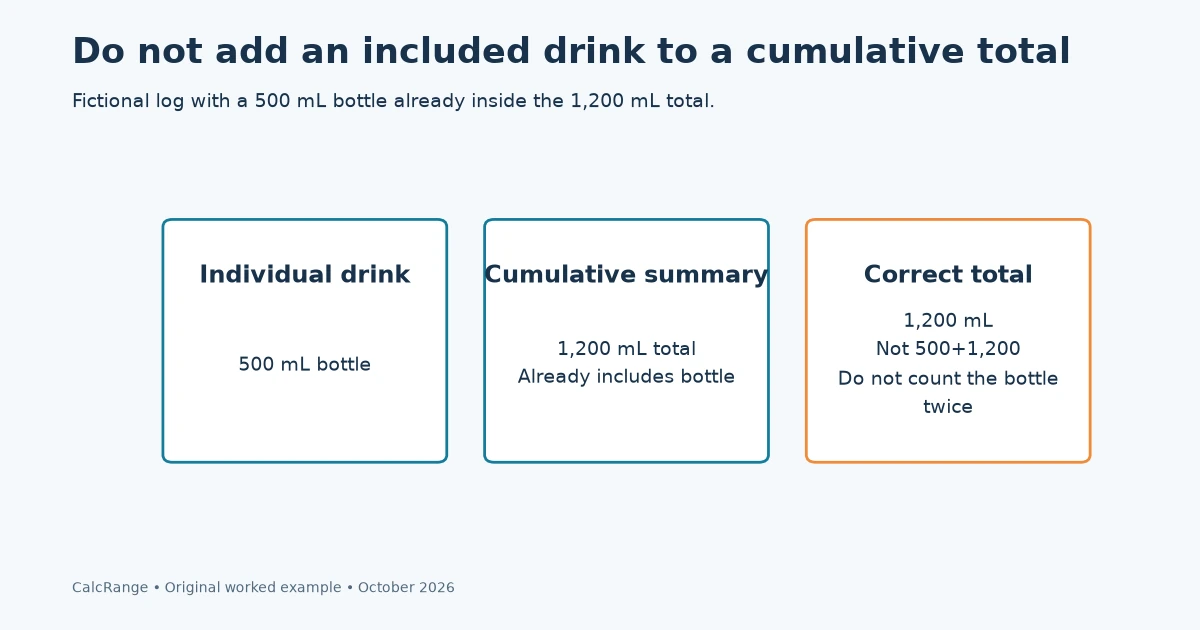
Suppose a log includes a 500 mL bottle of plain water and a later summary entry called “drinks so far: 1,200 mL” that already includes that bottle. Adding both entries would count the same 500 mL twice and produce 1,700 mL instead of the intended 1,200 mL total.
Choose either a list of individual drinks or a cumulative total at each checkpoint. If both are retained, label the cumulative figure as a summary rather than another drink.
The same boundary issue can occur with food-water estimates. If a prepared dish is already represented by a composition estimate, do not also add its ingredient water separately unless the method explicitly excludes that contribution.
A simple ledger can have source, amount, unit, whether it is an individual entry or summary, and what is included. This small amount of structure prevents an exact addition from producing the wrong total.
If the record is incomplete, state that fact. A planner’s remainder is computed from the inputs supplied; it does not know that a drink was omitted or that a summary included earlier entries.
Separate a changed goal from a changed intake record
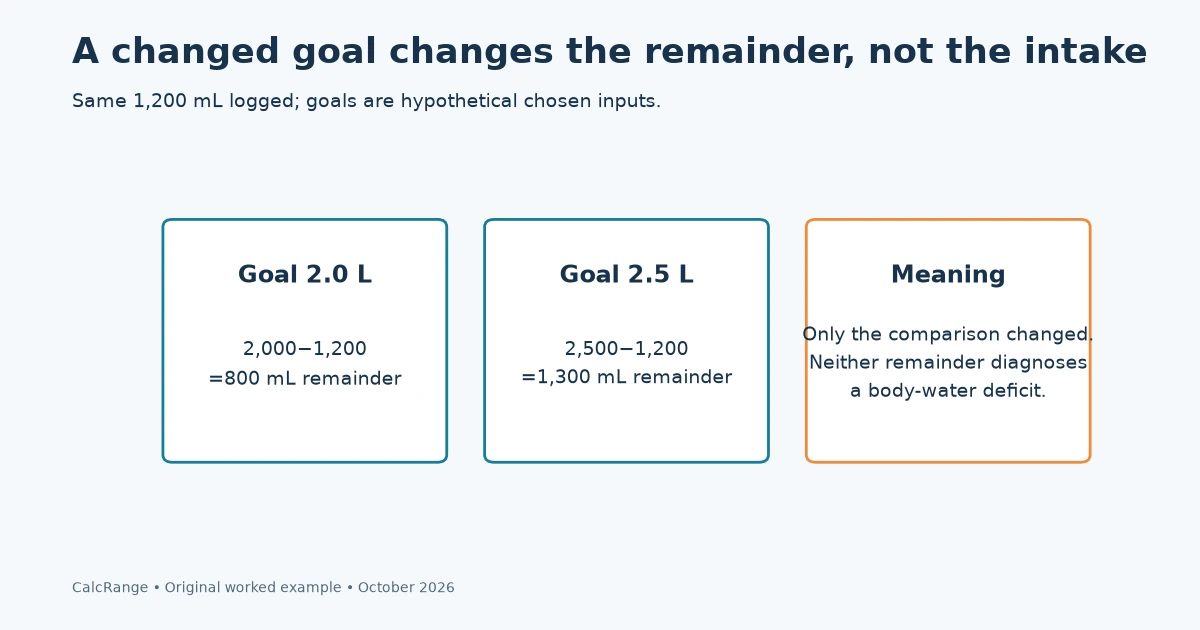
Consider the same fictional 1,200 mL logged amount under two explicitly chosen goals. Against 2.0 L, the arithmetic remainder is 800 mL. Against 2.5 L, it is 1,300 mL. The logged drinking has not changed; only the comparison goal has.
This is why a progress percentage should always be accompanied by the goal’s value and basis. A smaller percentage can result from changing the denominator rather than drinking less.
Do not interpret either remainder as proof that the body is short of that exact amount of water. The tool is comparing a log with a chosen fluid goal, not measuring hydration or losses.
If a goal was supplied by a healthcare professional, preserve its units, scope and date. Do not convert a total-water reference into a plain-water instruction, or replace a prescribed fluid limit with a generic number from an unrelated article.
The most useful final record states what was counted and what was compared: for example, “1,200 mL of recorded beverages compared with a chosen 2,000 mL fluid goal.” It does not claim a complete dietary-water measurement when food water was unmeasured.
When definitions are clear, the arithmetic is straightforward. When definitions differ, converting litres into bottles cannot resolve the underlying mismatch. Return to the scope of the original recommendation before changing the numbers.
Total water and drink-record questions
Does total water mean only plain water?
No. It includes water from drinking water, other beverages and food.
Can I assume food always supplies 20% of my water?
No. A population average is not a measurement of your meals. Food composition and portions vary.
Does the planner tell me how much water my body medically needs?
No. It converts a goal you choose into volume equivalents and a logged remainder. Individual clinical needs require appropriate advice.
Sources and calculation notes
All quantities are original illustrative accounting inputs. They are not a personal intake recommendation, food analysis or instruction to drink a calculated remainder rapidly. Sources checked October 30, 2026.