
A fixed-rate mortgage payment can rise even when the loan’s interest rate is unchanged. For a standard fully amortizing fixed-rate loan, the scheduled principal-and-interest payment is generally stable, but a bill that also collects escrow for property taxes and insurance can change.
This guide uses a U.S. escrow example. Use the mortgage calculator to estimate principal, interest and entered recurring costs, then compare the components with the servicer’s actual statement. A calculator cannot reproduce a particular escrow analysis without the account’s payment history and rules.
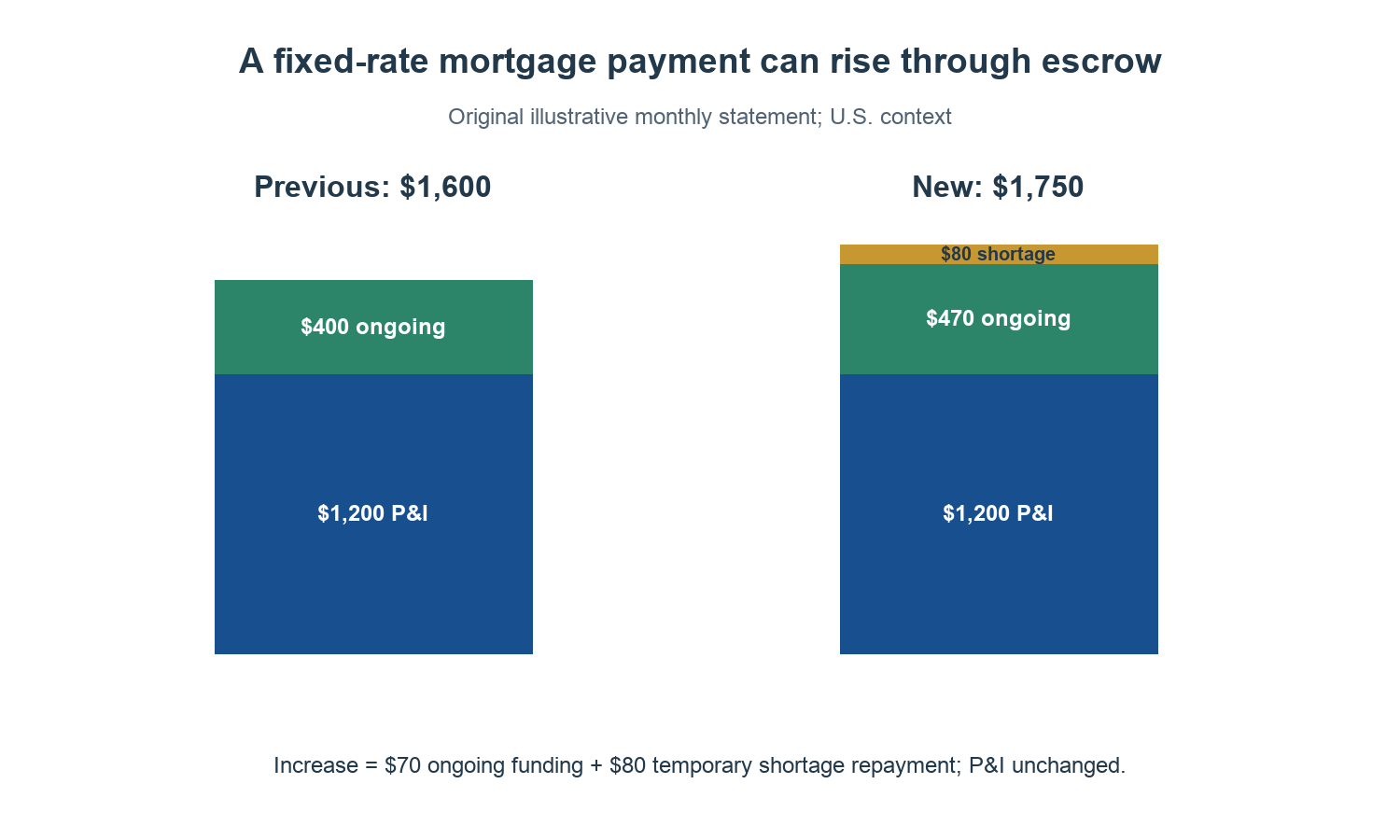
Table of Contents
What is fixed in a fixed-rate mortgage payment?
The interest-rate promise belongs to the loan terms. It does not promise that your property-tax assessment, insurance premium or every charge collected with the payment will remain unchanged.
Separate the statement into scheduled principal and interest, escrow deposits, mortgage insurance if applicable, shortage repayments and any other charges. Optional extra principal is another separate item. An automatic bank transfer that includes several of these components can change even if the principal-and-interest line does not.
The Consumer Financial Protection Bureau’s payment-change guide identifies taxes, homeowners insurance and other loan or billing features as possible reasons for a changed amount. The itemized statement is the starting point for identifying which applies to you.
Fixed-rate mortgage payment: a $150 escrow increase
Assume a fictional homeowner has a scheduled monthly principal-and-interest payment of $1,200. Last year’s estimated property taxes were $3,600 and insurance was $1,200. Spreading those annual bills over twelve months gives an illustrative escrow contribution of $400 per month.
For the next year, expected taxes rise to $4,200 and insurance to $1,440. Those estimates total $5,640, or $470 per month. Separately, suppose the servicer’s analysis identifies a $960 shortage and the applicable repayment arrangement spreads it over twelve months, adding $80 temporarily.
| Component | Previous monthly amount | New monthly amount | Change |
|---|---|---|---|
| Scheduled principal and interest | $1,200 | $1,200 | $0 |
| Estimated ongoing tax and insurance funding | $400 | $470 | +$70 |
| Illustrative shortage repayment | $0 | $80 | +$80 |
| Total in this simplified example | $1,600 | $1,750 | +$150 |
The increase has two different sources: $70 for higher expected bills and $80 to address the existing shortage. Neither changes the loan’s assumed interest rate. The table omits mortgage insurance, other charges and detailed escrow timing or cushion calculations.
After the illustrated twelve shortage installments, removing that $80 would leave $1,670 if all other components stayed unchanged. That is a conditional arithmetic result, not a promise of the next payment: another analysis or changed bill could alter it.
A shortage is not the same as next year’s higher cost
A shortage concerns the account’s balance relative to its required level under the escrow analysis. Higher future taxes or insurance affect how much needs to be collected going forward. They may appear together, but solving one does not necessarily solve the other.
In the example, paying the $960 shortage separately, if the servicer permits it under the applicable arrangement, would not make the higher expected annual bills disappear. The ongoing illustrative contribution would still be $470 rather than $400.
Actual U.S. escrow analysis includes the timing of deposits and disbursements and permitted account cushions. The applicable federal rules are in Regulation X, section 1024.17. This article’s twelve-month shortage installment is an assumption for the example, not a statement that every shortage has the same treatment or repayment option.
A shortage also differs from a deficiency, where the escrow account has a negative balance. Read the servicer’s terminology and analysis rather than treating every adjustment as the same kind of charge.
Model recurring costs without pretending to recreate escrow
The mortgage calculator has annual property-tax and annual home-insurance inputs. Enter annual amounts in those fields. Entering $470 as annual insurance merely because it is a monthly combined contribution would model the wrong quantity.
For a comparison, hold the loan amount, rate and term constant while changing annual taxes from $3,600 to $4,200 and annual insurance from $1,200 to $1,440. Their simple monthly equivalents increase by $70 in total.
The calculator does not have a dedicated escrow-shortage schedule. Keep the illustrative $80 temporary repayment on a separate worksheet. Do not hide it by raising the interest rate or putting it into optional extra principal; those inputs have different meanings.
For the underlying amortization component, see how mortgage payments are calculated. If the loan itself changes rate, that is a different question discussed in fixed vs variable rates.
Review a fixed-rate mortgage payment line by line
- Compare the old and new scheduled principal-and-interest amounts.
- Find the annual escrow analysis and its projected tax and insurance bills.
- Check those bill amounts against the tax authority and insurer’s documents.
- Identify any shortage installment, its start date and stated duration.
- Separate mortgage insurance, fees and optional extra principal from escrow.
- Ask the servicer to explain any unexplained difference before changing payment arrangements.
Keep copies of the statements and a dated record of the explanation. A formula can reveal a mismatch, but it cannot determine whether the underlying tax bill, insurance charge or servicing entry is correct.
Translate annual bill changes into monthly estimates
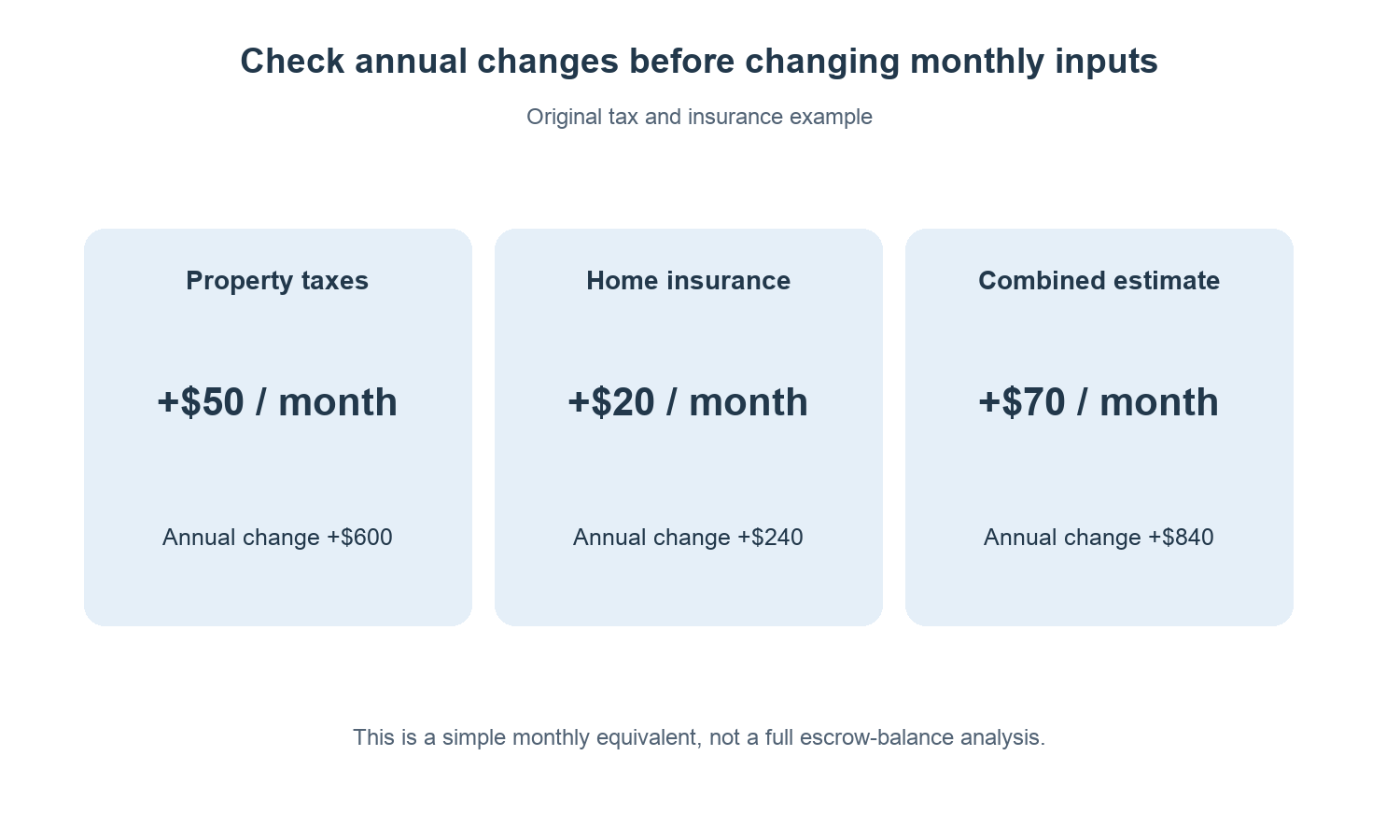
In the original fixed-rate mortgage payment example, property taxes rise by $600 per year and insurance by $240 per year. Their simple monthly equivalents are $50 and $20. Adding them gives the $70 increase in expected ongoing funding.
| Bill | Previous annual amount | New annual amount | Simple monthly increase |
|---|---|---|---|
| Property taxes | $3,600 | $4,200 | ($4,200 − $3,600) ÷ 12 = $50 |
| Home insurance | $1,200 | $1,440 | ($1,440 − $1,200) ÷ 12 = $20 |
| Combined | $4,800 | $5,640 | $70 |
This fixed-rate mortgage payment worksheet checks the recurring-cost component. It does not replace the servicer’s account-balance analysis, because the dates on which large bills are paid and the required account level also matter.
A common input error is putting $350 of monthly tax into a calculator field labelled annual property tax. The corresponding annual amount is $4,200. Read every field’s time basis instead of relying on the position of the number in a statement.
Principal and interest can change internally while their sum stays fixed
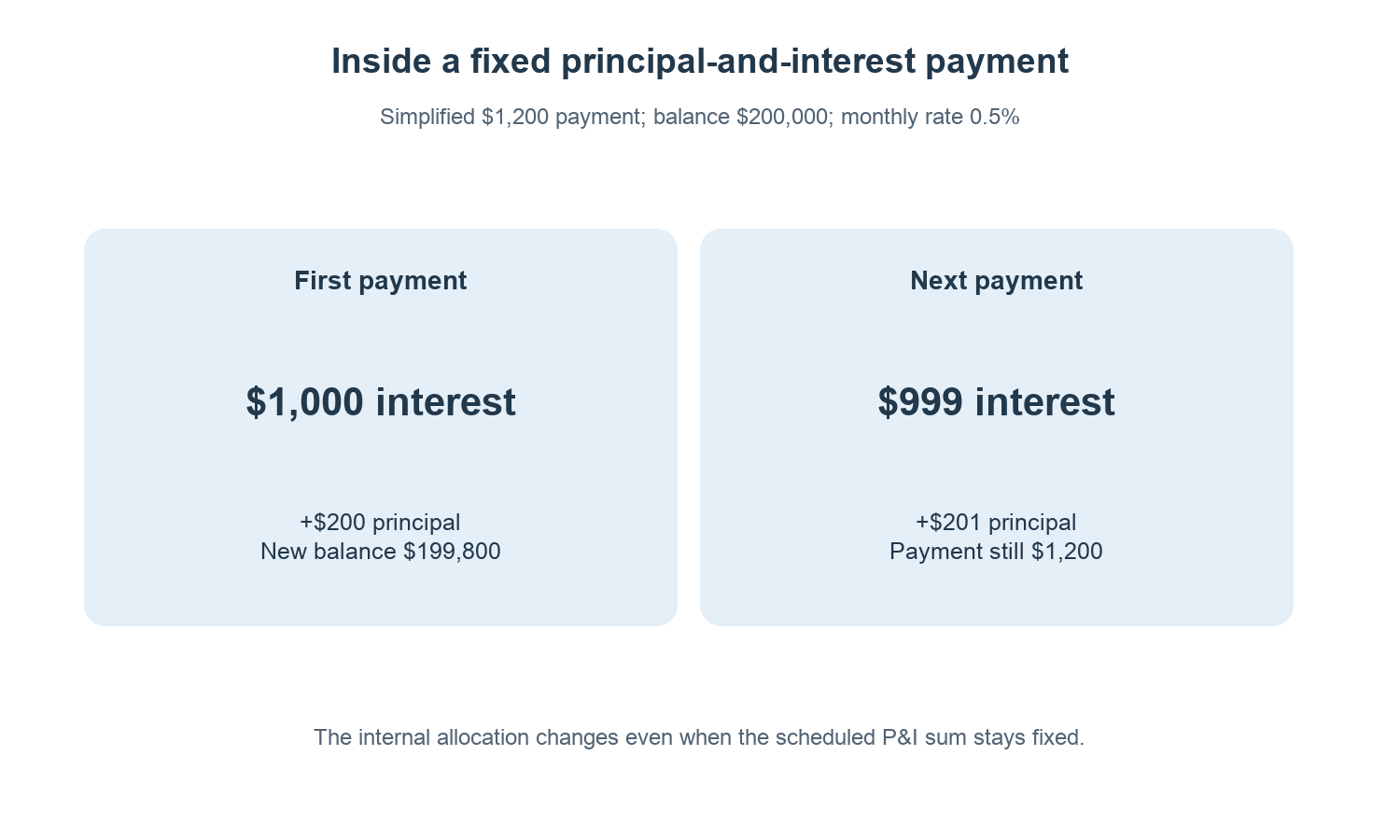
The principal-and-interest portion of a fixed-rate mortgage payment can stay stable while its two internal parts change. In a simplified monthly-interest example, suppose the balance is $200,000, the monthly rate is 0.5% and the scheduled payment is $1,200.
The first month’s interest is $1,000, leaving $200 of that payment to reduce principal. The new balance is $199,800. The next month’s interest is $999, leaving $201 toward principal, while the combined payment is still $1,200.
This original two-payment illustration explains the direction of a standard amortization schedule. It omits daily accrual, rounding and other contract details. It should not be used to infer a complete loan term from two rows.
An escrow increase sits outside that internal principal-interest allocation. If the statement’s total rises while the principal-and-interest sum stays unchanged, inspect the other components before concluding that the amortization formula changed.
Avoid counting a bill both inside and outside escrow
When building a household budget, identify which property costs the fixed-rate mortgage payment actually includes. If the $1,750 illustrative payment already contains tax and insurance funding, adding the same $470 again as another monthly bill would double-count that part of the budget.
Conversely, a homeowner who pays taxes or insurance directly needs to budget for those bills outside the mortgage transfer. The same annual cost can be funded through different payment arrangements; the bank-transfer label alone does not establish what is included.
Keep homeowners-association dues and other separately paid costs identifiable too. The calculator can include a monthly HOA estimate, but that does not mean the servicer collects it in escrow for your property.
Track the shortage in a fixed-rate mortgage payment
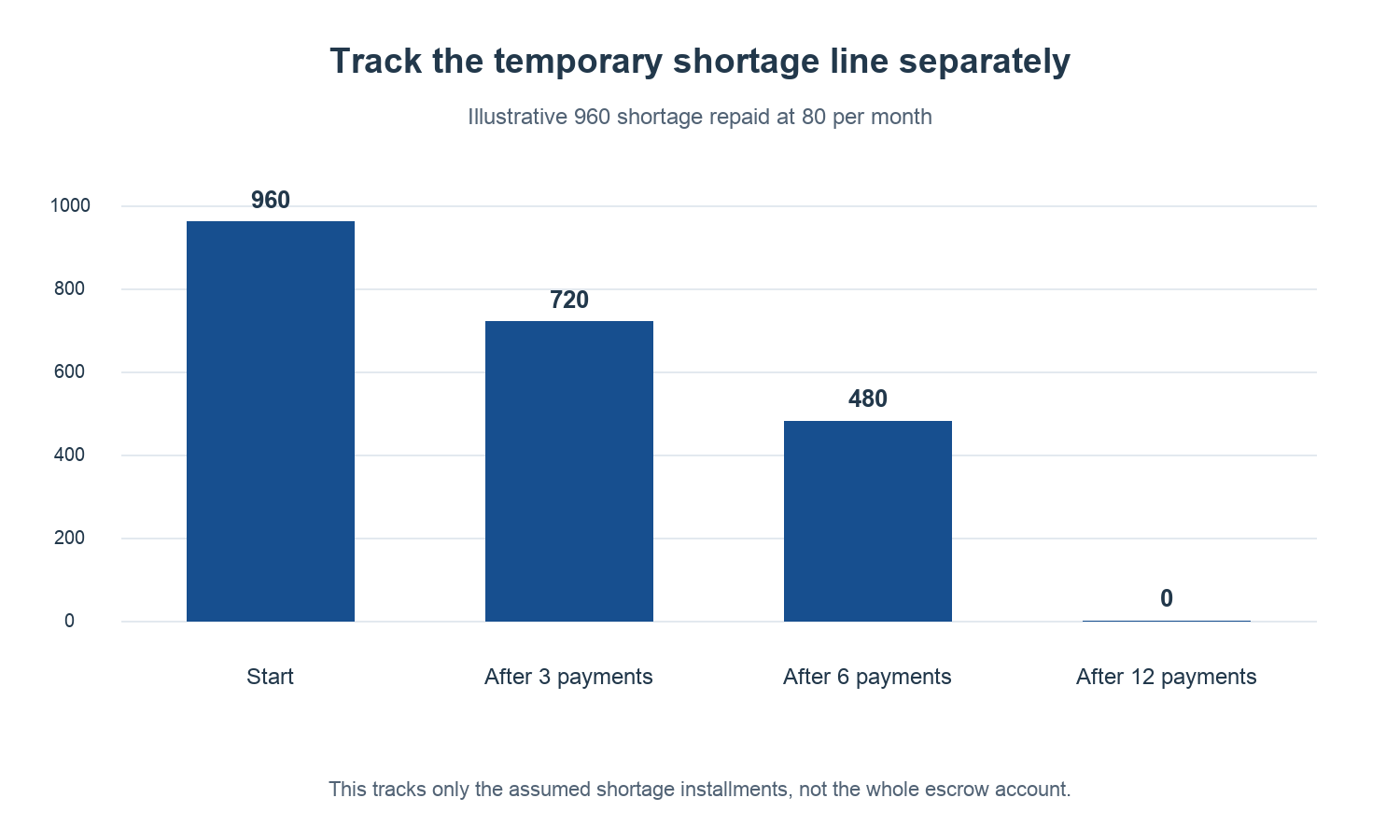
For the illustrative $960 shortage repaid at $80 per month, a simple tracking sheet starts at $960 and subtracts each confirmed $80 installment. After three payments the tracked remainder is $720; after six it is $480; after twelve it is zero, assuming no other adjustment to that specific arrangement.
Do not use this small tracker as the total escrow balance. Ongoing deposits and tax or insurance disbursements still occur in the actual account. It tracks only the assumed repayment line so that you can compare its stated duration with your records.
If the next analysis changes the amount, save both versions and ask which components changed. That makes a payment discussion more precise than asking why a “fixed” bill moved without separating its parts.
Common questions
Will an extra principal payment reduce my escrow contribution?
Not directly. Extra principal reduces the loan balance under the loan’s rules; it does not itself pay the tax or insurance bill. Keep those purposes separate.
Does a fixed rate guarantee an unchanged total bill?
No. The fixed-rate feature concerns interest terms. Escrow and other components can change, and some loans have additional features such as temporary buydowns that need separate review.
Can the total payment decrease?
It can if a component falls or a temporary collection ends, but the actual amount depends on the account analysis and loan terms. Do not predict a reduction from this example alone.
Use the mortgage calculator to separate recurring estimates, then use the servicer’s documents to explain the actual bill.