
Double counting Zakat assets often happens when the same money appears in more than one view: a transfer history and a bank balance, a brokerage total and its individual holdings, or a savings goal and the account holding it. Reconcile ownership and balances first, then apply the Zakat treatment relevant to each asset.
This guide addresses bookkeeping, not a ruling on every investment, debt or savings purpose. Eligibility, nisab, hawl and deductible liabilities require the applicable religious guidance. Use the Zakat Calculator only after deciding which amounts belong in its fields; a total does not make those decisions for you.
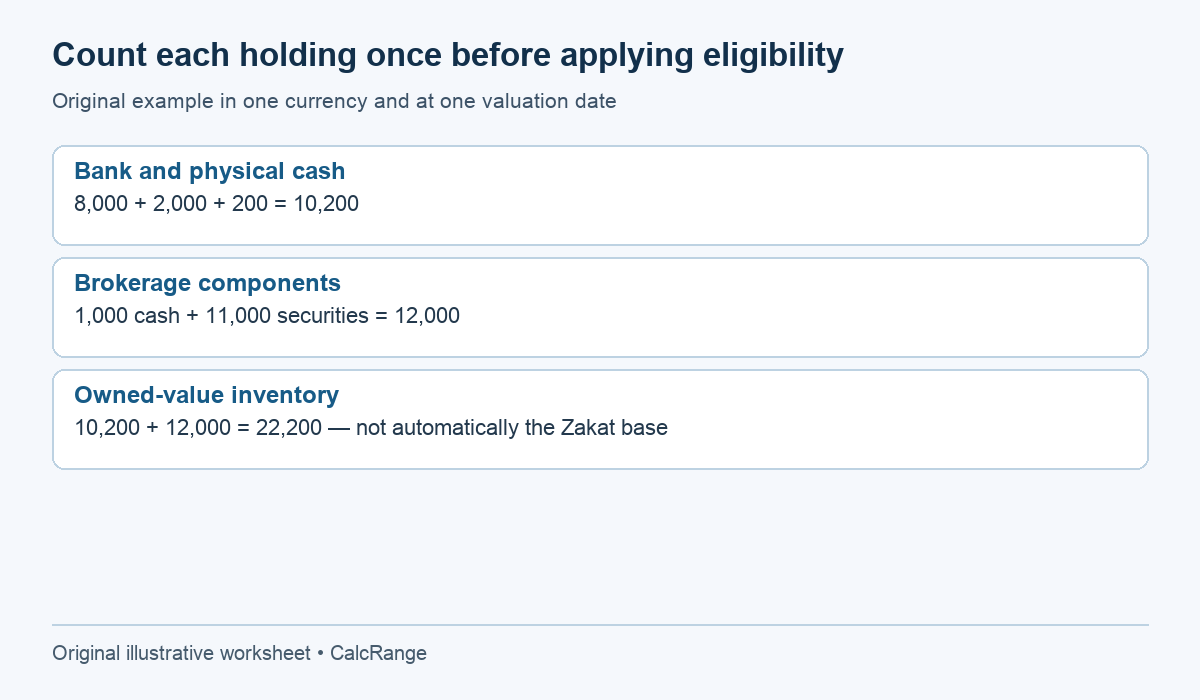
Table of Contents
1. Set one date, currency and ownership scope for Zakat assets
Choose the relevant assessment date under the guidance you follow and record the balances at that point. Do not combine one account’s month-end statement with another account’s later live balance if a transfer occurred between them. The mismatch can count money twice or omit it.
Write the currency next to every amount. For assets held in another currency, keep the conversion rate, source and valuation date used. This worksheet does not prescribe a particular religious valuation convention; it makes the chosen convention visible and repeatable.
Also identify ownership. A joint account’s total balance is not automatically the amount owned by one person. Record the ownership facts and seek guidance where they are unclear rather than blindly dividing by two or assigning the entire balance to every account holder.
2. Reconcile Zakat assets transfers without changing the total twice
Suppose an account held 10,000 currency units. You move 2,000 to a second account, with no fee and no other transactions. The final balances are 8,000 and 2,000. Their sum is still 10,000.
| Entry | Before transfer | After transfer |
|---|---|---|
| Bank account A | 10,000 | 8,000 |
| Bank account B | 0 | 2,000 |
| Total owned cash in these accounts | 10,000 | 10,000 |
Do not add the 2,000 transfer transaction to the final balances: it is already represented in account B. Do not combine the old 10,000 balance in A with the new 2,000 balance in B either. Both errors arise from mixing a movement with a snapshot.
If the transfer is pending, document what each displayed balance includes and obtain a consistent statement of the funds’ location and ownership. Do not resolve a pending item by automatically adding it to both accounts. Keep the uncertainty visible until reconciled.
3. Reconcile brokerage totals before adding Zakat assets
Now add 200 in physical cash and a brokerage statement totaling 12,000. The statement contains 1,000 in cash and 11,000 in securities. The total owned-value inventory is 8,000 + 2,000 + 200 + 12,000 = 22,200.
The same inventory can be written as 8,000 + 2,000 + 200 + 1,000 + 11,000 = 22,200. Both are correct descriptions of the same holdings. Adding the 12,000 account total as well as the 1,000 and 11,000 components would duplicate the entire brokerage account.
| Holding | Value | Duplicate check |
|---|---|---|
| Bank A | 8,000 | Current balance after transfer |
| Bank B | 2,000 | Transfer already included |
| Physical cash | 200 | Not also in a bank balance |
| Brokerage cash | 1,000 | Part of the 12,000 brokerage total |
| Brokerage securities | 11,000 | Other part of the same total |
| Total | 22,200 | Each holding counted once |
A portfolio app, bank app and personal spreadsheet may all display the same account. Treat them as different views of one asset, not separate assets. An account identifier in your private worksheet helps match them without relying on similar display names.
4. Separate owned value from Zakat-eligible value
The 22,200 inventory is not automatically the Zakat base. National Zakat Foundation Canada’s investment guidance distinguishes approaches according to the holding’s purpose and characteristics. That is why a securities balance should not be assigned a universal percentage merely to complete the arithmetic.
For a conditional worked example, assume qualified guidance has established that all 11,200 of the listed cash is included, that the relevant eligible value of the securities is 3,600, and that 600 of liabilities is deductible. These are supplied assumptions for this example, not rulings or a recommended investment proxy.
The calculation is 11,200 + 3,600 − 600 = 14,200. Keep both the 11,000 owned securities value and the separately established 3,600 eligible value in the supporting worksheet, but enter only the appropriate eligible amount in the calculation. Do not add them together.
Likewise, money labeled “house fund” in a spreadsheet is still the same money held in a bank account. Its intended use may raise a religious-treatment question, but the label does not create another asset. Our house-savings guide discusses that separate question with attributed approaches.
5. Apply the rate only after the scope is settled
If the applicable conditions are met and a 2.5% lunar-year calculation applies to the assumed 14,200 base, the arithmetic is 14,200 × 0.025 = 355. This does not establish that the example person meets nisab or hawl; those conditions were assumed for the worked calculation.
Use a reverse check: 355 ÷ 0.025 = 14,200. Then check the earlier stages separately: cash 11,200, eligible investment amount 3,600 and permitted liability 600. A correct final multiplication cannot reveal an asset omitted or counted twice upstream.
Do not subtract the same liability once in an account net value and again in a liabilities field without checking how the account figure was constructed. A balance labeled “net” needs an explanation of what was deducted. Keep the gross components when they are needed to apply the chosen treatment correctly.
Three Zakat assets reconciliation checks before using the worksheet
Check 1: match both sides of a transfer at one valuation time
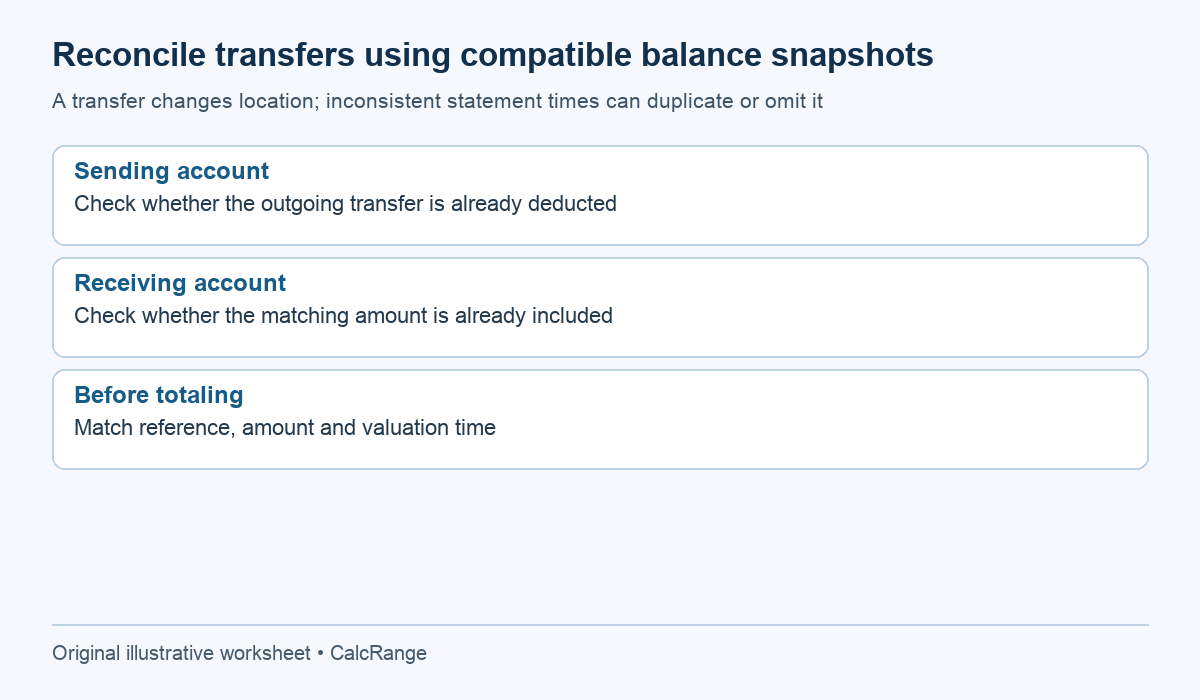
Suppose a bank statement shows a transfer of 2,000 out of an account while a second account’s latest downloaded statement was produced before the incoming transfer appeared. Adding the two statement balances may omit the money in transit. Using an older sending-account balance with a newer receiving-account balance may count it twice.
For Zakat assets, choose the valuation date and record the balance times or statement cutoffs. Match the transfer reference, amount and receiving account. If the position at that moment is unclear, keep a reconciliation note and obtain the missing statement or transaction confirmation. Do not invent a balancing asset merely to make two inconsistent snapshots agree.
This is an accounting check on where the money is recorded. It does not determine the religious treatment of a particular transfer, receivable or ownership arrangement. Once the record is reconciled, apply the guidance you follow to the actual asset and circumstances.
Check 2: do not add a dividend again when it is already cash
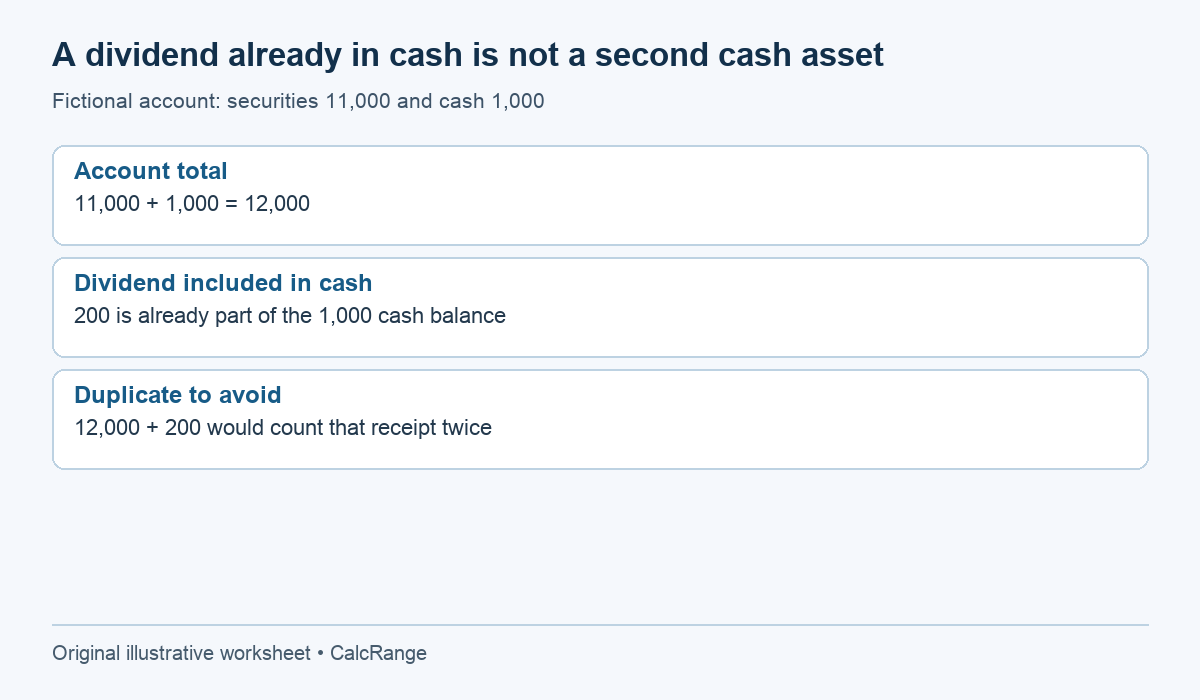
Imagine a brokerage account showing securities worth 11,000 and a cash balance of 1,000. Its total is 12,000. If the 1,000 cash already includes a 200 dividend received before the snapshot, adding a separate “dividend” asset of 200 would produce 12,200 and count that same cash twice.
Keep a transaction record explaining where the dividend went, but distinguish transaction history from assets held at the valuation time. A historical receipt does not automatically create an additional current asset line. The same issue can arise with interest, sale proceeds or a returned deposit already included in a displayed balance.
The eligibility and treatment of different receipts can require qualified guidance. The arithmetic here only prevents the account total and its components from being added together. A worksheet should preserve the separate classification question rather than treating every receipt the same because it passed through one account.
Check 3: convert each currency once, then keep the original amount
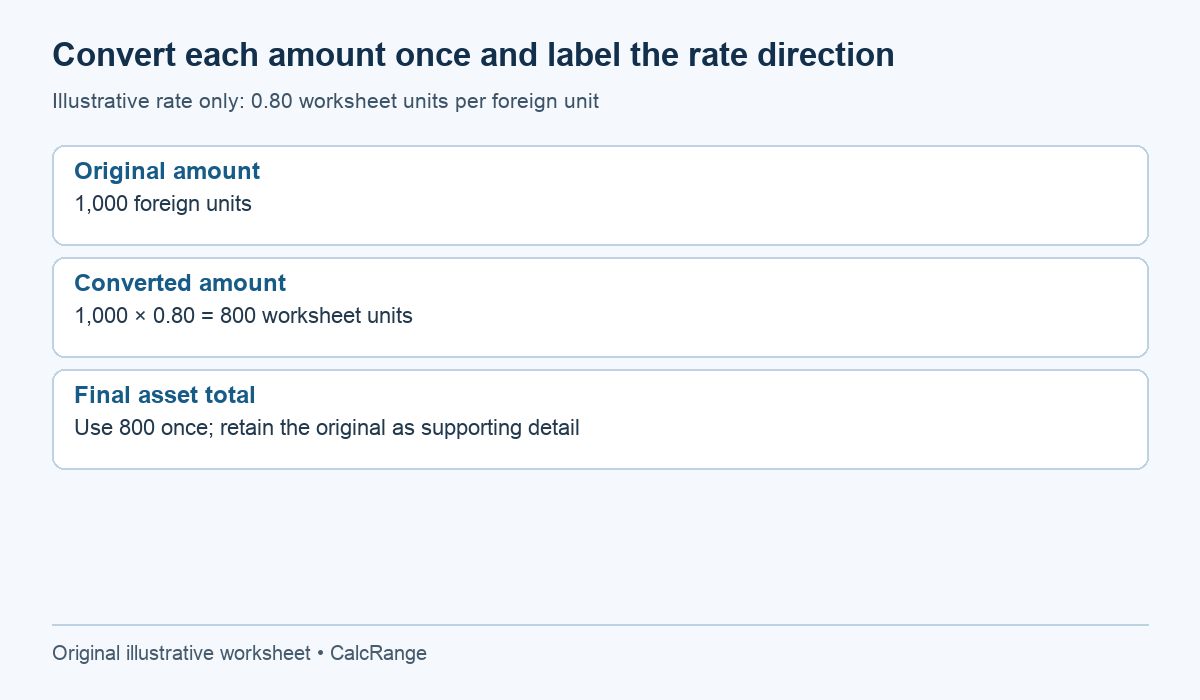
Suppose a record contains 1,000 units of a foreign currency and the chosen documented conversion rate is 0.80 units of the worksheet currency per foreign unit. The converted value is 800. Enter either the original amount with its conversion calculation or the converted amount in the final total, not both as separate assets.
Keep the currency code, rate direction, source and valuation date beside the calculation. The inverse rate would be 1.25 foreign units per worksheet unit. Multiplying by 1.25 instead of 0.80 changes the result because the rate is being used in the wrong direction; the labels explain which operation is appropriate.
The example rate is invented for arithmetic and is not a current exchange quote. Follow the valuation approach relevant to your guidance and circumstances. If an account statement already expresses several currencies in one reporting currency, check whether its grand total includes those converted balances before adding them individually.
Before transferring the reconciled Zakat assets total to a calculator, mark each line as a distinct asset, a component of another total or a historical transaction. Include only the distinct amounts in the ownership total. Then identify the portion included in the calculation under the guidance you follow, rather than assuming the ownership total and the zakatable base are identical.
Save the Zakat assets worksheet with its date and assumptions. The same structure can be reused next year, but balances, liabilities, valuation choices and eligibility should be reviewed again. Copying a previous total without checking its supporting lines carries forward any old duplication as well as any legitimate amount.
Resolve these Zakat assets questions before relying on the result
- Are all balances from the same relevant date and currency basis?
- Have transfers been reconciled rather than added as new wealth?
- Does each account appear once, using either totals or components?
- Has asset eligibility been established under the guidance you follow?
- Are liabilities deducted only once and only where permitted?
- Have nisab, hawl and the applicable rate been addressed separately?
For the broader cash calculation, see how to calculate Zakat. For investment-specific distinctions, see Zakat on stocks and consult qualified guidance. Retain enough supporting detail to explain the number, while keeping private account identifiers and documents secure.