
Multi-leg trip distance is the sum of the distances travelled between consecutive stops. Measuring only the first and last point skips the detours in between. A journey can even finish where it started and still cover a substantial distance.
Use the distance calculator to calculate individual geometric legs, then add those results in a worksheet. Its two-point calculations do not automatically create a drivable multi-stop itinerary. For road travel, use actual route distances rather than treating straight-line distances as road mileage.
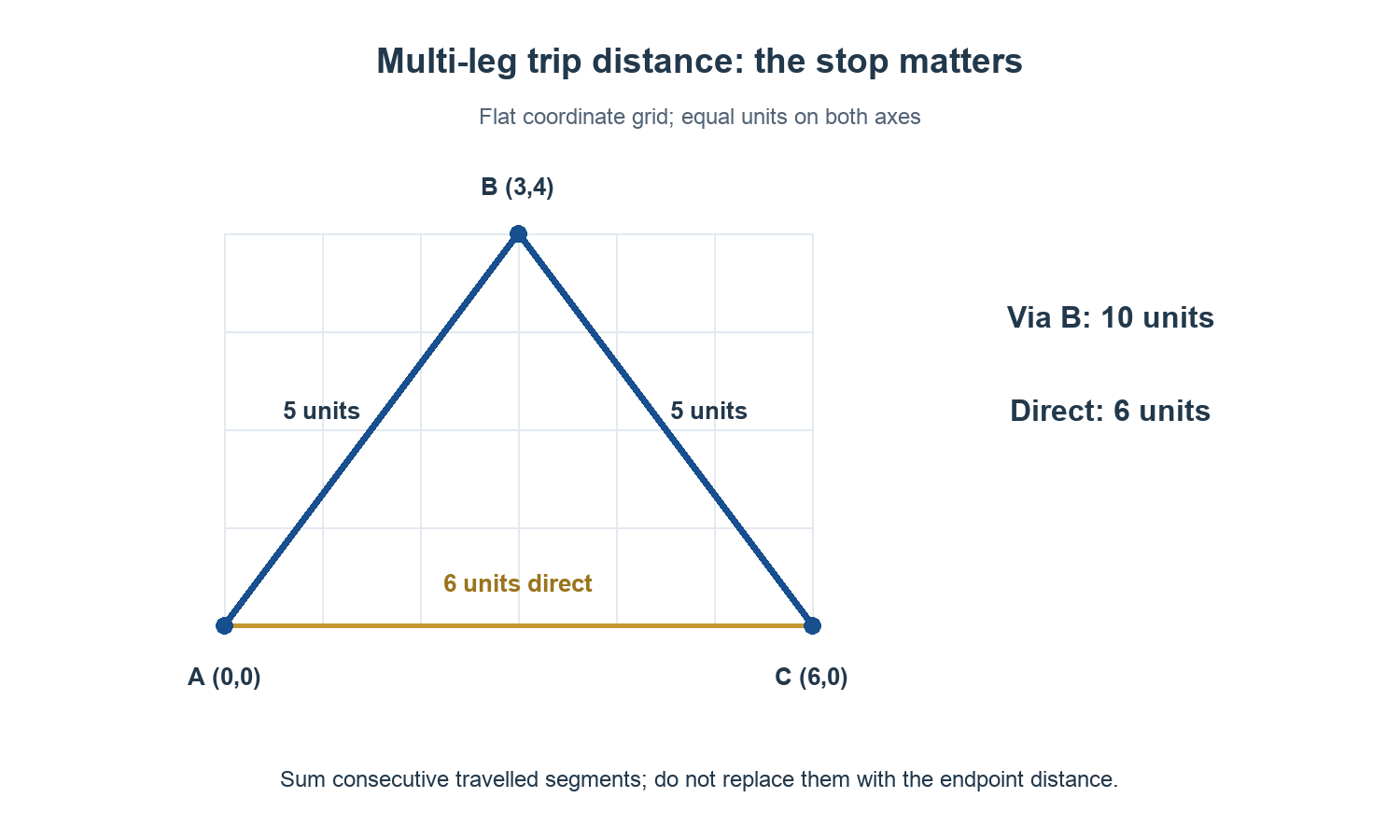
Table of Contents
Multi-leg trip distance: A to B to C
Our original diagram uses three points on a flat coordinate grid: A = (0, 0), B = (3, 4) and C = (6, 0). Every grid unit represents the same length on both axes. The route travels in straight segments from A to B, then from B to C.
For one planar segment, the distance formula is √((change in x)² + (change in y)²). It follows from the Pythagorean theorem; see OpenStax’s coordinate-system chapter for the underlying formula.
| Segment | Coordinate changes | Distance |
|---|---|---|
| A → B | 3 horizontally, 4 vertically | √(3² + 4²) = 5 units |
| B → C | 3 horizontally, −4 vertically | √(3² + (−4)²) = 5 units |
| Travelled A → B → C | Add the two legs | 5 + 5 = 10 units |
| Direct A → C | 6 horizontally, 0 vertically | 6 units |
The route length is 10 units; the direct endpoint distance is 6 units. Substituting the direct value would undercount the route by four units. The stop at B is part of the journey and cannot be discarded just because A and C share the same vertical coordinate.
In the calculator’s coordinate mode, calculate A to B first, record 5, then calculate B to C and record another 5. Adding those two lengths is the multi-leg calculation. Calculating A to C is a useful comparison, not a replacement for it.
Multi-leg trip distance needs the actual return leg
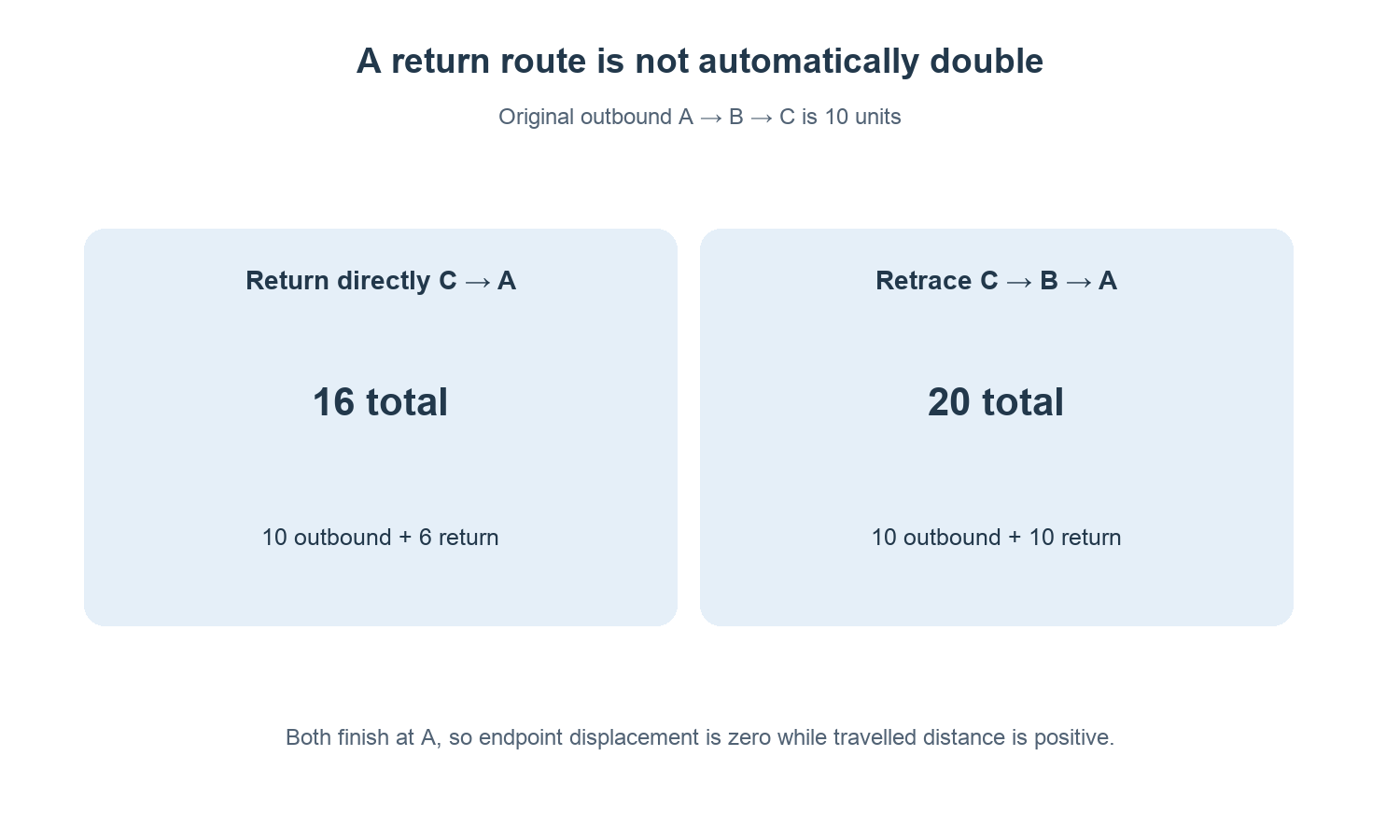
If the traveller returns directly from C to A along the bottom of the diagram, that return leg is six units. The complete A → B → C → A journey is 5 + 5 + 6 = 16 units.
It would be wrong to double the outbound ten-unit route unless the return also follows C → B → A. That retraced route would be 20 units. “Round trip” means a return to the starting point; it does not guarantee an identical route in both directions.
The start-to-finish displacement of either closed trip is zero. That does not make the distance travelled zero. Keep route length and endpoint displacement as separate values in sports, vehicle logs and geometry exercises.
Build a multi-leg trip distance worksheet
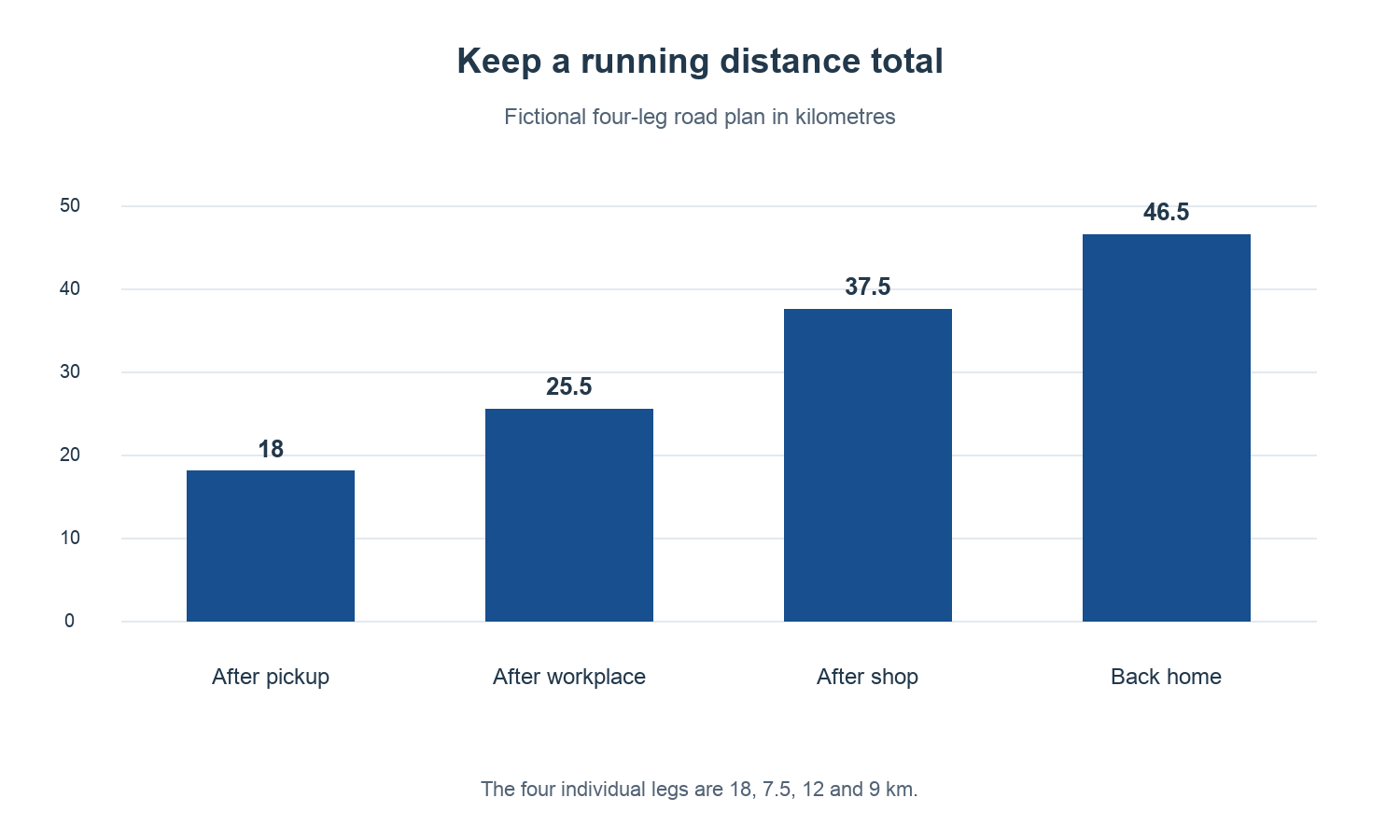
For a real trip, list the intended stops in order and obtain the route distance for each leg. The following distances are fictional planning inputs, not measurements of actual roads.
| Leg | Recorded route distance | Running total |
|---|---|---|
| Home → pickup | 18 km | 18 km |
| Pickup → workplace | 7.5 km | 25.5 km |
| Workplace → shop | 12 km | 37.5 km |
| Shop → home | 9 km | 46.5 km |
Keep each source distance beside the leg it describes. If a stop changes, replace the affected connecting legs. Adding a new stop usually changes both the approach to that stop and the route away from it; simply adding the distance from the old destination to the new stop may miss that change.
For a completed drive, an odometer log can measure the actual overall distance, provided the readings cover only that trip. A planned map route and an odometer record can differ because of detours, parking movements or a changed road choice. Our map-distance comparison guide discusses that distinction.
Normalize units and count every leg once
Do not add 10 miles and 10 kilometres as if they were the same unit. Ten international miles equal 16.09344 km, so the combined distance is 26.09344 km before rounding. Convert the legs to one unit, then sum them.
A repeated road section is counted each time it is travelled. That is different from double-counting the same logged leg by mistake. Label direction and sequence: “shop to home, second visit” is clearer than two unexplained entries both named “home.”
Do not enter latitude and longitude degrees into a flat x–y formula and interpret the result as kilometres. Geographic coordinates require an appropriate Earth-distance model, and even an Earth straight-line or great-circle estimate is not a road route. See straight-line vs driving distance before choosing the input method.
Multi-leg trip distance does not determine travel time
A 46.5 km itinerary does not tell you its duration unless travel speeds or actual leg times are supplied. Stops also add time without adding much distance. If you already have leg times, add them and the stop durations separately.
For example, fictional travel times of 25, 15, 20 and 15 minutes total 75 minutes. Two ten-minute stops make the whole outing 95 minutes. Dividing 46.5 km by a guessed single speed would hide those waits.
Once the total distance is established, the fuel cost calculator can estimate fuel from an assumed efficiency and price. Use the already-complete 46.5 km total as one-way input; selecting a round-trip multiplier again would double-count the return.
Multi-leg trip distance after replacing a stop
Suppose the original fictional road plan contains a 7.5 km leg from pickup to workplace and a 12 km leg from workplace to shop. If the workplace stop is replaced by another location, both connecting legs must be updated.
Assume the new pickup-to-stop distance is 9 km and the new stop-to-shop distance is 14 km. The unchanged home-to-pickup and shop-to-home legs remain 18 km and 9 km. The new total is 18 + 9 + 14 + 9 = 50 km, compared with the original 46.5 km.
| Component | Original plan | Revised plan |
|---|---|---|
| Unchanged outer legs | 18 + 9 = 27 km | 27 km |
| Two legs around the changed stop | 7.5 + 12 = 19.5 km | 9 + 14 = 23 km |
| Whole itinerary | 46.5 km | 50 km |
The increase is 3.5 km. Do not add the entire revised middle segment to the old total without removing the obsolete segment first. A leg list makes that replacement visible.
Multi-leg trip distance with mixed units
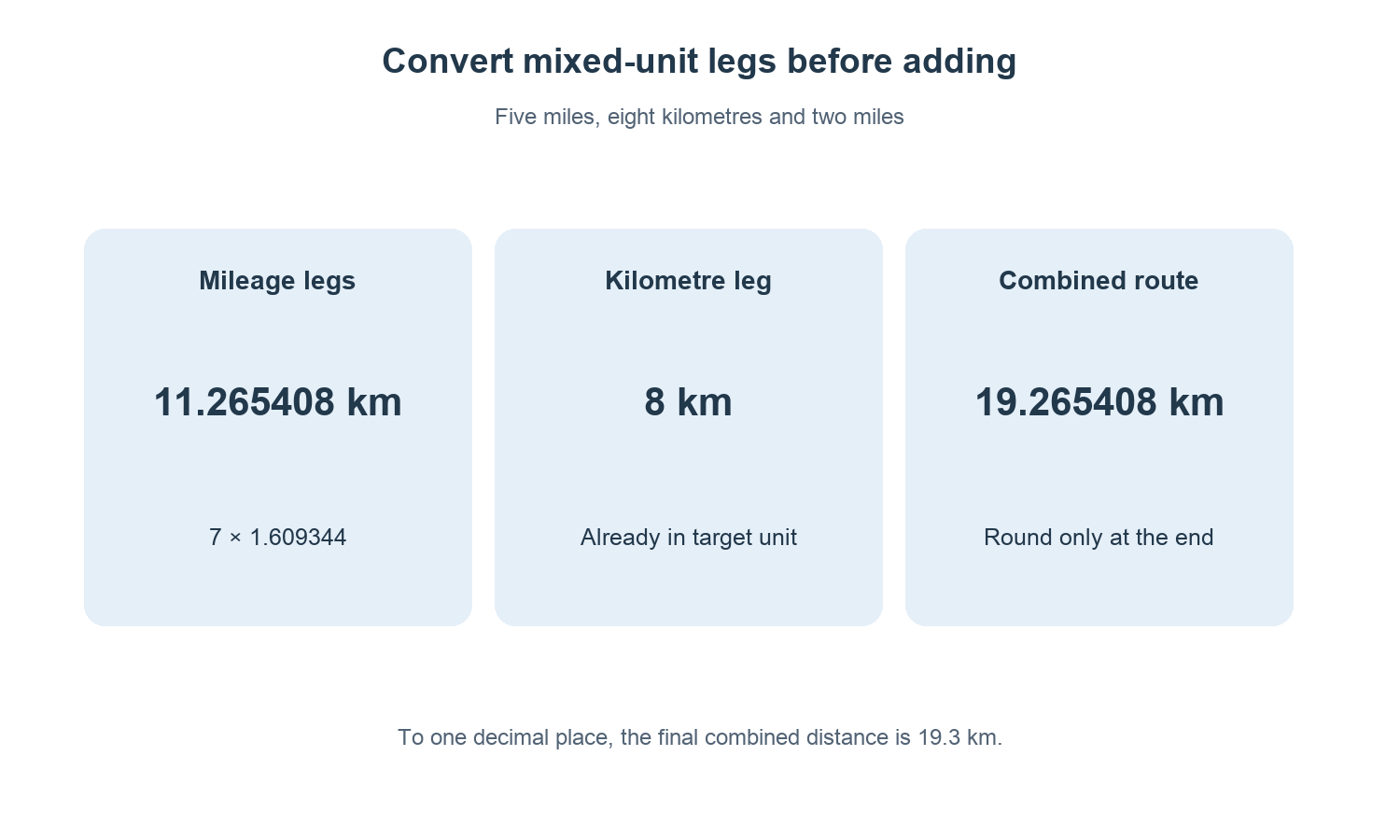
Consider three fictional legs recorded as 5 miles, 8 km and 2 miles. Using the exact international-mile conversion of 1.609344 km, the mileage legs total 7 × 1.609344 = 11.265408 km. Adding the 8 km leg gives 19.265408 km.
If you round each converted leg to one decimal place first, 5 miles becomes 8.0 km and 2 miles becomes 3.2 km, giving 19.2 km. Converting and summing before final rounding gives 19.3 km to one decimal place.
Neither display adds real precision to the original observations. Keep enough internal precision to avoid unnecessary rounding drift, then report a total consistent with the measurement quality.
Repeated travel needs repeated entries
A delivery run might travel A → B → A → B. If the measured route in each direction is 4 km, three travelled legs total 12 km. The final endpoint is only 4 km from the start along that route, but two extra traversals occurred.
This is legitimate repetition, unlike accidentally importing the same leg record twice. Add a sequence number or timestamp to each entry so the worksheet distinguishes repeated travel from duplicate data.
For road routes, do not assume B → A always has the same distance as A → B. One-way streets, entry points or route choices can differ. Use the actual return measurement when that distinction matters.
Two checks on a completed itinerary
First, compare the sum of recorded legs with the trip odometer difference when both cover exactly the same journey. If the odometer includes an extra errand or the leg list excludes parking movements, they are not measuring the same scope.
Second, inspect the running total after each leg. It should increase by that leg’s positive distance. A total that decreases usually indicates a sign error or a value entered as a coordinate rather than a length.
Keep planned and completed distances in separate columns. The difference can be useful for reviewing a route, but it should not be silently overwritten so that the original plan appears to have predicted the actual journey exactly.
Checks and common questions
- Are all stops listed in their intended order?
- Does every leg start where the previous one ended?
- Are lengths in one unit and based on a consistent distance method?
- Is the return route explicitly included?
- Have you kept travel distance, travel time and stop time separate?
Can the sum be shorter than the direct distance?
For consistent straight segments on the same flat plane, the sum cannot be shorter than the direct endpoint distance. An apparent exception suggests mixed units, inconsistent measurement methods or a calculation error.
Does adding more stops always add distance?
A stop directly on the existing route can add no geometric distance, though it may add time. A detour away from that route generally adds length.
Calculate each known geometric leg in the distance calculator, and retain the leg list so the total can be checked.