
To calculate overnight shift hours, place clock-out on the correct next date, find the full elapsed duration, then subtract only breaks that should be excluded from paid time. An ordinary 22:00-to-06:00 shift lasts eight hours when the clock’s offset does not change. A qualifying 30-minute unpaid break leaves 7 hours 30 minutes, or 7.5 decimal hours.
Use the time card calculator to check the ordinary time-of-day arithmetic. Keep the actual dates and any clock-change information in your records, because its weekday rows and time fields do not capture a named time zone or every payroll rule.
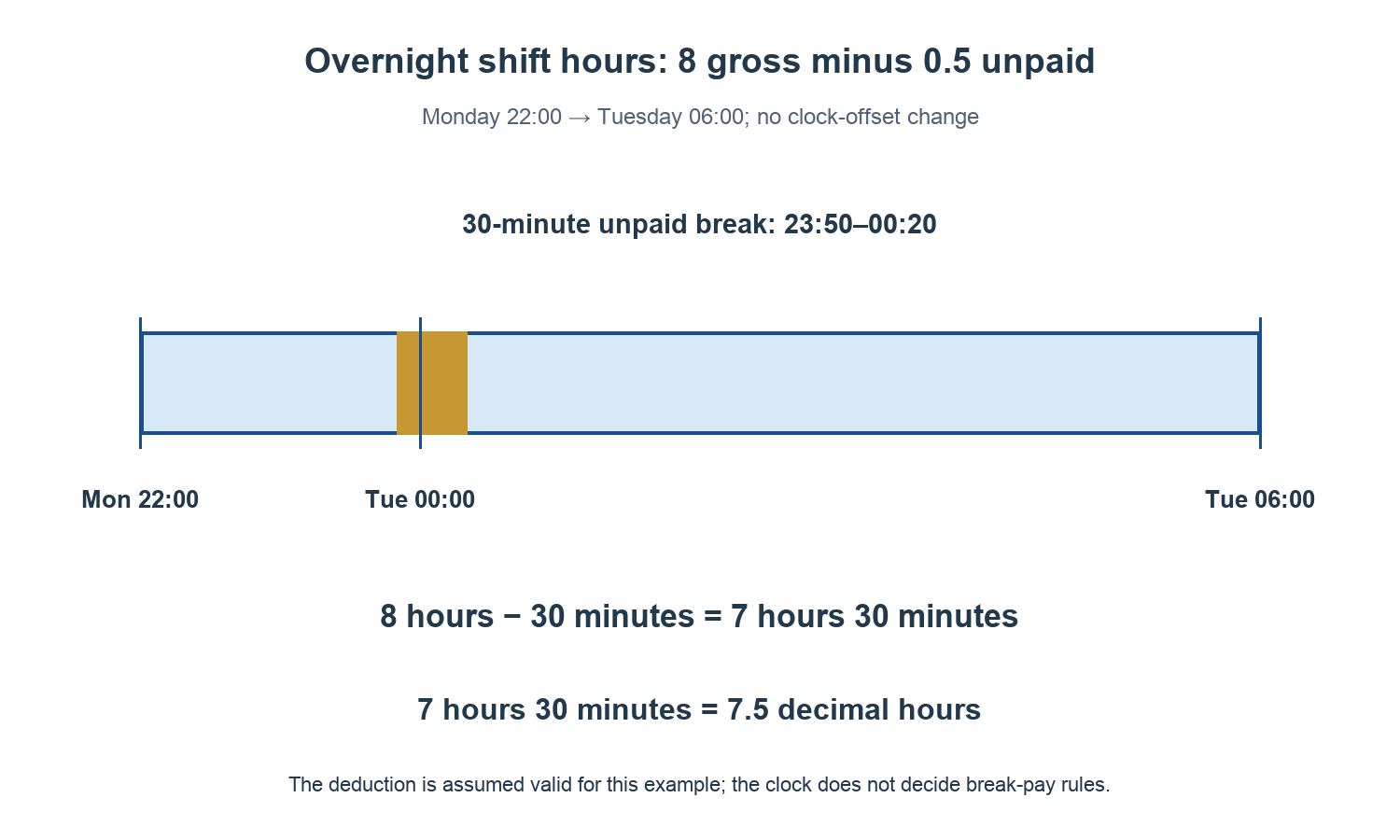
Table of Contents
Overnight shift hours: 22:00 Monday to 06:00 Tuesday
Write the dates before subtracting. In this example, clock-in is Monday, October 19, 2026 at 22:00, and clock-out is Tuesday, October 20 at 06:00. Assume no time-zone offset change and no other unpaid intervals.
| Part | Calculation | Duration |
|---|---|---|
| Before midnight | 22:00 → next 00:00 | 2 hours |
| After midnight | 00:00 → 06:00 | 6 hours |
| Gross shift | 2 + 6 | 8 hours |
| Qualifying unpaid break | 30 minutes ÷ 60 | 0.5 hour |
| Net hours | 8 − 0.5 | 7.5 hours |
Subtracting the bare numbers 06:00 − 22:00 gives a negative result because it treats both times as if they belonged to the same date. Adding the missing date boundary resolves the ordinary overnight case.
A negative time-only difference does not always prove a night shift, however. It could also be a mistyped time, an AM/PM mistake or reversed inputs. Confirm the original clock records before accepting the next-day interpretation.
Overnight shift hours when the break crosses midnight
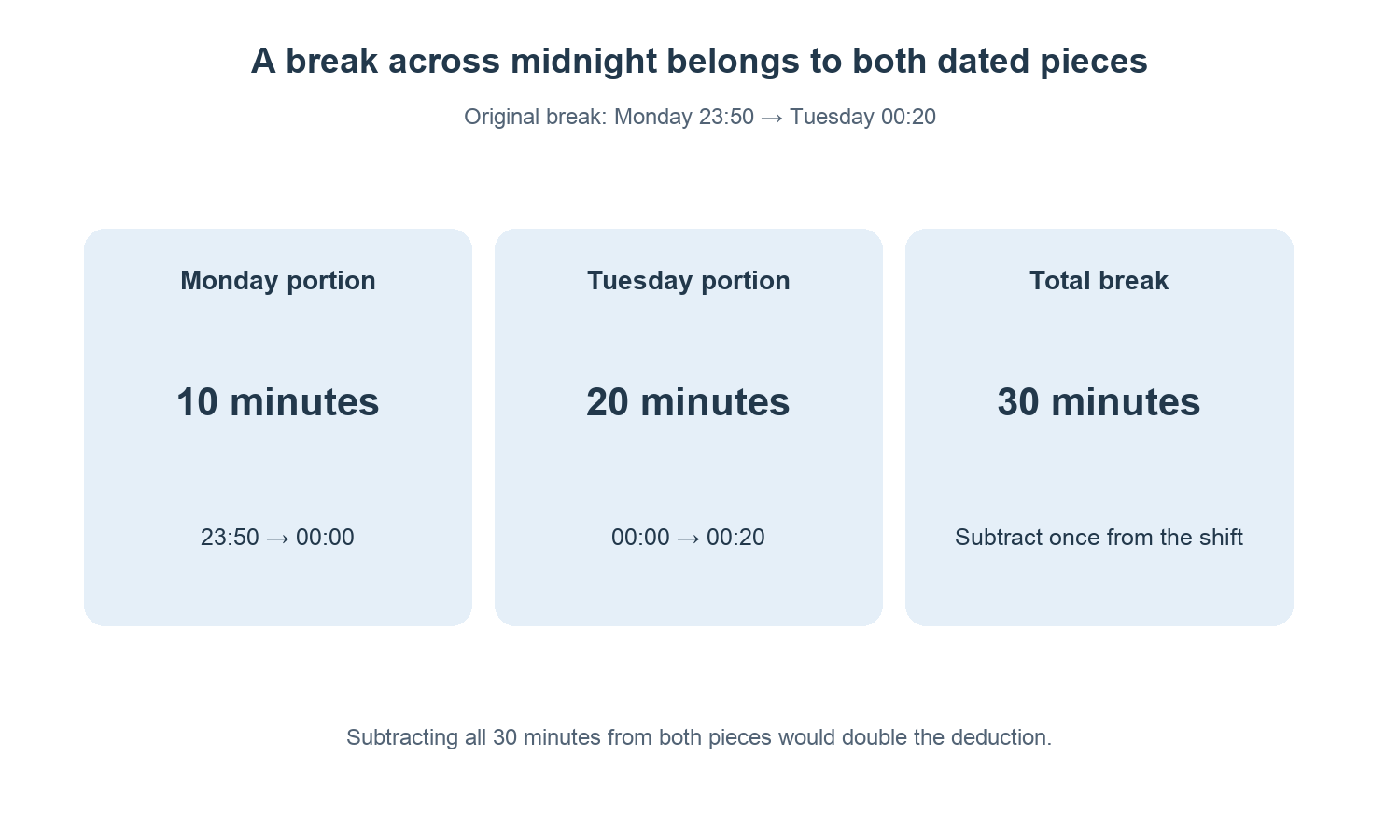
Suppose the break starts at 23:50 Monday and ends at 00:20 Tuesday. Count ten minutes to midnight plus twenty minutes afterward: the break lasts 30 minutes. Subtract it once from the full shift.
If you split the shift into dated pieces, you can instead allocate ten break minutes to Monday and twenty to Tuesday. Monday contributes 1 hour 50 minutes of net time, and Tuesday contributes 5 hours 40 minutes. Together they still total 7 hours 30 minutes.
Do not subtract the full 30 minutes from both pieces. That would reduce an eight-hour gross shift to seven hours, understating the actual net duration by half an hour.
Keeping a dated break record also makes it possible to explain corrections later. A single “30 minutes” field is convenient for arithmetic but does not say when the break happened or whether work interrupted it.
Convert minutes using 60, not 100
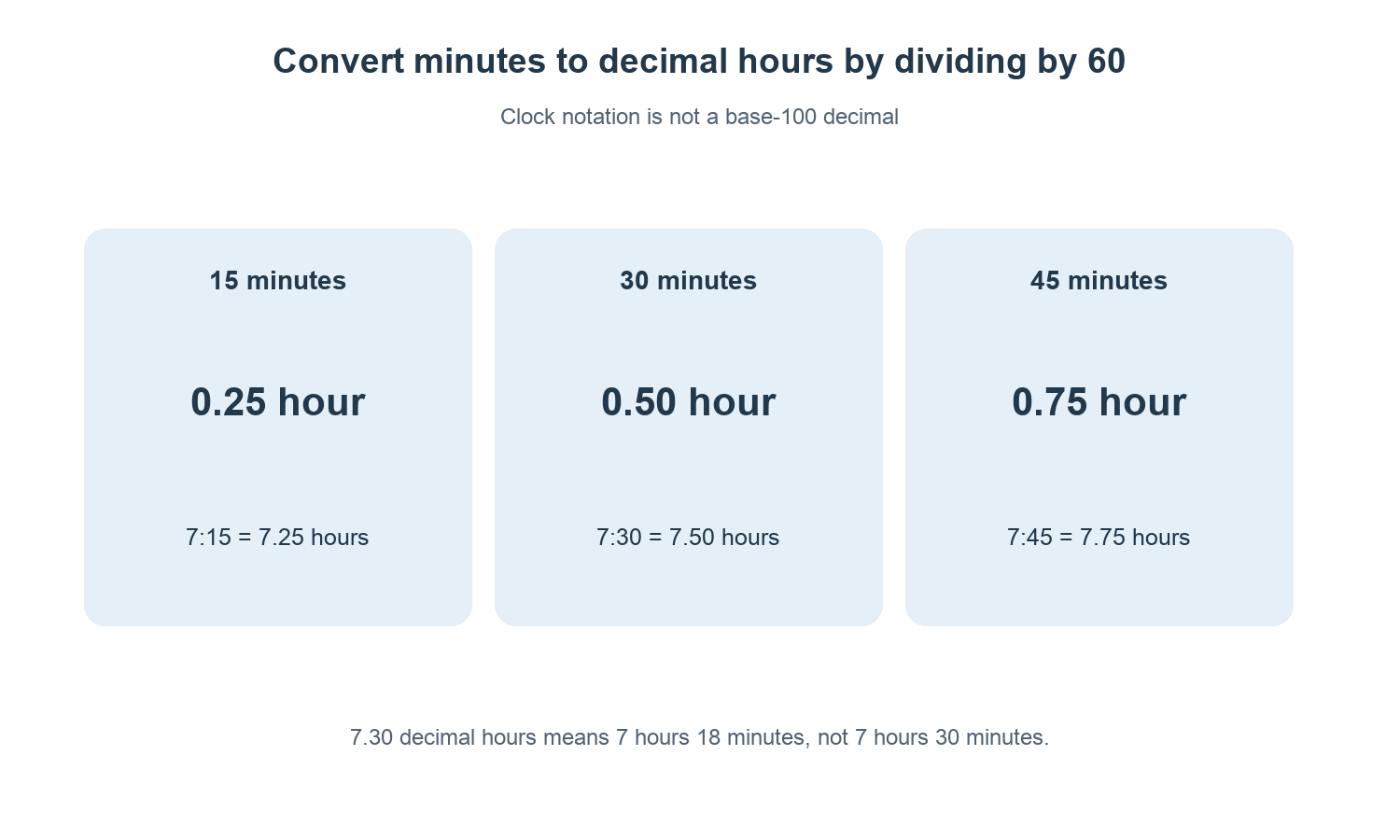
Clock notation and payroll decimals use different bases. Seven hours and thirty minutes is 7 + 30/60 = 7.5 hours. It is not 7.30 decimal hours. In decimal form, 0.30 hour means 18 minutes.
| Minutes | Decimal hours | Example duration |
|---|---|---|
| 15 | 0.25 | 7 h 15 min = 7.25 h |
| 30 | 0.50 | 7 h 30 min = 7.50 h |
| 45 | 0.75 | 7 h 45 min = 7.75 h |
| 6 | 0.10 | 7 h 6 min = 7.10 h |
For another example, 22:15 to 06:45 the next day is eight hours thirty minutes. Deducting a qualifying 45-minute unpaid break gives seven hours forty-five minutes, or 7.75 hours.
Enter ordinary overnight shift hours
- Choose the weekday row used for the shift in your worksheet.
- Enter 22:00 as clock-in and 06:00 as clock-out.
- Enter 30 in the unpaid-break-minutes field, provided that deduction is appropriate.
- Select no rounding for an exact arithmetic check.
- Compare the result with the expected 7.5 hours before using an optional hourly-rate estimate.
A worksheet’s choice to place the shift in Monday’s row is not a decision about how payroll must allocate hours across a workweek boundary. If the employer’s workweek ends during the shift, preserve the dated segments and have payroll apply the correct allocation.
For weekly premium calculations, use the overtime calculator separately. A time-card total by itself does not decide whether overtime, a night differential or another premium is due.
Daylight saving and shifts lasting a day or more
A time-only calculator cannot tell whether a repeated or skipped hour occurs between clock-in and clock-out. Across a one-hour spring-forward transition, a 22:00-to-06:00 local-clock span can be seven actual hours. Across a one-hour fall-back transition, it can be nine. The exact answer depends on the date and location.
The NIST daylight-saving explanation describes those one-hour U.S. transitions. For the distinction between date labels and duration, see calendar days vs 24-hour periods.
Use dated, zone-aware timestamps for those cases. Similarly, equal clock-in and clock-out values might mean no time or a 24-hour interval; a single pair of time-of-day values cannot establish which. A shift spanning more than one midnight needs explicit dates rather than an automatic one-day rollover.
Do not deduct a break solely because it is called a break
For covered U.S. work, the Department of Labor explains that short rest breaks are generally compensable. The federal meal-period rule distinguishes a bona fide meal period in which the worker is relieved of duties. State requirements may add protections.
The examples here assume a valid unpaid deduction; they do not establish one from the clock times. Record actual interruptions and check the governing rules rather than automatically deducting a scheduled meal that was not taken.
Combine four overnight shift hours without averaging them
The following fictional week contains four ordinary overnight shifts with no offset changes. Each break is assumed to be a valid unpaid interval for this arithmetic exercise. The table does not establish a payroll entitlement or a required work schedule.
| Shift | Clock-in → next-day clock-out | Unpaid break | Net time | Decimal hours |
|---|---|---|---|---|
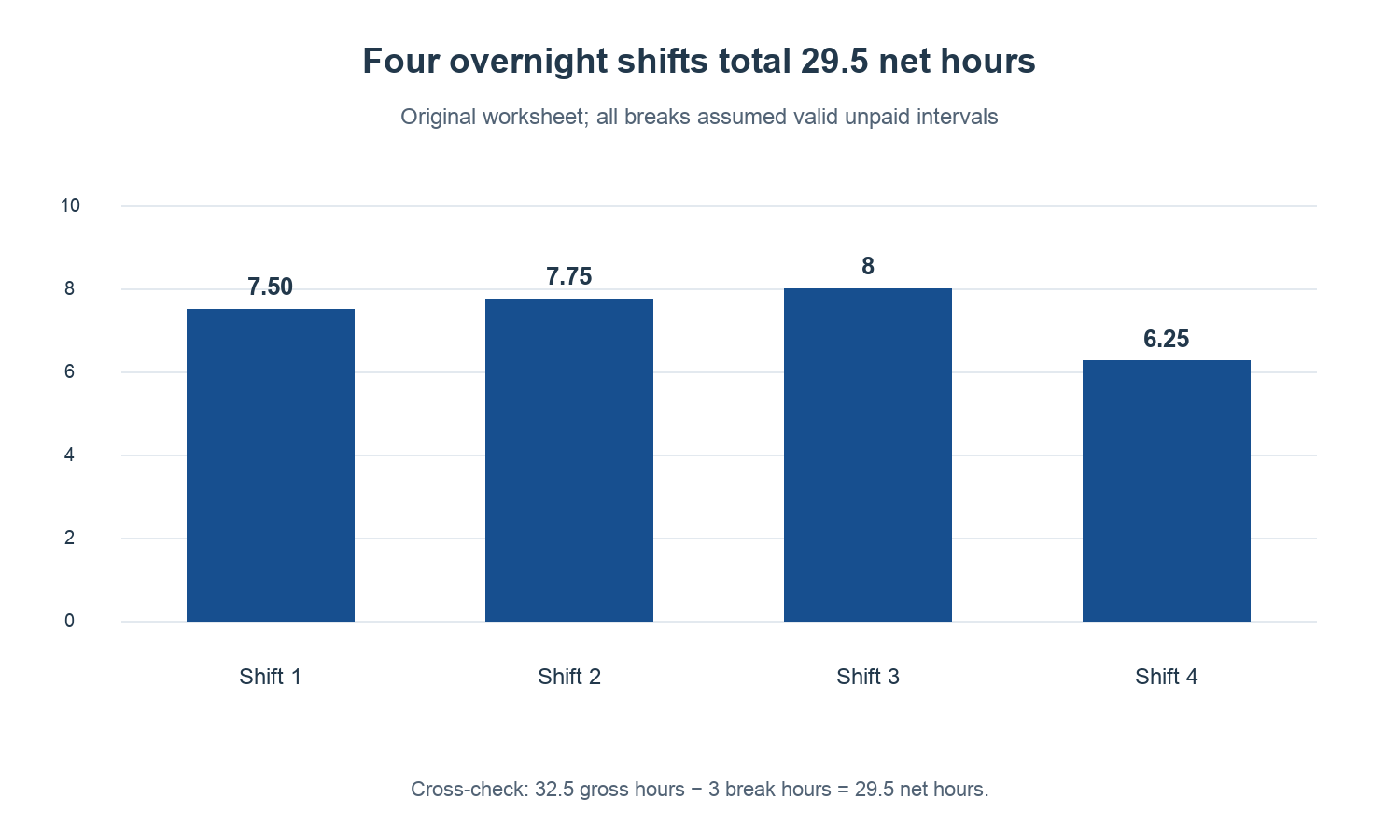
| 1 | 22:00 → 06:00 | 30 minutes | 7 h 30 min | 7.50 |
| 2 | 22:15 → 06:45 | 45 minutes | 7 h 45 min | 7.75 |
| 3 | 21:00 → 06:00 | 60 minutes | 8 h | 8.00 |
| 4 | 23:00 → 06:00 | 45 minutes | 6 h 15 min | 6.25 |
| Total | Four shifts | 180 minutes | 29 h 30 min | 29.50 |
Gross time is 8 + 8.5 + 9 + 7 = 32.5 hours. Breaks total 180 minutes, or three hours. Subtracting gives 29.5 hours, matching the sum of the net rows.
This second route to the same total is a useful control. If the two calculations disagree, inspect a break conversion or a row’s next-day interpretation before rounding away the difference.
Cross-check overnight shift hours by summing minutes
The four net shifts are 450, 465, 480 and 375 minutes. They total 1,770 minutes. Dividing by 60 gives 29.5 hours; dividing into whole hours and a remainder gives 29 hours and 30 minutes.
This method avoids carrying a column of minutes incorrectly. For example, 7:45 plus 6:30 is 14:15, not 13:75 written as if it were an ordinary decimal. The 75 accumulated minutes must carry one hour and leave 15 minutes.
Keep the unit in the column heading. A spreadsheet cell labelled “hours” should not silently mix 7.5 decimal hours with the text 7:30 or a duration formatted as a clock time. Convert all rows to the same representation before summing.
A straight-time cost check is not an overtime calculation
At a fictional flat rate of 20 currency units per hour, 29.5 hours gives 590 units of straight-time earnings. That multiplication checks the entered rate and duration only. It does not decide whether other weekly hours, premiums, different rates or deductions must be included.
If the employee also worked daytime shifts, add those relevant records before evaluating a workweek total. Do not conclude that overtime is absent merely because this four-row subset is below a threshold.
Correct overnight shift hours without losing the history
Suppose the recorded clock-out for the second shift is corrected from 06:45 to 06:30. With the same 45-minute unpaid break, net time changes from 7.75 to 7.50 hours, reducing the four-shift total by 0.25 hour to 29.25.
Record both the original and corrected punch, the relevant date and why it changed. Changing only the final decimal total makes it harder to distinguish a real correction from a calculator or transcription error.
The same principle applies to a break that was interrupted or not taken. Resolve the correct paid-time treatment from the actual record and applicable rules, then update the break input. The calculator should follow the verified record rather than dictate it.
Checks and common questions
Should I round each clock punch?
For a transparent calculation, first preserve the actual recorded times and use no rounding. A calculator’s rounding option is a mathematical feature, not confirmation that a payroll rounding practice is lawful.
Does working past midnight automatically earn overtime?
No. Crossing a date boundary establishes an overnight duration, not an overtime entitlement. The applicable workweek, jurisdiction and employment rules matter.
What should I save with the result?
Save both dated clock punches, actual break intervals, the time zone if relevant, any applied rounding and the reason for corrections. Those details make a total reproducible.
Check a normal night shift in the time card calculator, then keep the dated source record for payroll decisions.