
Primer vs paint quantity should be calculated separately because the treated area, coat count and coverage can differ. For each product, use quantity = area × coats ÷ coverage per litre or gallon. Then round each product to available pack sizes. The Paint Calculator includes separate primer coverage and coat inputs, but you must supply the product and surface assumptions.
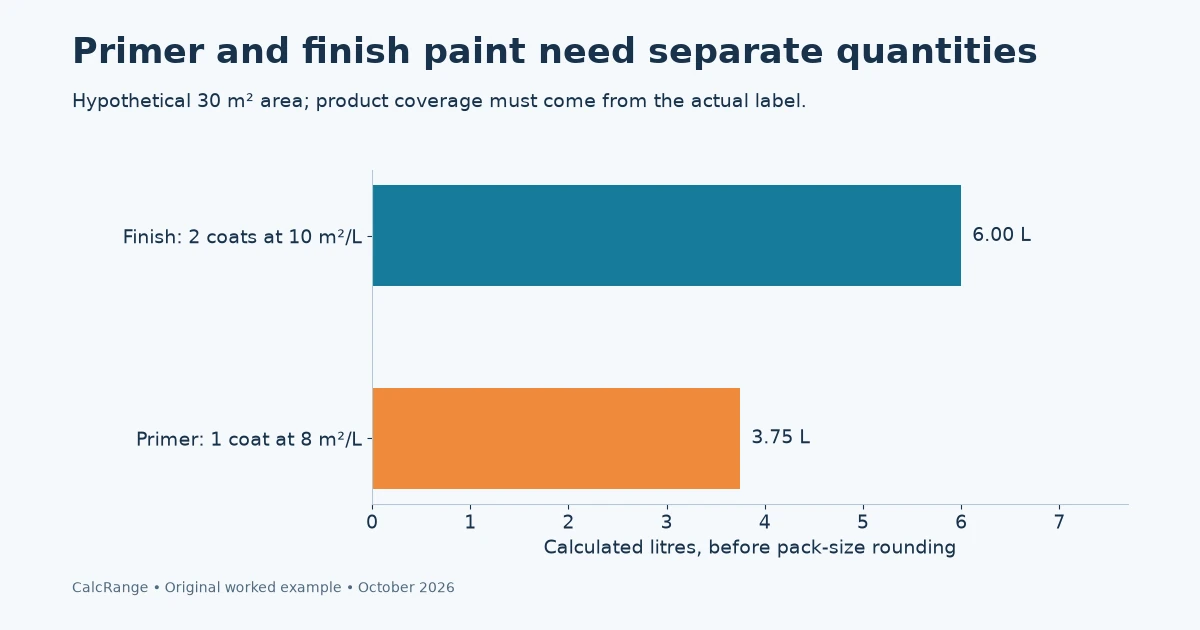
Table of Contents
Primer vs paint: why combined coat totals can be wrong
One primer coat plus two finish coats is not three coats of the same product. If primer covers 8 m²/L and finish paint covers 10 m²/L, dividing three times the wall area by a single coverage number loses that distinction. It can also leave the shopping list short of one product even when the combined litre total looks reasonable.
Whether primer is needed, and which primer is suitable, depends on the coating system and surface. This worksheet does not prescribe primer for every repaint. Follow the current label and preparation instructions for the exact product, including any conditions attached to “paint and primer” claims.
Behr’s quantity guidance gives product-specific coverage ranges and tells readers to consult the label. Its Premium Plus guidance also distinguishes surfaces that may need a dedicated primer. These examples illustrate why one universal spreading rate is insufficient.
Primer vs paint: a 30 m² room example
Assume a measured net area of 30 m². A hypothetical product plan specifies one primer coat at 8 m²/L and two finish coats at 10 m²/L. These are invented inputs for arithmetic, not coverage specifications for a named brand.
| Product | Area | Coats | Coverage | Calculated quantity |
|---|---|---|---|---|
| Primer | 30 m² | 1 | 8 m²/L | 3.75 L |
| Finish paint | 30 m² | 2 | 10 m²/L | 6.00 L |
Primer: 30 × 1 ÷ 8 = 3.75 L. Finish paint: 30 × 2 ÷ 10 = 6 L. The total liquid is 9.75 L, but the useful purchase list still has two separate lines. Buying 9.75 L of finish paint would not supply the primer.
If primer is available only in 2.5 L packs, two packs provide 5 L. If finish paint is available in 5 L and 1 L packs, one of each provides 6 L. That is an illustration of available sizes, not a claim that those packs exist for every product. Record both calculated use and purchased volume.
What if only part of the room needs primer?
Keep the primer area independent. If only 6 m² of repaired patches is to be primed under the specified coating system, one coat at 8 m²/L requires 0.75 L. The finish-paint calculation can still cover all 30 m² twice, giving 6 L.
| Scenario | Primer area | Primer quantity | Finish quantity |
|---|---|---|---|
| Full-area primer assumption | 30 m² | 3.75 L | 6.00 L |
| Specified patch-only primer assumption | 6 m² | 0.75 L | 6.00 L |
The difference is 3 L of calculated primer, caused by area rather than coat count. Do not reduce the finish-paint area merely because only some of the wall is primed.
The calculator’s primer option follows its selected painting area. If primer and finish cover different areas, run separate area calculations and label the outputs clearly, or use the manual worksheet here. Do not assume a same-area switch models selective patch priming.
Copy the right facts from each product label
Record product name and version, intended surface, coverage unit, coat guidance, application method and pack size. A number expressed in square feet per US gallon cannot be entered unchanged into a square-metres-per-litre field.
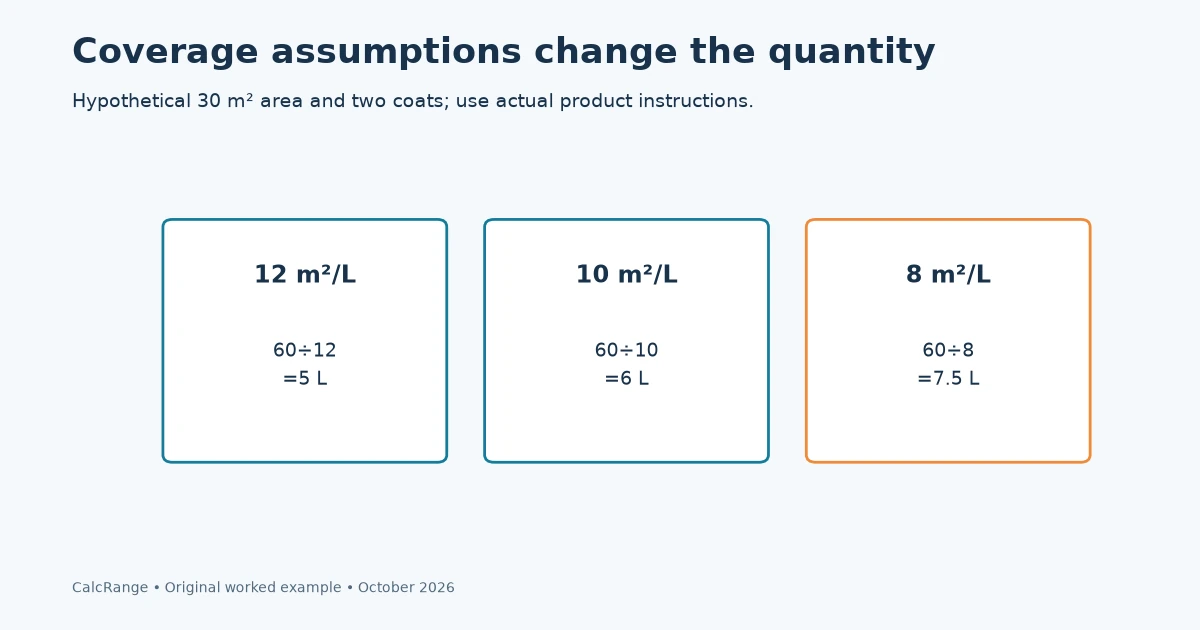
When a label supplies a coverage range, calculate the range rather than silently choosing the most optimistic end. For a hypothetical 30 m² job with two coats and coverage from 8 to 12 m²/L, estimated use ranges from 60 ÷ 12 = 5 L to 60 ÷ 8 = 7.5 L. Lower coverage means more material.
A manufacturer may quote a theoretical spreading rate, a practical rate or conditions tied to film thickness. Follow those conditions and ask the supplier if the surface or application differs. An arbitrary extra coat or an invented waste percentage is not a substitute for that information.
| Item to record | Primer | Finish paint |
|---|---|---|
| Exact product | Write label name | Write label name |
| Area actually treated | m² or ft² | m² or ft² |
| Specified coats | Number | Number |
| Coverage and conditions | Copy exact unit/range | Copy exact unit/range |
| Available pack sizes | List sizes | List sizes |
Keep recoat time separate from material quantity. A litre calculation cannot determine when a coating is ready for the next layer. Follow the label’s timing, preparation and safety instructions rather than multiplying time by the number of coats.
Check the Paint Calculator against the worksheet
Select the correct measurement system and either room dimensions or total wall area. Make sure openings are deducted only once: if 30 m² is already a net area, do not subtract the same doors and windows again. Check whether the ceiling belongs in this product calculation.
For the full-area example, use one primer coat and its own coverage rate, then two finish coats and their separate rate. Choose the smooth/repaint assumption for a plain arithmetic comparison; any selected surface adjustment changes the effective model and should be recorded. Compare the separate result lines with 3.75 L and 6 L before relying on purchase rounding.
For irregular walls, calculate each painted area first. The room measurement guide supplies the geometry, while coat-count guidance is a separate decision to reconcile with your product instructions. Use the Unit Converter when the label and measurements use different units.
Primer vs paint packs: round each product separately
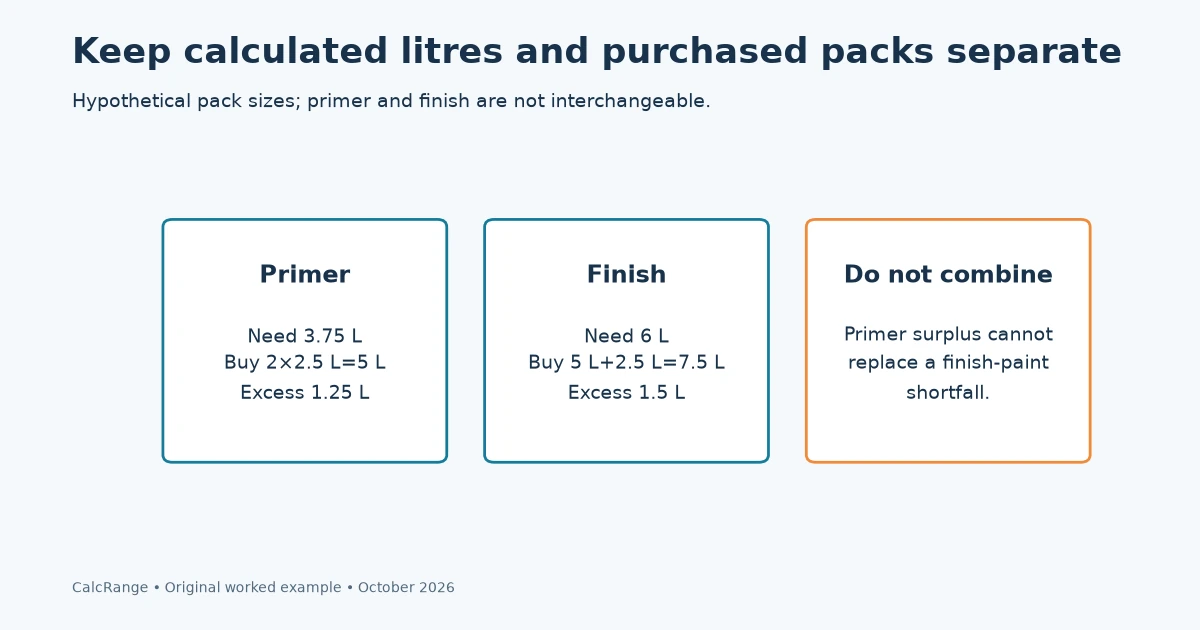
Calculated litres and purchasable pack sizes are different outputs. Suppose primer comes in 2.5 L packs and the calculated need is 3.75 L. Two packs provide 5 L, leaving 1.25 L above the arithmetic estimate. One pack is insufficient under the stated assumptions.
For 6 L of finish paint, suppose 2.5 L and 5 L packs are available. A 5 L pack plus a 2.5 L pack supplies 7.5 L. Three 2.5 L packs supply the same volume, but their price may differ.
| Product | Calculated quantity | Chosen packs | Purchased quantity |
|---|---|---|---|
| Primer | 3.75 L | 2 × 2.5 L | 5 L |
| Finish | 6 L | 1 × 5 L + 1 × 2.5 L | 7.5 L |
Keep the 1.25 L primer excess and 1.5 L finish excess on separate lines. They cannot be combined to make one product’s shortfall disappear. An allowance already included in the input should also be distinguished from the extra volume created by pack rounding.
Compare available pack combinations and the actual prices before describing one as cheapest. The calculator’s price fields can support an estimate, but it does not check a retailer’s live stock, return policy or tinting conditions.
Split a project when walls and ceiling use different products
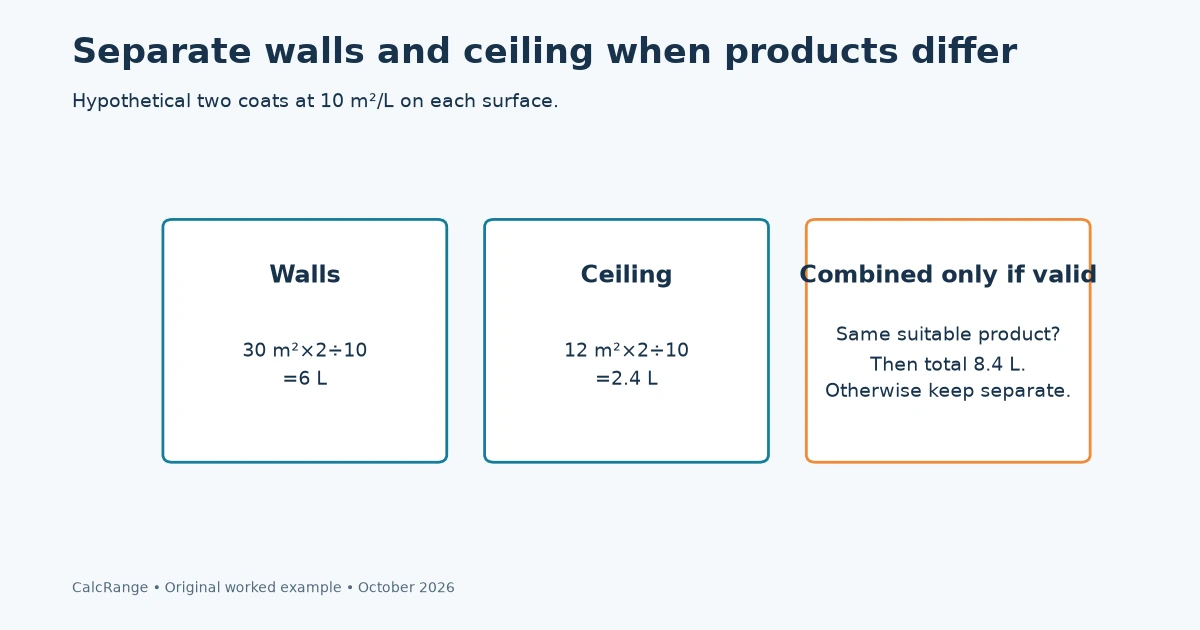
A combined room area is convenient only when the same product assumptions apply. Suppose net walls are 30 m² and the ceiling is 12 m². Two finish coats at a hypothetical 10 m²/L require 6 L for the walls and 2.4 L for the ceiling.
If the same coating is suitable for both surfaces under its instructions, the arithmetic combined quantity is 8.4 L. If different products are specified, retain the two quantities separately even though the geometry can be added.
The primer scope may differ again. Fresh repair patches, a newly prepared ceiling and previously coated walls need not share the same treatment. Record the actual area to which each product will be applied instead of automatically assigning the full room area to every line.
Run separate calculator scenarios when a single form assumes one coverage and coat count for the entire selected area. Save a short label such as “walls, finish only” with each result so later totals do not include the same surface twice.
This is a bookkeeping distinction, not a claim that any particular surface always needs primer. The product instructions and actual substrate determine that decision.
Primer vs paint coverage: separate ranges and allowances
For 30 m² with two coats, a coverage of 12 m²/L implies 5 L, 10 m²/L implies 6 L, and 8 m²/L implies 7.5 L. This three-point comparison is useful before choosing a purchase quantity.
If you also enter a 10% quantity allowance, the 6 L midpoint becomes 6.6 L. That is a separate stated assumption. It is not the same as changing coverage to 9 m²/L, which would require about 6.67 L.
Avoid quietly layering several conservative assumptions without identifying them. Choosing the low end of coverage, increasing the number of coats and adding a further allowance can all increase quantity. Any may be justified, but the record should show the reason for each rather than call the final total an exact requirement.
When comparing the estimate with actual use, record leftover usable product and the actual area and coats completed. An unopened pack is not consumed paint. A short project log can improve the next estimate without turning one project’s result into a universal spreading rate.
The final purchase note should name each product, treated area, coat count, label coverage, any explicit allowance and selected packs. That is the useful output of a primer-versus-paint quantity comparison.
Primer vs paint: common questions
Does one primer coat replace one finish coat?
Not automatically. Follow the specified coating system. Keep primer and finish coat counts on separate lines rather than subtracting one without product guidance.
Can I add primer litres to paint litres when shopping?
You can total liquid volume for bookkeeping, but the products are not interchangeable. Keep a separate calculated and purchased quantity for each.
Should I use the highest coverage on the label?
Do not assume the best-case coverage applies. Check its stated conditions; if uncertain, calculate the full range and confirm a suitable allowance with the supplier.
Sources and calculation notes
The 8 and 10 m²/L examples are hypothetical. No universal primer requirement, coverage rate or safety procedure is inferred from them. Sources checked October 30, 2026.