
A discounted meal tip changes when you change the percentage base. A chosen 20% of a $100 menu subtotal is $20; 20% of the $75 subtotal after a coupon is $15. The percentage is identical, but the voluntary amount differs by $5.
This guide compares those choices without declaring one universal etiquette rule. Start with the receipt, decide which base you intend, and check the final currency amount. The Tip Calculator currently calculates a tip after any entered discount, so an original-price tip needs a separate step.
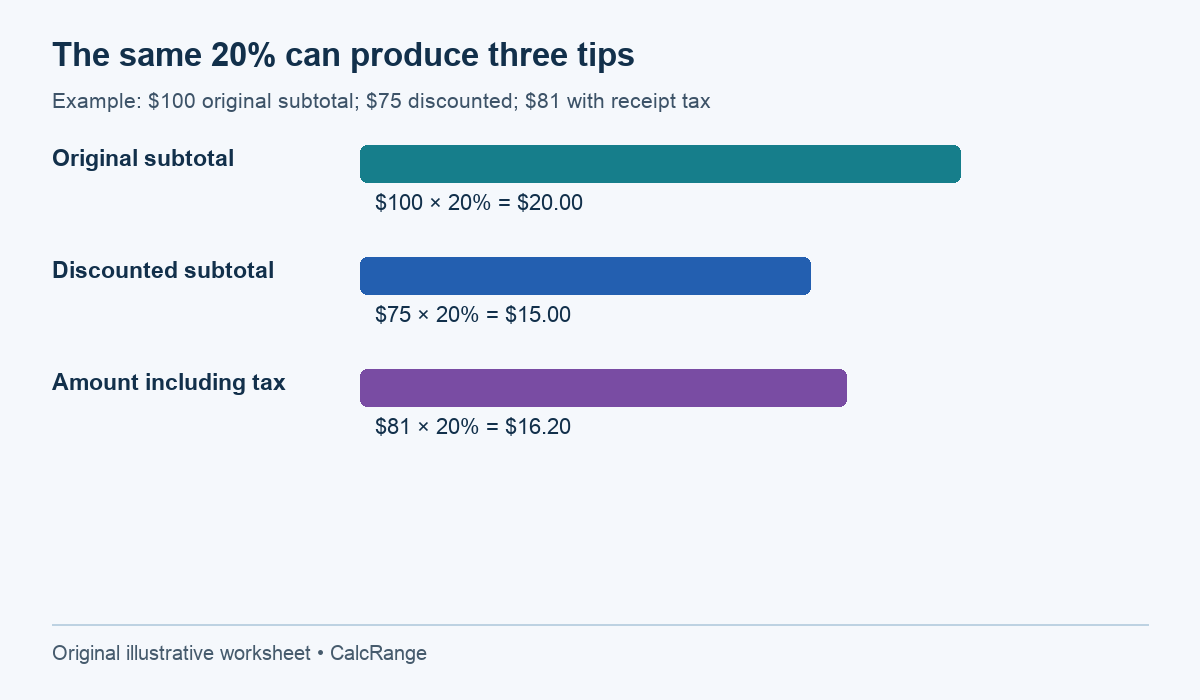
Table of Contents
Build a discounted meal tip ledger
Imagine a meal with a $100 food-and-drink subtotal and a $25 promotional discount. The receipt then shows $6 of tax, no mandatory service charge and $81 due before a voluntary tip. The tax is a supplied receipt value, not a claim about the tax law or rate in a particular location.
| Receipt line | Amount | What it represents |
|---|---|---|
| Original subtotal | $100.00 | Selected menu items before the offer |
| Discount | −$25.00 | Reduction in the price charged |
| Discounted subtotal | $75.00 | Food and drink after the offer |
| Tax shown | $6.00 | Copied from this hypothetical receipt |
| Amount due before tip | $81.00 | $75 + $6 |
Record an existing service charge on its own line if there is one. Also identify whether a payment terminal’s suggested percentage refers to the original subtotal, reduced subtotal or total including tax and fees. A button marked “20%” does not reveal that choice by itself.
Compare two discounted meal tip bases
For an original-price discounted meal tip, multiply $100 by 0.20. The voluntary tip is $20 and the payment is $81 + $20 = $101. The customer still receives the $25 discount on the meal; choosing a different tip base does not reverse that discount.
For a reduced-price discounted meal tip, multiply $75 by 0.20. The tip is $15 and the payment is $81 + $15 = $96. The difference between the payments is exactly the difference between the tips, $5.
| Chosen method | Tip calculation | Tip | Final payment |
|---|---|---|---|
| Original subtotal | $100 × 20% | $20.00 | $101.00 |
| Discounted subtotal | $75 × 20% | $15.00 | $96.00 |
| Tax-inclusive amount due | $81 × 20% | $16.20 | $97.20 |
The third row is included to expose another possible screen calculation, not to recommend it. When comparing two methods, change one variable at a time. Otherwise, a switch from original subtotal to discounted tax-inclusive total hides both a discount change and a tax-base change.
Use the calculator for a discounted meal tip
For the reduced-subtotal example, enter bill amount 100, discount 25%, tip 20%, tax 8%, service charge 0%, one person and no rounding. In this arithmetic example only, 8% of the reduced $75 subtotal reproduces the receipt’s $6 tax. The output should show a $15 tip and $96 total.
If your real receipt’s tax does not follow that simple model, use the receipt’s actual amount instead of forcing an approximate percentage. You can calculate the voluntary tip separately and add it to the existing amount due. This is particularly useful when different items receive different tax treatment.
For the original-subtotal option, enter bill amount 100, tip 20%, discount 0%, tax 0% and service charge 0%. Read the tip amount, $20. Then add that $20 to the receipt’s $81 amount due. Do not pay the calculator’s $120 total from this separate tip-only run; that run intentionally does not contain the receipt’s discount and tax.
For an arbitrary cash discount, first divide discount by original subtotal to obtain the equivalent percentage. A $25 reduction from $100 is 25%; a $25 reduction from $90 is approximately 27.7778%. Rounding that percentage can cause a small difference, so a separate tip calculation is clearer when exact receipt reconciliation matters.
Separate a discount from a method of payment
A voucher that reduces the listed price and a gift card used to pay an unchanged bill are different ledger entries. Read how the receipt records the transaction. If the total remains $100 and a $25 gift card pays part of it, the remaining balance is $75, but the meal itself has not necessarily received a 25% price reduction.
Likewise, a friend’s deposit or prepaid credit can reduce what remains to pay without changing the amount originally charged. Using only the outstanding balance as the tip base would then change the base because of payment timing. Decide intentionally rather than treating every deduction as a coupon.
If a complimentary item appears at zero with no reliable original price, do not invent a menu price simply to produce a precise percentage. Choose a voluntary amount you understand or ask the business to clarify the receipt. The calculator cannot reconstruct a price it was never given.
Split and round the discounted meal tip and bill
Agree on the discounted meal tip method before splitting. Four equal shares of the original-price example are $101 ÷ 4 = $25.25 each. Four equal shares of the reduced-price example are $96 ÷ 4 = $24 each. Those shares reconcile exactly, so no rounding adjustment is required.
For three diners, $101 ÷ 3 gives $33.666… each. Two people could pay $33.67 and one $33.66, totaling $101. Alternatively, three payments of $34 total $102: the extra dollar is a deliberate additional payment, not a rounding identity. Keep it visible.
If the discount applies only to one person’s item, an equal split of the whole receipt may not reflect the group’s agreement. Allocate that item and its discount first, then distribute shared charges using the method you have chosen. Our bill-splitting guide covers itemized and equal approaches.
Three discounted meal tip variations worth checking
Variation 1: a fixed coupon rather than a percentage
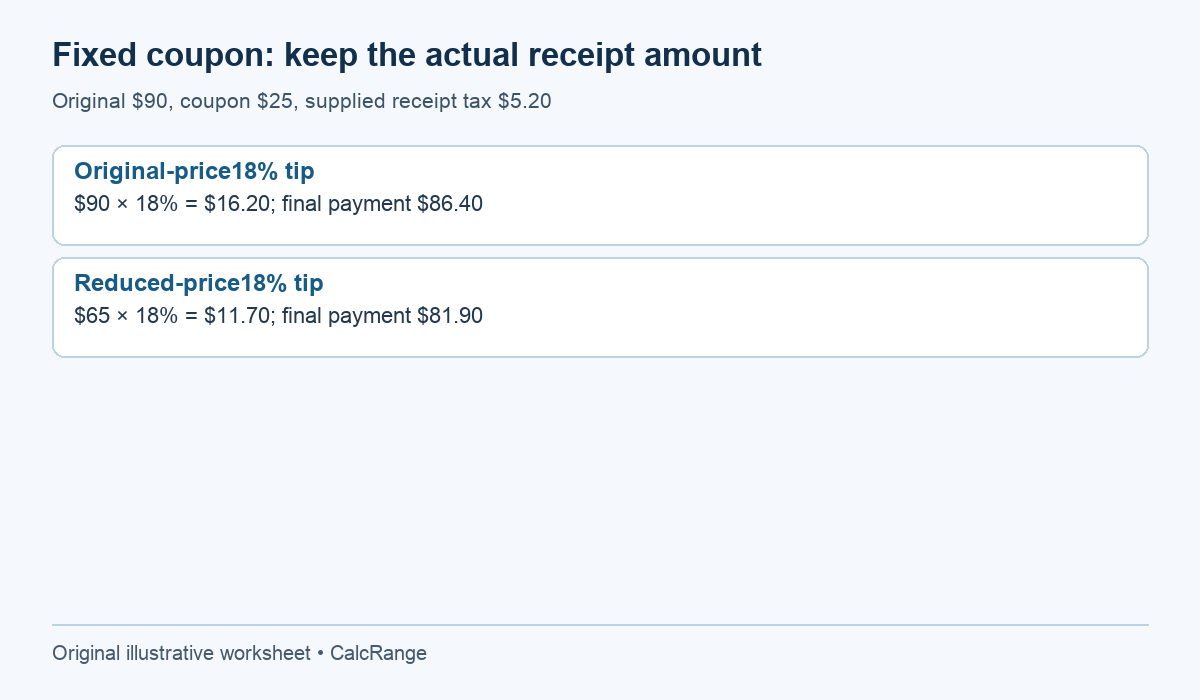
Suppose a receipt starts at $90 and applies a $25 coupon, leaving a $65 subtotal. At a voluntarily chosen 18%, a tip on the original subtotal is $16.20; a tip on the reduced subtotal is $11.70. Their difference is $4.50, which also equals 18% of the $25 discount. That independent check can catch an entry error.
If the receipt lists $5.20 tax and no other charge, its amount due before tip is $70.20. The two final payments are $86.40 and $81.90. Use the actual tax printed on the real receipt; the supplied $5.20 is an example input, not a tax-law conclusion.
The coupon is 27.777…% of the original $90. A rounded 27.78% discount input can slightly change the modeled subtotal. To keep the ledger exact, calculate the chosen tip from its intended base separately, then add it to the receipt’s actual amount due. This avoids reverse-engineering a finite percentage for a fixed cash adjustment.
Variation 2: a service charge already appears on the reduced bill
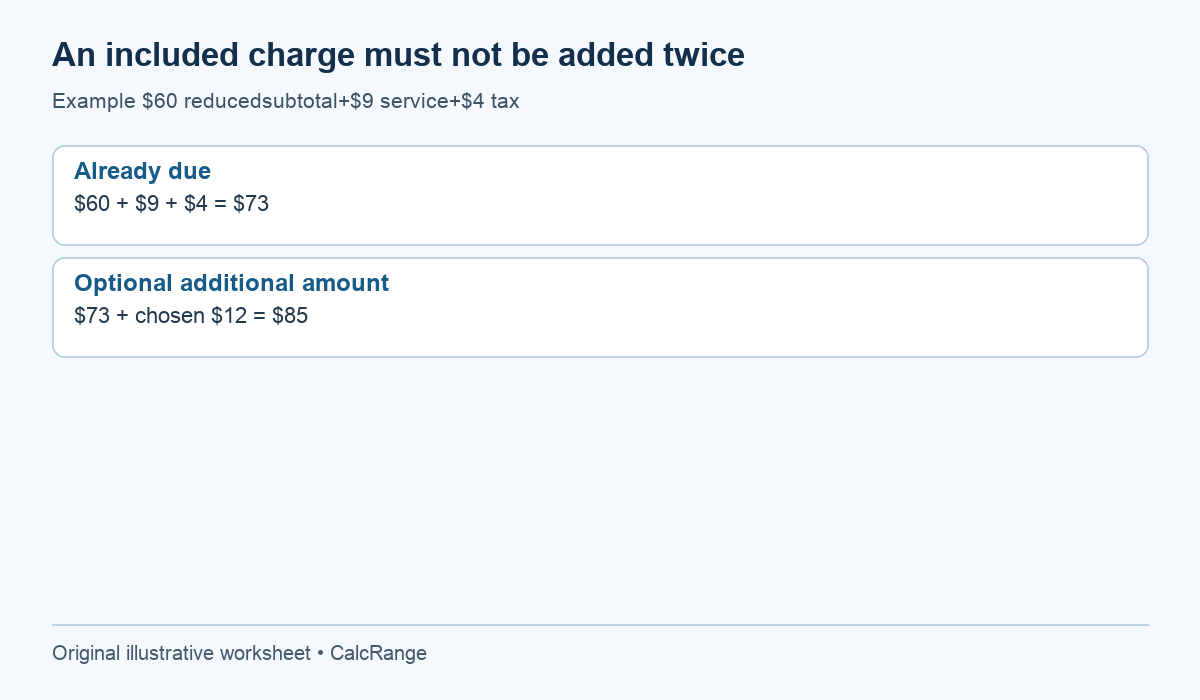
Consider an $80 original subtotal reduced to $60, with a $9 service charge and $4 tax already included. The amount due is $73. If you voluntarily choose an additional $12, the payment is $85. If you instead choose no extra voluntary amount, the payment remains $73. The existing charge does not vanish in either case.
Do not enter $73 as the bill and then add the $9 charge again. If using a percentage tool for separate components, confirm that its service-charge percentage is applied to the same base as the receipt. A charge of $9 on $60 is 15%; the same $9 on $80 is 11.25%. The amount is unchanged even though the percentage description differs.
For US federal tax reporting, the IRS distinguishes a freely chosen tip from a mandatory service charge. That source helps identify the receipt lines; it does not prescribe a tipping percentage, establish another country’s rules or tell you how this restaurant distributes its charge.
Whether the service charge reaches particular employees is a question for the establishment. The arithmetic cannot establish distribution. Decide the additional amount using the information you have, then verify that the payment screen adds exactly that amount to the existing total.
Variation 3: a gift card partly pays an undiscounted receipt
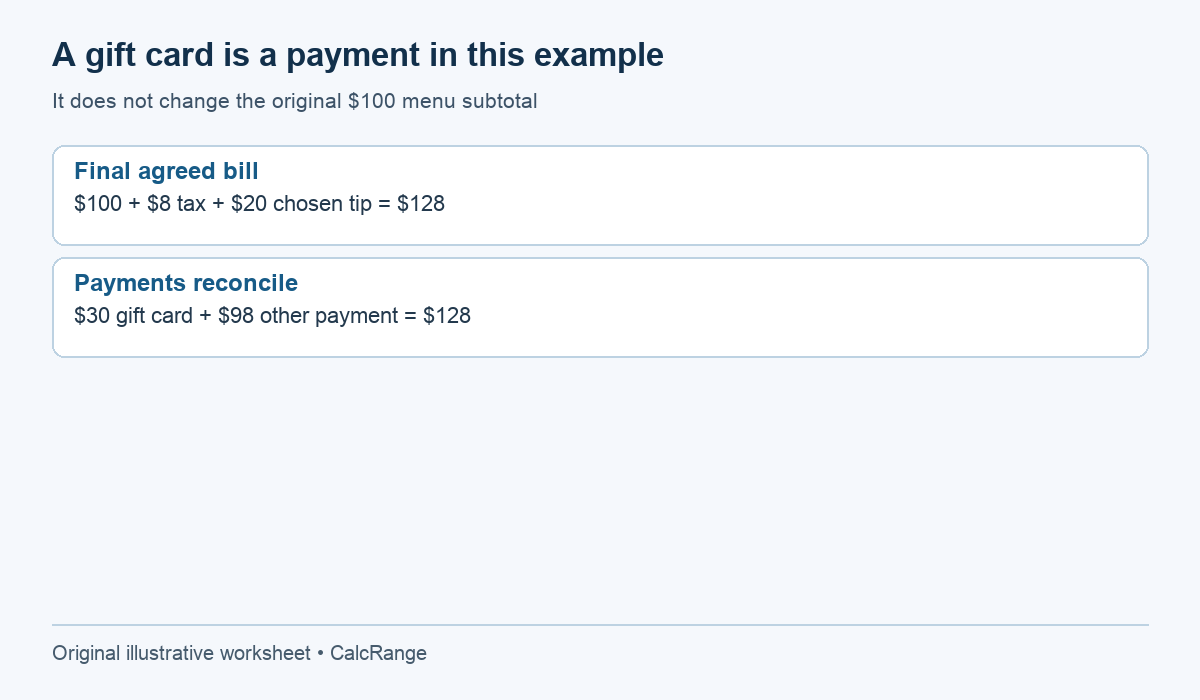
A $100 meal with $8 tax totals $108 before tip. A $30 gift card used as payment leaves $78 outstanding; it does not by itself reduce the $100 menu subtotal. If you choose a $20 tip based on that subtotal, the total settlement is $128: $30 from the gift card and $98 from the other payment method.
Check the reconciliation both ways. The original $108 plus $20 tip is $128. The two payment methods, $30 and $98, also total $128. Counting the gift card as both a discount and a payment would lower the amount twice.
Real vouchers have different terms, including whether they cover a voluntary tip. Read those terms rather than assuming this example’s payment allocation is permitted. If the business requires the tip on a separate payment method, keep that as another settlement line. The same ledger principle applies: the sum of payments should equal the agreed final bill, with each credit used once.
Common discounted meal tip questions
Should an existing service charge be entered again?
No. If it is already in the amount entered as the bill, adding it again duplicates it. Keep an additional voluntary tip distinct from an existing compulsory amount. See service charge versus tip for a receipt-level comparison.
Does changing the currency convert the bill?
No. The calculator’s currency choice changes formatting. If you enter 100, it remains 100 in the selected currency. Use the same currency for the receipt, tip and contributions.
What should I check before paying?
Read the discount, existing charges, selected tip amount and final total. Check whether you chose a pre-tax or tax-inclusive base using our before-or-after-tax guide. The arithmetic here is original and illustrative; local expectations and a business’s policies are separate from what the multiplication proves.