
Protein Requirement Calculator
Estimate adult daily protein from body weight and planning assumptions. Children and medical or life-stage selections receive individual-care guidance rather than a numeric recommendation.
Enter Your Details
Your Protein Result
Ready to calculate
Enter your body details and goal to estimate your daily protein needs.
Protein Breakdown Chart
Detailed Protein Breakdown
| Item | Estimated Value | Explanation |
|---|---|---|
| Click calculate to generate your protein breakdown. | ||
Protein Food Ideas
| Food | Approx. Protein | Best For |
|---|
Smart Protein Tips
Dividing protein across breakfast, lunch, dinner, and snacks can make the target easier to reach.
Protein supports muscle repair, but resistance training is still needed for muscle growth.
Use eggs, dairy, fish, chicken, lean meat, lentils, beans, tofu, soy, and protein-rich whole foods.
A healthy diet also needs carbohydrates, fats, fiber, vitamins, minerals, and water.
How to understand your protein estimate
A protein estimate starts with your body weight and a daily allowance in grams per kilogram. Use the result to plan meals and compare assumptions. It cannot diagnose a deficiency or determine the right diet for a medical condition.
The formula and a worked example
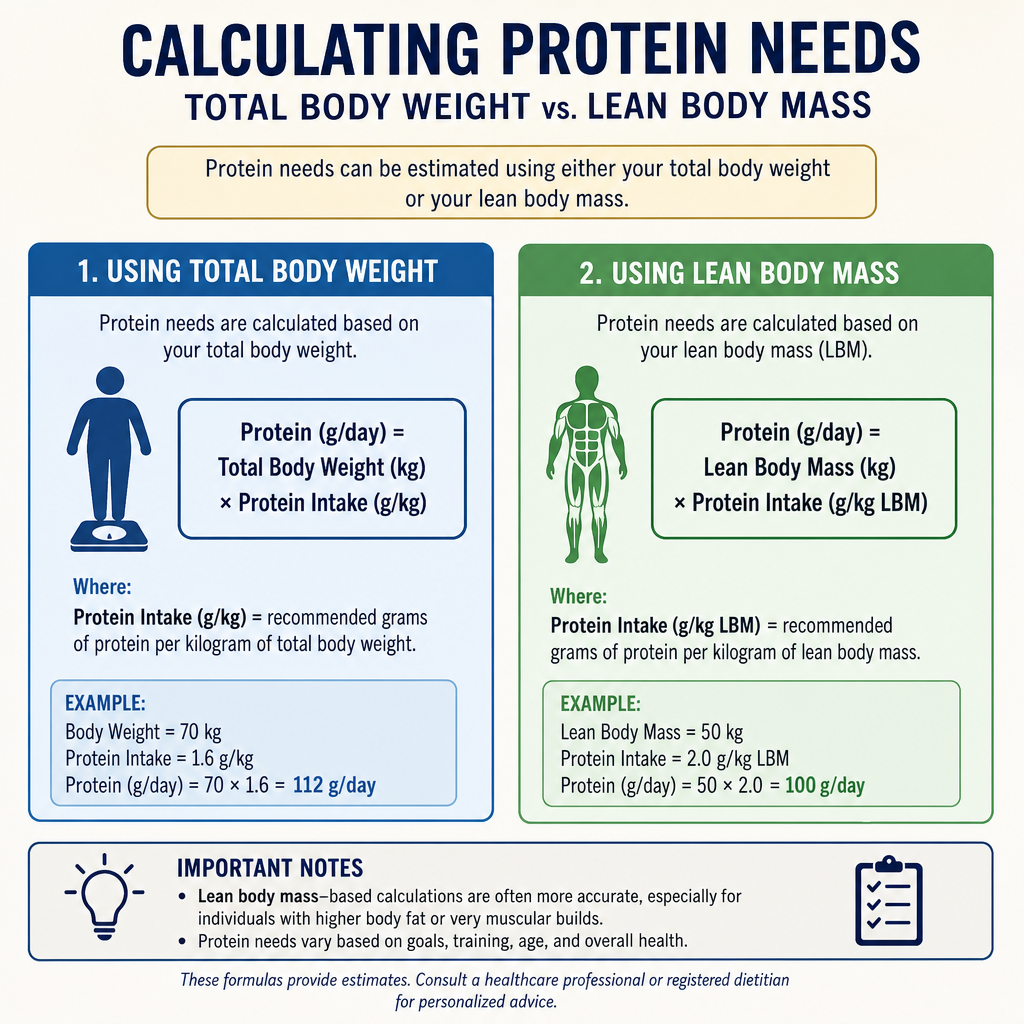
Protein per day (g) = body weight (kg) × chosen allowance (g/kg/day). To convert pounds to kilograms, divide by 2.20462. Keep the units consistent before multiplying.
For a 70 kg adult, an allowance of 0.8 g/kg gives 56 g per day. An illustrative range of 1.2–1.6 g/kg gives 84–112 g per day. These are different assumptions, not three measurements of that person’s actual needs.
If you divide a daily total between meals, 84 g over three meals is 28 g per meal. That is a planning example; every meal does not have to contain exactly the same amount.
What the reference values mean
The adult protein Recommended Dietary Allowance is commonly expressed as 0.8 g/kg/day. An RDA is designed to cover the nutrient needs of nearly all healthy people in a defined age and life-stage group. It is neither a diagnosis threshold nor proof that every person needs a much higher intake. See the Dietary Reference Intake tables and the NIH explanation of nutrient reference values.
Athletic training can change the useful planning range. The NIH Office of Dietary Supplements summarizes sports-nutrition guidance of approximately 1.2–2.0 g/kg/day for athletes. The appropriate amount depends on training, overall food intake and individual circumstances; the highest number is not automatically the best target.
Use the calculator without false precision
- Choose kilograms or pounds and enter a recent body-weight measurement.
- Select activity and goal settings that describe your current routine.
- Check which body weight and grams-per-kilogram range the result uses. Changing to a target weight changes the arithmetic; it does not validate that target.
- Use custom allowances only when you understand their source. A value you enter overrides a default assumption.
- Compare the estimate with food labels and actual portions. Recheck the inputs before changing your diet because of an unexpectedly high or low result.
CalcRange’s activity, goal and meal settings are planning presets, not an individually validated nutrition assessment. Small differences caused by rounding are less important than choosing an appropriate allowance.

When a standard estimate is unsuitable
Kidney disease needs individual advice. Protein needs can differ with disease stage and treatment, and people receiving dialysis may need more protein. A generic low-protein preset cannot account for this. Follow a clinician or renal dietitian’s plan. See NIDDK guidance on eating with chronic kidney disease.
Children, pregnancy, breastfeeding, recovery from illness and medically prescribed diets also need guidance appropriate to the person. Do not use a calculator to investigate unexplained symptoms, prescribe supplements or replace a professional assessment.

Do I need protein powder?
Not necessarily. Protein can come from ordinary foods, including beans, lentils, tofu, eggs, dairy, fish and meat. A varied diet can meet an athlete’s needs; supplements are an option when food intake is insufficient, not a requirement created by this calculator. The NIH consumer guide explains the role and limits of supplements.
How reliable is the number?
The multiplication is reproducible. Choosing the right allowance is the uncertain part. Record the weight, allowance and date when comparing results, and discuss significant diet changes with a qualified professional.
Related: estimate resting energy with the BMR calculator. Read our editorial policy or report a calculation error.