
Overtime with two pay rates generally starts with a weighted regular rate under the U.S. federal rule for covered, nonexempt employees. Add the week’s includable earnings, then divide by the relevant hours worked. Simply averaging the two quoted rates gives the wrong answer when the hours at each rate are unequal.
The overtime pay calculator accepts one hourly rate. For the simple federal example below, first calculate the weighted rate outside the tool, then use it to check the total. The tool does not collect separate jobs, bonuses or all facts needed to resolve state-specific payroll obligations.
Scope: this is an educational U.S. federal calculation for one workweek, with no exemption, special agreement, daily overtime or additional compensation in the example. State law, contracts and particular employment arrangements can require a different or more protective calculation.
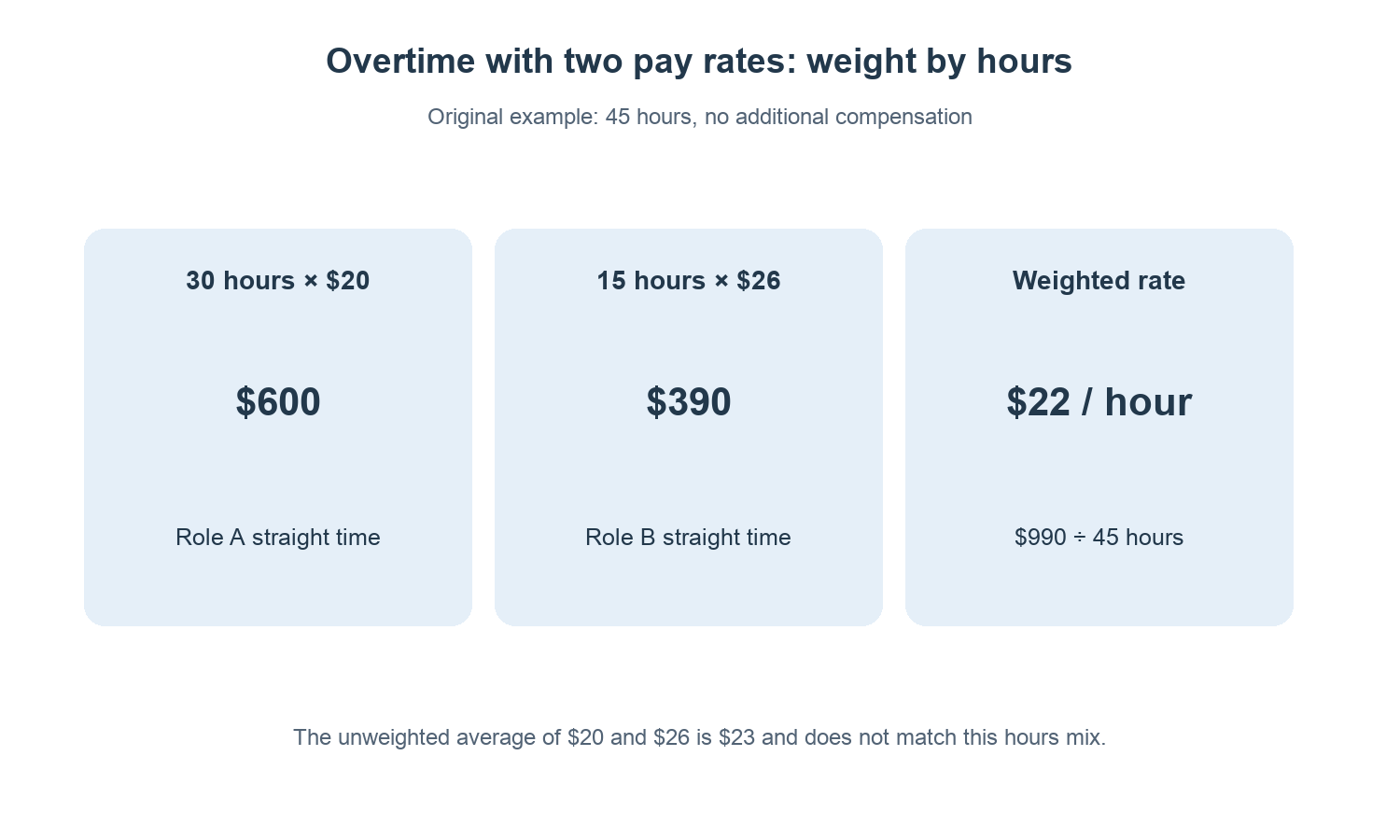
Table of Contents
Overtime with two pay rates: weight by hours
29 CFR 778.115 describes the regular-rate calculation for work at two or more nonovertime rates. The hours at each rate determine its weight. The regulation also points to specific statutory exceptions; the weighted method should not be treated as the only legally permitted arrangement in every situation.
For the simplified hourly-only case:
Regular rate = sum of (hours × hourly rate) ÷ total hours worked
The numerator is money and the denominator is hours, so the result is money per hour. This unit check helps catch a common mistake: averaging earnings totals instead of hourly rates, or dividing by 40 even though the employee worked 45 hours.
Regular rate example: 30 hours at $20 and 15 at $26
Assume one employee performs two types of work for the same employer during the same workweek. All 45 hours already receive their stated straight-time rates. There are no bonuses or other includable earnings in this example.
| Work | Hours | Straight-time rate | Straight-time earnings |
|---|---|---|---|
| Role A | 30 | $20 | $600 |
| Role B | 15 | $26 | $390 |
| Total | 45 | Weighted rate calculated below | $990 |
Weighted regular rate = $990 ÷ 45 = $22 per hour
A simple average of $20 and $26 would be $23. That gives equal weight to both rates even though twice as many hours were worked at $20. The weighted result of $22 properly reflects the 30-to-15 hour split.
In this federal weekly example, overtime hours are 45 − 40 = 5. The U.S. Department of Labor’s overtime fact sheet explains the usual over-40 workweek rule, regular-rate concept and qualifying alternative arrangements. It also cautions against averaging hours across workweeks.
Why add one-half of the regular rate here?
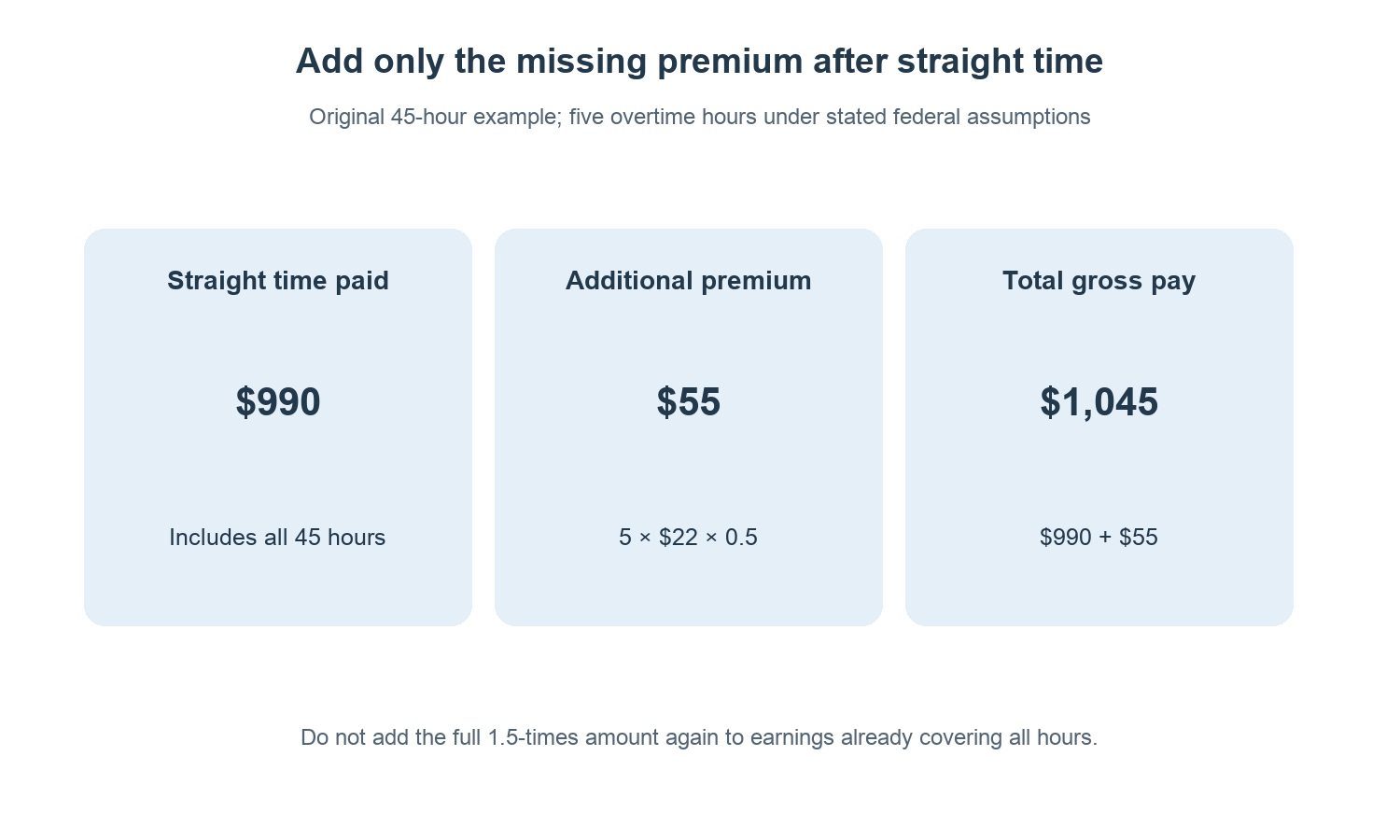
The $990 already pays straight time for all 45 hours, including the five overtime hours. To reach one-and-one-half times the regular rate for those overtime hours, this calculation adds the remaining one-half premium:
Additional overtime premium = 5 × $22 × 0.5 = $55
Total gross weekly pay = $990 + $55 = $1,045
Adding 5 × $22 × 1.5 to the full $990 would produce $1,155. That would count the straight-time component of those five hours again. The error comes from mixing two valid-looking calculation formats without checking what the starting amount includes.
An equivalent total-only check is 40 × $22 + 5 × $33 = $1,045. This recreates the same total with a single blended rate. It does not mean every actual hour was contractually paid at $22, and its “regular” and “overtime” display lines are not a substitute for the two-role payroll record.
A second example with a repeating decimal
Suppose the week instead contains 32 hours at $18 and 12 hours at $24. Straight-time earnings are $576 + $288 = $864 for 44 hours. The weighted regular rate is $864 ÷ 44 = $19.636363… .
There are four overtime hours in the same simplified federal model. The additional premium is 4 × 0.5 × $19.636363… = $39.272727… . Adding that to $864 gives $903.27 after rounding the final total to cents.
Keep sufficient precision while calculating the weighted rate. Rounding it prematurely can change the premium. Payroll systems may have specified rounding procedures, so preserve the original hours and rates when reconciling a small difference.
Using the single-rate calculator carefully
- Calculate the actual straight-time earnings. Keep a separate row for each rate and its hours.
- Derive the weighted rate. For the first example it is exactly $22.
- Choose the applicable calculation context. The worked example assumes the ordinary federal weekly threshold, not daily or special-industry rules.
- Check 45 hours at the $22 blended rate. A simple 40-hour, 1.5-times model should total $1,045.
- Compare totals, not labels alone. Preserve the original $600 and $390 earnings lines and the $55 extra premium for your worksheet.
Use the time card calculator to organize ordinary clock-in, clock-out and break durations, while retaining dated records for overnight or clock-change shifts. For the mathematical weighting step, the weighted-average guide gives examples outside payroll.
Overtime with two pay rates changes when the hours mix changes
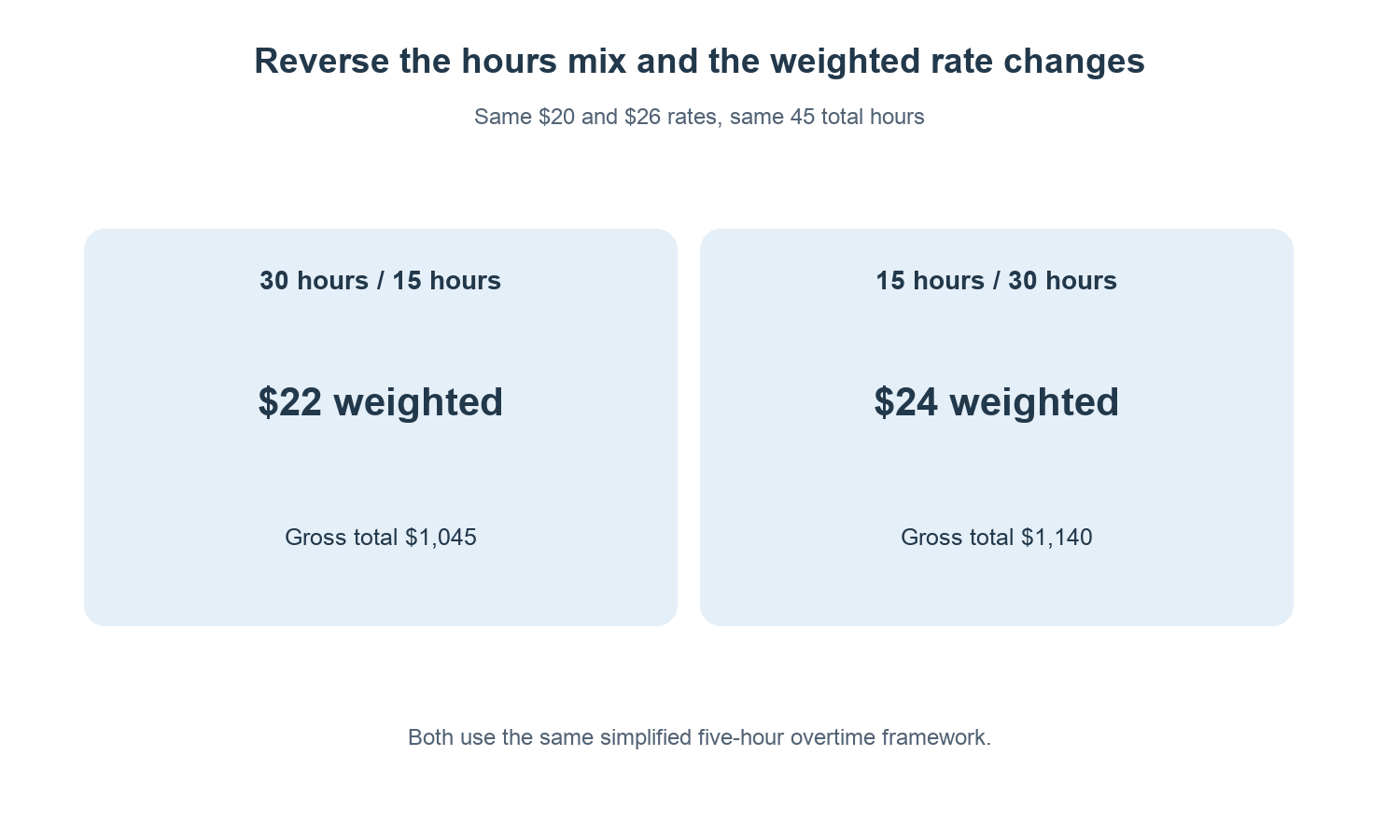
Keep the two quoted rates at $20 and $26, but reverse the hours from the original example. Now the employee works 15 hours at $20 and 30 hours at $26. Straight-time earnings are $300 + $780 = $1,080 for the same 45 total hours.
The weighted regular rate becomes $1,080 ÷ 45 = $24. Under the same simplified federal weekly assumptions, the extra premium is 5 × 0.5 × $24 = $60, giving total gross pay of $1,140.
| Hours at $20 / $26 | Straight-time earnings | Weighted rate | Extra premium | Total |
|---|---|---|---|---|
| 30 / 15 | $990 | $22 | $55 | $1,045 |
| 15 / 30 | $1,080 | $24 | $60 | $1,140 |
The regular rate remains between the two stated rates in these hourly-only examples. If your result falls below $20 or above $26, recheck the arithmetic or identify another included payment that changes the numerator. This range check applies to the simplified inputs, not to every payroll arrangement.
An included payment changes the regular rate numerator
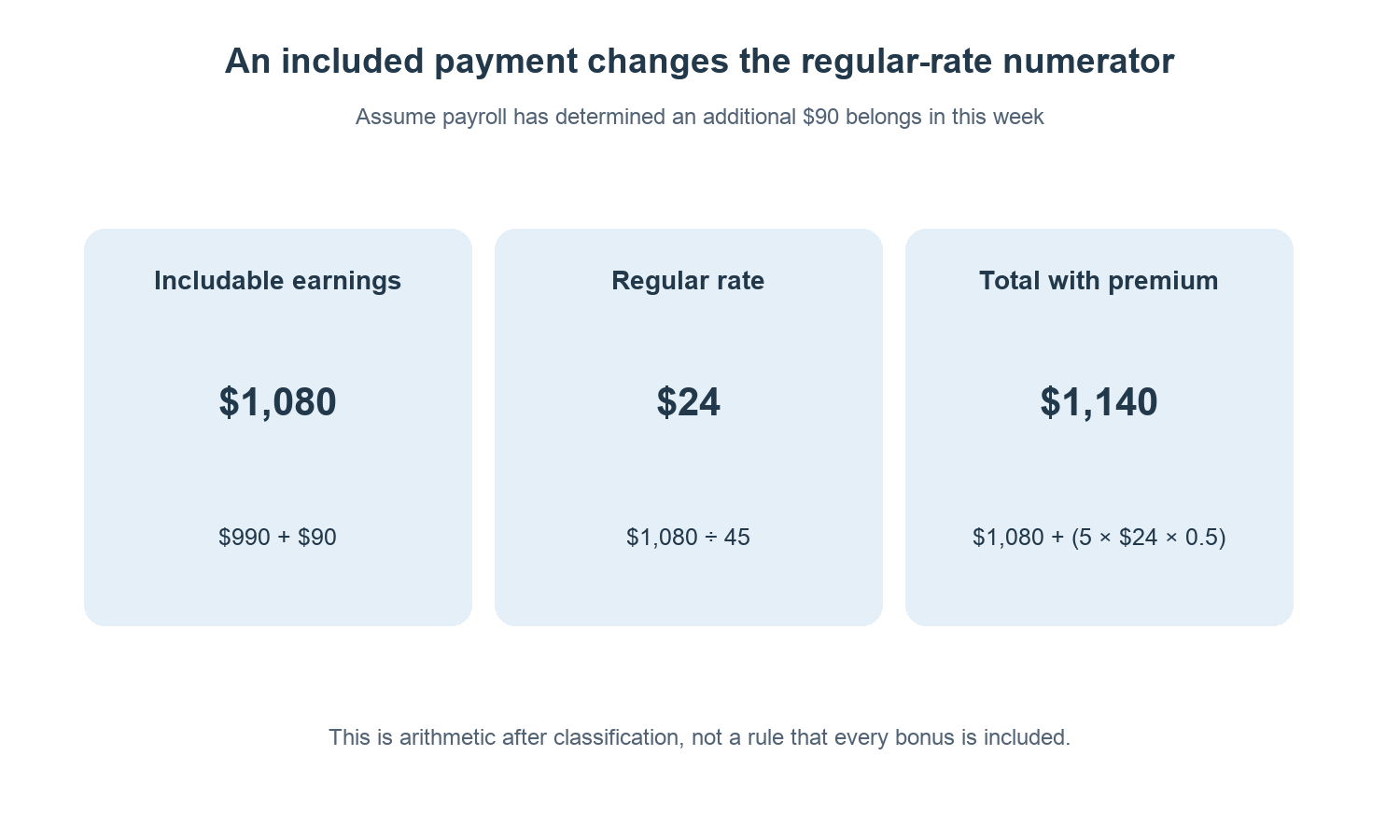
For a purely arithmetic variation, return to the original $990 straight-time week and assume that payroll has already determined an additional $90 payment belongs in that week’s regular-rate earnings. This article does not classify a real bonus; that determination is an input to the example.
The numerator becomes $990 + $90 = $1,080. Dividing by 45 gives a regular rate of $24. The additional half-time premium is $60, and total earnings in this model are $990 + $90 + $60 = $1,140.
If the $90 has already been paid, do not pay it twice when reconciling the remaining balance. Separate “total amount due under the model” from “additional amount still unpaid.” Those are different questions even when they refer to the same workweek.
Use columns that expose a double-counting error
A transparent worksheet has one column for hours, one for the nonovertime rate, one for straight-time earnings and one separate line for the additional premium. Sum hours and earnings before computing the weighted rate.
Do not label the entire 1.5-times amount as “extra premium” if straight time for those hours is already included above. In the original example, $165 is the full blended pay for five overtime hours, but only $55 is additional to the $990 that already includes those hours.
Likewise, do not divide earnings by forty merely because forty is the assumed threshold. The original regular-rate divisor is the 45 actual hours represented by the $990 numerator. Using forty would create $24.75, a different and incorrect rate for this stated example.
Reconcile a payslip using like-for-like amounts
Compare gross earnings before comparing take-home amounts. Taxes, deductions and other items can make the bank deposit differ from the gross calculation even when the overtime arithmetic agrees.
Keep the employer’s workweek boundaries, dated hours, each applicable rate and the description of any other payment with the worksheet. If a payslip uses different labels, ask how its lines map to the original straight-time earnings and additional premium rather than assuming every “overtime” line follows the same presentation.
These checks help identify the source of a discrepancy. They do not determine coverage, exemption status or the validity of a special arrangement, which require the relevant facts and current rules.
What can change the answer?
This worksheet assumes the listed hourly earnings are the complete regular-rate numerator. Additional compensation can change it. Do not simply leave out a payment because it is labelled a bonus, allowance or incentive; determine its treatment under the applicable rules.
Check the employer’s defined workweek, actual hours worked, the applicable state rules and any valid special arrangement before using the result for payroll. Hours from unrelated employers are not automatically pooled into this same-employer example. Joint-employment situations require their own analysis.
Can I use whichever rate applied to the last five hours?
Not as an automatic shortcut to the weighted method shown here. Alternative arrangements have conditions; confirm those conditions rather than selecting the cheaper rate after the work is done.
Does a two-week total of 80 hours prove no overtime?
No. In the standard federal weekly framework, a 45-hour week and a 35-hour week are evaluated separately. The second week’s lower hours do not erase the first week’s overtime.
Is $1,045 take-home pay?
No. It is the gross total in this worked example, before taxes, deductions and any other payroll items.
Keep the two-rate worksheet beside the overtime calculator so the single-rate input has a documented basis.